Table of Contents
Introduction
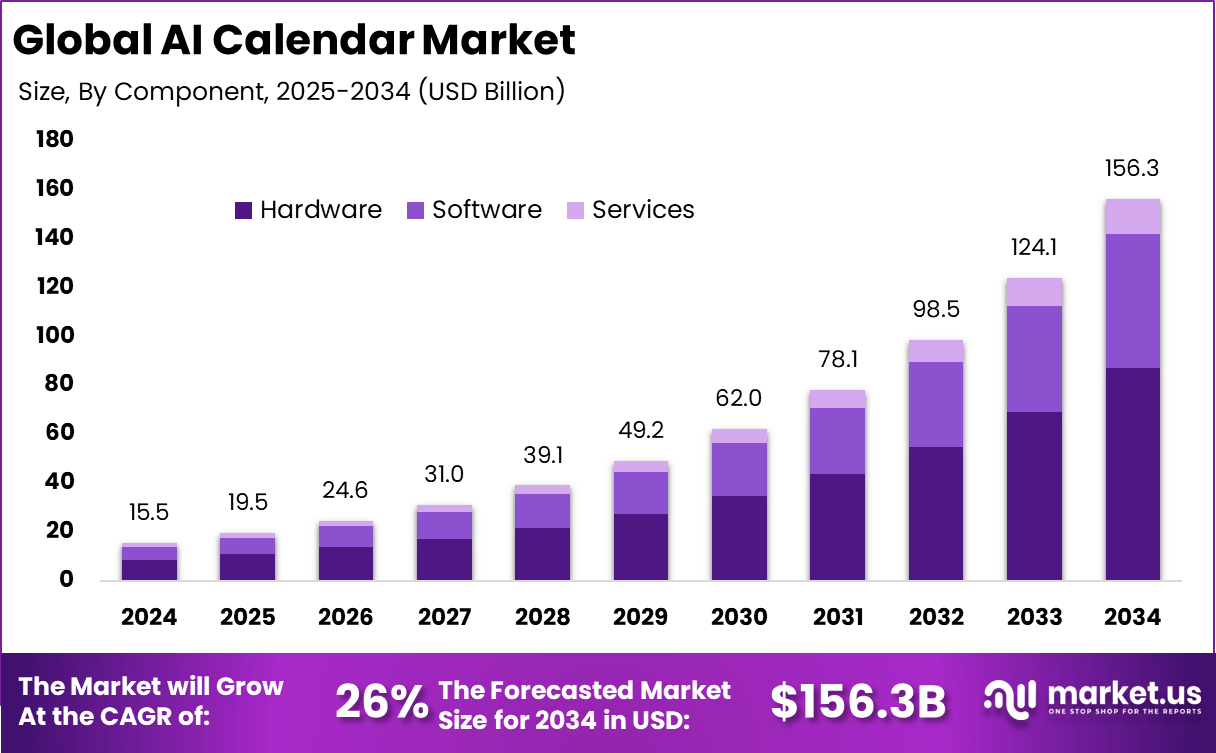
The global AI calendar market size is expected to be worth around USD 156.3 billion by 2034, up from USD 15.5 billion in 2024, growing at a CAGR of 26.0 % during the forecast period from 2025 to 2034. In 2024 North America held a dominant market position with more than 38.2 % share, equating to USD 5.92 billion in revenue. The rapid expansion reflects mounting enterprise and consumer adoption of AI-powered scheduling, optimisation and time-management solutions that leverage machine learning and cloud-based intelligence. The large growth potential stems from hybrid-work models, integration of calendars with productivity tools and rising demand for automation in meeting coordination.
How Growth is Impacting the Economy
The expansive growth of the AI calendar market is delivering broader economic effects by amplifying productivity, reducing time waste and reshaping service industries. As organisations deploy AI scheduling tools to automate meeting coordination, task prioritisation and calendar conflict resolution, they enable knowledge workers to reclaim hours formerly lost to logistics and coordination.
This uplift in productive time contributes to higher output per worker, which in turn supports GDP growth in advanced economies. Furthermore, the growth of AI calendar solutions stimulates investment in cloud infrastructure, dataanalytics and AI software development, thus generating demand for skilled professionals and tech-services firms, boosting employment in high-value sectors.
The resulting digital-productivity gains also ripple into service sectors—consulting, education, software as a service—enabling faster turnaround, reduced overhead and improved workforce engagement. Collectively, the expansion of this market enhances economic efficiency and supports the shift toward a more automated, digitally-enabled economy.
➤ Smarter strategy starts here! Get the sample – https://market.us/report/ai-calendar-market/free-sample/
Impact on Global Businesses
Rising Costs & Supply Chain Shifts
Businesses adopting AI calendar systems face initial investments in AI-capable infrastructure, integration with existing enterprise systems and training staff to manage hybrid human–AI workflows. The shift implies increased spend on cloud platforms, APIs and vendor partnerships rather than purely manual scheduling services. Supply-chain shifts appear as companies embed scheduling intelligence into employee productivity platforms, influencing vendor ecosystems and shifting service contracts toward AI-enhanced providers.
Sector-Specific Impacts
In professional services, AI calendars streamline client-engagement scheduling, improve billable time and reduce administrative drag. In healthcare, intelligent scheduling helps optimise patient appointments, resource allocation and clinician time-use. In education and training, AI calendars align course modules, sessions and personalised timeline planning for learners. In sales and customer-facing operations, automated scheduling of demos, follow-ups and outreach via AI calendars improves conversion rates and customer responsiveness.
Strategies for Businesses
To capitalise on the AI calendar market growth, organisations should first pilot AI calendar solutions in high-coordination functions (such as client meetings, project planning) to capture measurable productivity gains. They should choose vendors with strong integration capabilities into ERP/CRM systems to ensure seamless workflow. Businesses must train employees in hybrid scheduling workflows, combining human judgement with AI automation. They should monitor key metrics like time saved per meeting, reduction in planning overhead and employee satisfaction. Vendor diversification and contractual flexibility will mitigate lock-in and supply-chain risk. Finally, firms should embed governance around AI-calendar usage to maintain data privacy, transparency and user trust.
Key Takeaways
- The AI calendar market is projected to reach USD 156.3 billion by 2034 at a CAGR of 26.0 %.
- North America led in 2024 with around 38.2 % share (USD 5.92 billion).
- Economic impact includes higher worker productivity, digital-services growth and employment in AI/analytics.
- Businesses incur higher initial costs but benefit from scheduling efficiency, lower admin overhead and improved employee time-use.
- Key sectors benefiting include professional services, healthcare, education and sales operations.
- Strategic imperatives include pilot deployment, system integration, performance measurement, vendor risk management and governance.
➤ Unlock growth secrets! Buy the full report – https://market.us/purchase-report/?report_id=161740
Analyst Viewpoint
At present the AI calendar market is gaining traction as organisations realise the value of automating time-management and schedule optimisation. Adoption is expected to accelerate across enterprise and mid-market segments as hybrid work and distributed teams become the norm. Looking ahead the outlook remains positive: as AI-calendar technologies mature, integration becomes simpler, user acceptance improves and recurring subscription models proliferate. Over the next decade, AI calendar systems are projected to become ubiquitous productivity tools embedded within enterprise stacks, driving enhanced workforce output, smarter scheduling workflows and competitive differentiation for early movers.
Use Case and Growth Factors
| Use Case | Growth Factors |
|---|---|
| Client-appointment scheduling | Rising demand for 24/7 availability, global time-zones, hybrid-work coordination |
| Resource and room allocation | Need for efficient meeting room utilisation, remote/hybrid resource scheduling |
| Task/time-block automation | Growing focus on deep work, context switching reduction and time-budgeting for knowledge workers |
| Event and meeting follow-up | Increasing complexity in stakeholder coordination, need for automated reminders and follow-through |
| Workflow integration & analytics | Growth in productivity platforms, demand for data-driven scheduling insights and performance metrics |
Regional Analysis
In 2024 North America held a dominant share of more than 38.2 % of the AI calendar market, driven by advanced cloud infrastructure, high enterprise tech adoption and mature productivity ecosystems. Europe is expected to show steady growth, supported by digital-workplace transformation and regulatory emphasis on workflow optimisation. Asia Pacific offers strong upside as large enterprises, rising digital adoption and remote/hybrid-work models boost demand for AI-scheduling tools. Latin America and MEA are emerging regions where growth will be slower initially but will accelerate as cloud and AI infrastructures improve.
➤ More data, more decisions! see what’s next –
- Web3 Blockchain Market
- AI Soundbar Market
- AI Governance Market
- AI in Computer Aided Synthesis Planning Market
Business Opportunities
The expanding AI calendar market presents multiple opportunities: providers can deliver tailored solutions for sectors such as healthcare, education and legal services where scheduling complexity is high; subscription-based SaaS models for AI calendars with analytics, integration and workflow insights provide revenue potential; consulting firms can offer change-management services around scheduling automation; integration specialists can embed AI calendar capabilities into CRM, ERP and workforce-productivity suites; regional players can target markets under-penetrated by global players, offering local-language, localisation-friendly AI calendars and custom workflows.
Key Segmentation
The AI calendar market can be segmented by component (software platform and services), deployment type (cloud-based, on-premises, hybrid), functionality (appointment scheduling, resource allocation, task/time-block automation, meeting follow-up, analytics) and end-user industry (professional services, healthcare, education, sales & customer service, enterprise workforce). Each segment addresses unique needs—software platforms enable core capabilities, services support integration and change-management, functionality maps to specific scheduling workflows and industries determine customisation and compliance requirements.
Key Player Analysis
Leading players in this market are expanding through feature enhancements—such as natural language scheduling, automated follow-ups and resource-optimisation—while forming integrations with CRM and productivity suites. They focus on user experience, enterprise-grade security, scalability and platform extensibility. Subscription pricing, global availability and multilingual support are becoming differentiators. The competitive landscape is increasingly driven by partnerships with cloud-providers, acquisitions of niche scheduling firms and investment in AI-analytics and workflow insights. Customer retention, platform depth and ecosystem integration will determine market leadership.
- AV Costar
- Axis Communications AB
- Bosch Security Systems GmbH
- Canon Inc.
- Hangzhou Hikvision Digital Technology Co., Ltd.
- Honeywell International Inc.
- Huawei Technologies Co., Ltd.
- Johnson Controls
- LG Electronics
- Nikon Corporation
- Panasonic Holdings Corporation
- Samsung Electronics Co., Ltd.
- Sony Corporation
- Teledyne FLIR LLC
- Others
Recent Developments
- A recent survey reports that knowledge-worker throughput increased by 66 % when using AI scheduling tools.
- The U.S. market, valued at USD 5.09 billion, shows strong momentum within the AI calendar segment.
- AI calendar applications now integrate deep-learning algorithms to optimise meeting times across time-zones and availability.
- Hybrid-work models are driving enterprise demand for AI scheduling and calendar automation tools.
- AI calendar platforms are expanding into task automation, resource allocation and scheduling analytics beyond simple time-slot coordination.
Conclusion
The AI calendar market is poised for significant expansion and is reshaping how organisations manage time, tasks and meetings. Companies that adopt, integrate and scale AI-driven scheduling will unlock productivity gains, cost savings and a competitive edge in the evolving workplace.
Discuss your needs with our analyst
Please share your requirements with more details so our analyst can check if they can solve your problem(s)