Table of Contents
Introduction
The Global AI Fridge Market was valued at USD 2.56 billion in 2024 and is projected to advance to approximately USD 16.0 billion by 2034, registering a strong CAGR of 20.2% over the forecast period. In 2024, North America accounted for around 37.5% of global revenue, with a market size of USD 0.96 billion, underscoring its role as the leading regional hub for AI-enabled refrigeration technologies. Within the region, the United States emerged as the key growth engine, contributing USD 0.81 billion in 2024 and forecast to reach nearly USD 4.34 billion by 2034, expanding at a robust CAGR of 18.3%, reflecting rising consumer adoption of connected, intelligent kitchen appliances.

Key Takeaways
- The Global AI Fridge Market was valued at USD 2.56 billion in 2024 and is expected to reach around USD 16.0 billion by 2034, growing at a 20.2% CAGR as AI is used to improve energy efficiency and connect fridges with smart homes.
- North America accounted for 37.5% of the global market in 2024, with a value of USD 0.96 billion, reflecting strong digital infrastructure and early adoption of connected appliances.
- The U.S. market generated USD 0.81 billion in 2024 and is projected to grow at a 18.3% CAGR, supported by rising demand for smart, connected kitchen solutions.
- Double-door AI fridges held a 35.8% share by product type, as households with middle to high income prefer larger storage and more premium features.
- Deep learning technology accounted for 40.5% of the market, as it is widely used to manage energy use, track stored food, and predict maintenance needs.
- Residential users represented 55.6% of demand, driven by growing smart home adoption and the desire for convenient, automated kitchen management.
- Supermarkets and hypermarkets contributed 44.8% of sales, helped by strong brand visibility, a wide range of models, and consumer confidence in buying large appliances in-store.
- Each year, around 10–15 mergers and acquisitions take place in this space, mainly involving smaller AI and IoT firms, with total deal values above USD 500 million, focused on improving algorithms, energy savings, and user convenience.
- Sustainability is becoming a key theme, as companies invest in AI models that cut power consumption and keep food fresh for longer, which supports global efforts to reduce waste.
- Recent deals include a large merger worth about USD 200 million and several acquisitions by bigger players seeking to strengthen their AI appliance capabilities.
- The Asia Pacific region accounts for roughly 30–35% of global AI fridge sales, supported by rising incomes and rapid smart home adoption in markets such as China, Japan, and South Korea, and overall the market is on track for strong, long term growth.
Request For Sample Before Purchasing Report: https://market.us/report/ai-fridge-market/request-sample/
| Report Features | Description |
|---|---|
| Market Value (2024) | USD 2.56 Billion |
| Forecast Revenue (2034) | USD 16.0 billion |
| CAGR(2025-2034) | 20.20% |
| Base Year for Estimation | 2024 |
| Historic Period | 2020-2023 |
| Forecast Period | 2025-2034 |
| Report Coverage | Revenue forecast, AI impact on Market trends, Share Insights, Company ranking, competitive landscape, Recent Developments, Market Dynamics, and Emerging Trends |
| Segments Covered | By Product Type (Single Door, Double Door, Side-by-Side Door, French Door, Others), By Technology (Deep Learning, Machine Learning, Natural Language Processing, Others), By Application (Residential, Commercial, Industrial), By Distribution Channel (Online Stores, Supermarkets/Hypermarkets, Specialty Stores, Others) |
| Regional Analysis | North America – US, Canada; Europe – Germany, France, The UK, Spain, Italy, Russia, Netherlands, Rest of Europe; Asia Pacific – China, Japan, South Korea, India, New Zealand, Singapore, Thailand, Vietnam, Rest of Latin America; Latin America – Brazil, Mexico, Rest of Latin America; Middle East & Africa – South Africa, Saudi Arabia, UAE, Rest of MEA |
| Competitive Landscape | Samsung Electronics Co., Ltd., LG Electronics Inc., Whirlpool Corporation, Haier Group Corporation, Panasonic Corporation, Bosch Siemens Hausgeräte (BSH) GmbH, Electrolux AB, Midea Group Co., Ltd., GE Appliances, Hisense Co., Ltd., Hitachi, Ltd., Toshiba Corporation, Sharp Corporation, Daewoo Electronics Corporation, Fujitsu General Limited, Liebherr Group, Sub-Zero Group, Inc., Viking Range, LLC, Godrej & Boyce Manufacturing Company Limited, Other Major Players |
| Customization Scope | Customization for segments, region/country-level will be provided. Moreover, additional customization can be done based on the requirements. |
| Purchase Options | We have three licenses to opt for: Single User License, Multi-User License (Up to 5 Users), Corporate Use License (Unlimited Users and Printable PDF) |
Key Market Segments
By Product Type
- Single Door
- Double Door
- Side-by-Side Door
- French Door
- Others
By Technology
- Deep Learning
- Machine Learning
- Natural Language Processing
- Others
By Application
- Residential
- Commercial
- Industrial
By Distribution Channel
- Online Stores
- Supermarkets/Hypermarkets
- Specialty Stores
- Others
Regional Analysis
The global AI Fridge Market is experiencing strong momentum, with the market value reaching approximately USD 2.56 billion in 2024, supported by rapid adoption of smart, connected kitchen appliances across key regions. Growth is being driven by rising demand for energy efficient fridges, real time food management features, and seamless integration with broader smart home ecosystems. North America holds a leading position, accounting for about 37.5% of global revenue, or nearly USD 0.96 billion in 2024, underpinned by high disposable incomes, mature digital infrastructure, and an early shift toward intelligent home devices. Within the region, the U.S. remains the core market, contributing close to USD 0.81 billion in 2024, which reflects its role as both a hub for innovation in smart appliances and a major center of consumer spending on premium home technologies.

US AI Fridge Market Size
- The United States is a leading country in the AI Fridge Market, with the market valued at about USD 0.81 billion in 2024 and expected to reach around USD 4.35 billion by 2034.
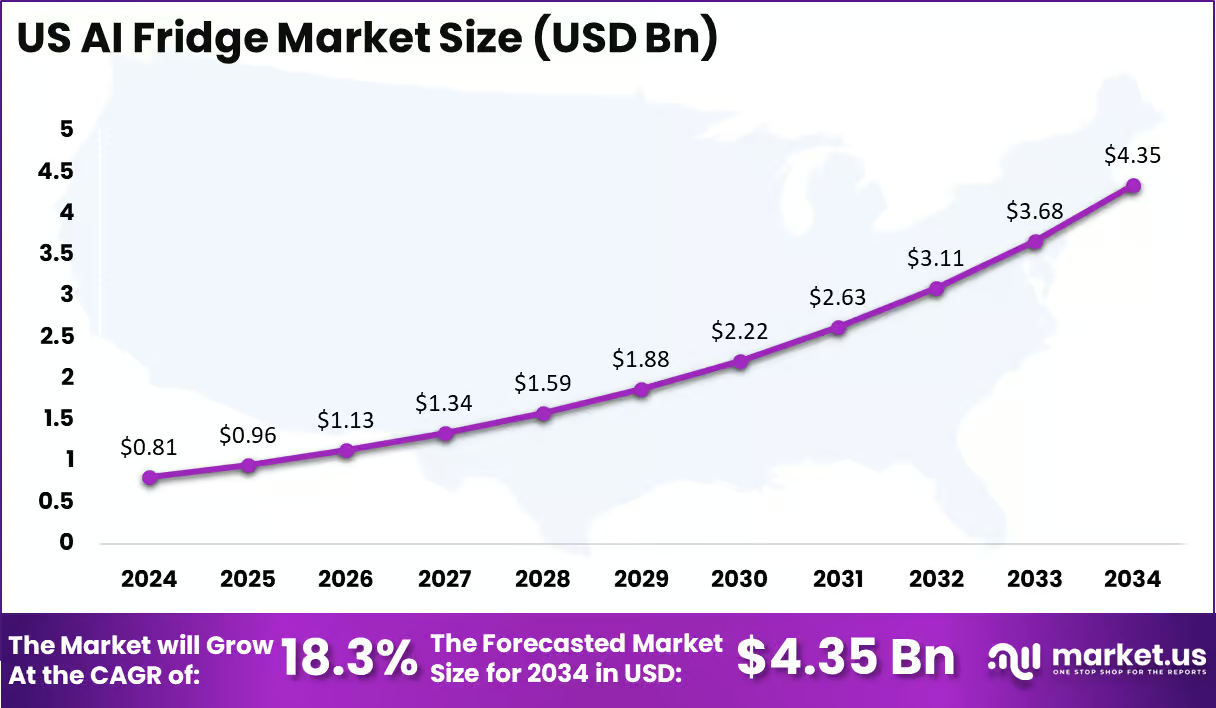
- This growth reflects a strong consumer base in the U.S., where people are quick to adopt smart home products that make daily life easier and more connected.
- The market is estimated to grow at a CAGR of about 18.3%, supported by rising demand for energy-efficient and internet-connected household appliances.
- AI fridges in the U.S. are increasingly used for predictive maintenance and smarter food management, helping households reduce waste and manage groceries better.
- The wider use of IoT devices and access to high-speed internet across the country is making it easier for consumers to use AI-enabled fridges and other connected appliances.
- Appliance manufacturers in the U.S. are investing in research and development to add AI features that improve convenience, support sustainable living, and offer more personalized user experiences.
Regional Analysis and Coverage
- North America
- US
- Canada
- Europe
- Germany
- France
- The UK
- Spain
- Italy
- Russia
- Netherlands
- Rest of Europe
- Asia Pacific
- China
- Japan
- South Korea
- India
- Australia
- Singapore
- Thailand
- Vietnam
- Rest of Latin America
- Latin America
- Brazil
- Mexico
- Rest of Latin America
- Middle East & Africa
- South Africa
- Saudi Arabia
- UAE
- Rest of MEA
Top Key Players in the Market
- Samsung Electronics Co., Ltd.
- LG Electronics Inc.
- Whirlpool Corporation
- Haier Group Corporation
- Panasonic Corporation
- Bosch Siemens Hausgeräte (BSH) GmbH
- Electrolux AB
- Midea Group Co., Ltd.
- GE Appliances
- Hisense Co., Ltd.
- Hitachi, Ltd.
- Toshiba Corporation
- Sharp Corporation
- Daewoo Electronics Corporation
- Fujitsu General Limited
- Liebherr Group
- Sub-Zero Group, Inc.
- Viking Range, LLC
- Godrej & Boyce Manufacturing Company Limited
- Other Major Players
Investment and Business Opportunities in the AI Fridge Market
- High growth and strong returns: The Global AI Fridge Market was valued at USD 2.56 billion in 2024 and is projected to reach about USD 16.0 billion by 2034, implying a high CAGR of 20.2% over ten years. A separate assessment of the AI refrigerator segment indicates a CAGR of about 22.5% during 2024–2030, confirming that AI fridges are growing faster than many other consumer appliance categories.
- Attractive regional profit pools: In 2024, North America held around 37.5% of the AI fridge market, generating about USD 0.96 billion in revenue. Within this, the United States alone contributed USD 0.81 billion in 2024 and is projected to reach roughly USD 4.34–4.35 billion by 2034, at a CAGR of 18.3%, which creates a sizeable, concentrated profit pool for investors focused on this region.
- Premium pricing and higher margins: Flagship AI refrigerators in developed markets command clear price premiums. For instance, one 2025 Bespoke AI fridge model is reported at about USD 4,999, positioned far above typical mass-market refrigerator price points. In emerging markets, AI-enabled double-door models in India are listed around INR 37,490 (roughly a mid-premium range). Such pricing power supports higher gross margins per unit for manufacturers and retailers.
- Fast-scaling unit volumes and segment leadership: Industry analysis indicates that around 15 million AI fridges are sold worldwide each year, signalling that the category is already at meaningful scale rather than a niche experiment. Within AI fridges, double-door products hold about 35.8% share, while deep-learning-based models account for 40.5% of technology use, and residential users represent 55.6% of demand, giving investors clear, numerically dominant sub-segments to target.
- Energy-efficiency benefits that support ROI cases: ENERGY STAR-certified refrigerators are about 9% more energy efficient than models that only meet the federal minimum standard and can save more than USD 220 over a 12-year lifetime. Studies of smart grid and IoT-enabled refrigeration equipment show energy or cost savings in the range of 15–49% through advanced energy-management systems and up to 51% energy-cost savings by shifting refrigerator loads from peak to off-peak hours. One case using waste-heat recovery around domestic refrigerators reported about a 40% reduction in energy consumption. These quantifiable efficiency gains support strong payback narratives for both households and commercial buyers.
- Food-waste reduction and sustainability value: In Europe, food waste is estimated at about 20% of total production or 88 million tonnes annually and research shows that household refrigerator use can reduce the food-waste carbon footprint by approximately 0.68 percentage points in high-income households. AI fridges with computer-vision systems are already able to recognise up to 37 fresh food items and around 50 processed items, tracking expiry dates and giving recipe suggestions that help consumers use food before it spoils. These quantified sustainability benefits can be monetised through green-branding, ESG-linked financing, and premium positioning.
- Service, ecosystem and data-monetization upside: New AI fridges integrate with grocery-delivery platforms so that on-board cameras and AI can detect low stock and automatically populate same-day delivery baskets. One leading 2025 AI fridge line is tied to an Instacart partnership, with automated restocking in the U.S. market. The same models include a 32-inch built-in display providing access to more than 300 live TV channels and thousands of on-demand titles, opening avenues for recurring advertising and content-partnership revenue on top of hardware sales.
- Favourable channel and product-mix economics: In the AI fridge market, supermarkets and hypermarkets account for about 44.8% of total sales, providing strong in-store visibility and efficient distribution. At the level of the broader household refrigerator and freezer market, Asia Pacific already holds about 36% global share, double-door models account for roughly 65%, and freestanding units about 55% of revenue in 2024. This channel and product structure allows investors to prioritise formats with proven high-volume throughput and profitable retail relationships.
- Robust funding and M&A environment: Between Q1 and Q3 2025, startups focused on AI algorithms for smart kitchen appliances, including AI fridges, raised more than USD 250 million in funding. The space also records around 10–15 mergers and acquisitions per year, with combined deal value above USD 500 million, including individual transactions of about USD 200 million. This level of capital flow signals active strategic interest and provides clear exit pathways for early-stage investors.
- Exposure to high-growth smart-home regions: Asia Pacific is estimated to contribute roughly 30–35% of global AI fridge sales, driven by rising incomes and rapid smart-home adoption in countries such as China, Japan and South Korea. At the same time, global smart-appliance revenues are projected to rise from about USD 42.35 billion in 2025 to USD 71.28 billion by 2030, a CAGR of 11.0%, with refrigerators highlighted among the key product categories. This gives AI-fridge investors exposure to both regional consumption growth and the wider connected-home ecosystem.
Discuss your needs with our analyst
Please share your requirements with more details so our analyst can check if they can solve your problem(s)