Table of Contents
Introduction to AI’s Role
Artificial intelligence is playing an increasingly central role in shaping the podcasting industry, influencing how audio is produced, distributed, and consumed. The shift toward automated workflows has allowed creators to streamline tasks that previously required significant time and technical expertise.
AI has supported faster editing, smoother production cycles, and more accurate content insights. Many creators report that advanced tools have reduced editing time by nearly 70%, allowing more focus on creative planning and audience building. This contribution has encouraged new formats and expanded output without increasing operational workloads.
Access AI Impact Study for the Podcasting Industry – Get PDF Brochure
Podcasting Market Size
The global podcasting landscape has expanded rapidly as audiences shift toward on-demand audio consumption. The market is projected to reach USD 233.9 Billion by 2032, rising from USD 27.3 Billion in 2023, supported by a strong 27.8% growth rate during the assessment period.
This rise has been driven by higher mobile usage, improved streaming access, and increasing investment in audio content creation. The steady movement toward personalized listening and multilingual content has also strengthened engagement, allowing podcasting to evolve into one of the most influential digital media formats worldwide.
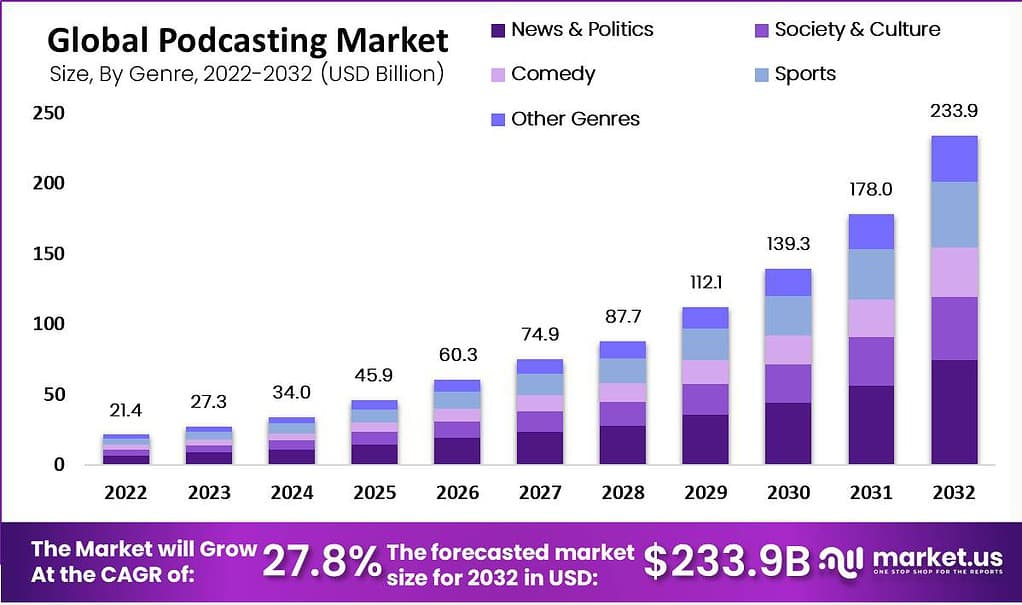
AI Impact Analysis on Podcasting industry
Production Enhancements
AI driven production tools have changed the technical foundation of podcasting by improving speed, quality, and consistency. Automated editing, noise reduction, and voice leveling have helped creators deliver polished audio even when recording conditions are not ideal.
Several studios have observed that audio clarity has improved by close to 50% after using AI based mastering systems. Synthetic voice technologies have also emerged as an alternative for narration, ad insertions, and last minute script updates. This capability has raised important discussions about creative authenticity, yet it remains valuable for meeting tight schedules and maintaining continuity.
Transcription and translation features have further strengthened production efficiency. AI systems now generate accurate transcripts within seconds and convert episodes into multiple languages. These capabilities have expanded creator reach, with some reporting listener growth of more than 25% after enabling multilingual access. This widening of global reach has transformed how creators plan content and distribute episodes.
Audience Engagement and Personalization
AI powered recommendations have played a significant role in increasing listener retention. Platforms that analyze tone, pacing, and contextual themes deliver more relevant suggestions, improving the likelihood that users complete episodes. Some services have documented increases of nearly 30% in completion rates after adopting this level of personalization. These insights help creators understand what listeners value most, guiding decisions about content direction, episode length, and publishing frequency.
Sentiment models also assist creators in identifying emotional reactions to episodes. These systems help determine which topics resonate strongly and which formats generate repeat listens. This deeper understanding has supported healthier growth patterns, particularly in fast moving categories where audience preference shifts rapidly.
Monetization Opportunities
AI has introduced new revenue opportunities by improving advertising relevance and campaign accuracy. Contextual ad placement now identifies ideal moments within an episode for delivering promotions aligned with listener interests. This improvement has been linked to increases of up to 40% in ad recall, strengthening the value proposition for advertisers and boosting earnings for creators. Analytics systems supported by AI also help publishers understand which demographics produce the strongest engagement and which content themes attract higher advertiser demand.
Programmatic advertising has benefited from improved targeting accuracy, helping creators with mid sized and smaller audiences generate more stable returns. Combined with predictive analytics, these tools allow creators to schedule episodes when listener activity is expected to peak. Some categories have experienced growth rates of nearly 35% when publishing strategies were guided by AI forecasting.
Challenges and Ethical Concerns
While AI has improved efficiency and monetization, it has also created concerns around authenticity, creative ownership, and responsible use. Synthetic voices have raised questions about transparency because listener surveys indicate that 58% of audiences express discomfort when cloned voices are not clearly disclosed. Data privacy remains an active concern as personalization systems rely on detailed listening behavior and content preferences. Maintaining clear guidelines around data usage is becoming increasingly important.
The rise of automated content moderation has also introduced new responsibilities for platforms. AI now reviews large volumes of audio to identify harmful narratives or unverified claims. Although these systems improve safety and consistency, they sometimes struggle with contextual nuance, highlighting the need for balanced human oversight. These challenges reflect the ongoing need for ethical frameworks that protect both creators and audiences while sustaining innovation.
Top AI-Powered Podcasting Tools
The top 10 AI-powered tools for podcasting in 2025 focus on editing, transcription, audio enhancement, and content generation to streamline production. These tools appear most frequently across recent expert lists for their automation features and ease of use.
- Descript: Descript enables text-based audio editing where changes to transcripts automatically update the audio file. It includes AI voice synthesis for fixing errors without re-recording and accurate transcription for quick workflows.
- Riverside FM: Riverside FM records high-quality remote podcasts with built-in AI for automatic transcripts and show notes after each session. Podcasters use it for superior audio over basic video calls, plus clip generation for promotion.
- Podcastle: Podcastle handles recording, editing, and enhancement with AI tools like Magic Dust for audio cleanup and Revoice for voice cloning. It supports multitrack work and turns raw clips into polished episodes efficiently.
- Auphonic: Auphonic automates post-production by balancing levels, removing noise, and generating transcripts with one click. It processes files quickly for consistent professional sound across episodes.
- Alitu: Alitu simplifies full podcast creation by automating noise removal, filler word cuts, and publishing directly to hosts. Beginners rely on its text-editing approach and built-in website tools for fast episode builds.
- Otter.ai: Otter.ai delivers precise transcription and live captions, outperforming some rivals in accuracy for interviews. It aids podcasters in summarizing episodes and extracting highlights from recordings.
- Adobe Podcast AI: Adobe Podcast AI cleans audio via Enhance Speech for noise reduction and auto-leveling in the cloud. It integrates with editing workflows for quick professional polish on transcripts and exports.
- Castmagic: Castmagic generates clips, timestamps, and social content from transcripts using AI analysis. It saves time on repurposing full episodes into shareable formats.
- Podsqueeze: Podsqueeze creates show notes, titles, and descriptions automatically from audio inputs. It focuses on content optimization to boost discoverability without manual writing.
- Wondercraft AI: Wondercraft AI turns text into podcasts with realistic voiceovers from over 500 voices or custom clones. It suits script-based production for ads or full episodes without live recording.
Driver Analysis
The growth of the podcasting market is being driven by steady increases in smartphone usage and audio streaming habits. The expansion of low cost data plans and the rise of on the go listening culture have encouraged more users to integrate podcasts into their daily routines.
This shift has supported higher engagement as listeners seek flexible content that fits into commuting, exercising, and multitasking situations. The availability of diverse genres has further strengthened adoption because audiences are able to follow specific interests through long form audio formats. As a result, demand has been lifted by consistent movement toward personalized and convenient media consumption.
Restraint Analysis
The market continues to face a restraint linked to monetization limitations for smaller creators. Many independent podcasters find it difficult to generate steady income because advertising revenue tends to favor large established shows with strong followings.
This imbalance reduces the ability of new creators to scale their content sustainably. Production costs can add pressure when teams must invest in editing tools, hosting platforms, and marketing activities. These challenges have slowed the commercial progress for smaller players, even as listener numbers continue to rise.
Opportunity Analysis
A major opportunity is emerging in the area of regional language content. A growing segment of listeners are shifting toward local stories and culturally relevant programming because such content feels more relatable and trustworthy. This trend is creating openings for platforms and creators to expand in underserved linguistic markets.
Brands are also beginning to target these new segments, which could enhance advertising revenue flows. As regional content libraries strengthen, a broader and more inclusive ecosystem is expected to develop, offering room for innovation and audience growth.
Challenge Analysis
One important challenge is rising competition among platforms. As more companies expand into audio entertainment, listeners are presented with multiple choices, which makes it harder for creators and platforms to retain long term loyalty.
Discoverability has become a pain point because many new podcasts struggle to stand out in crowded directories. Algorithms often favor established shows, creating a cycle in which emerging voices find it difficult to gain visibility. This competitive pressure has increased the need for better recommendation tools and more equitable distribution systems.
Related Report
Discuss your needs with our analyst
Please share your requirements with more details so our analyst can check if they can solve your problem(s)