Table of Contents
Introduction
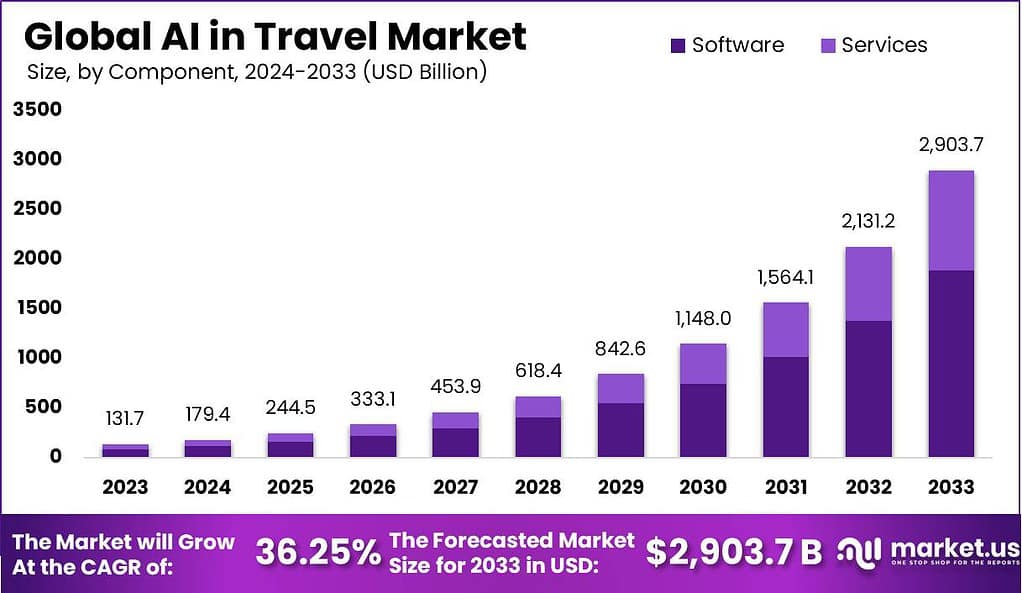
The global AI in travel landscape is undergoing rapid transformation as the sector moves toward more automated, personalized, and data-driven services. The market is projected to reach USD 2,903.7 Billion by 2033, rising sharply from USD 131.7 Billion in 2023, supported by a strong 36.25% growth rate throughout the forecast period. This expansion has been driven by increasing adoption of AI for trip planning, customer service, dynamic pricing, and operational efficiency across airlines, hotels, and mobility platforms.
The steady integration of intelligent systems has strengthened traveler engagement through real-time recommendations, seamless booking experiences, and predictive insights that optimize journeys end-to-end. As travel companies continue to prioritize efficiency and personalization, AI is expected to remain at the core of next-generation travel experiences worldwide.
Obtain AI-Based Analysis of the Travel Industry Market – PDF Request
According to WorldMetrics, AI adoption in travel has expanded quickly, supported by rising demand for automation and personalized assistance. AI-enabled virtual tours recorded a 45% rise during periods of restricted travel, signaling their value in enhancing traveler engagement. Experts have estimated that AI could help recover nearly USD 400 Billion in revenue lost during the pandemic by strengthening efficiency across booking, pricing, and customer experience. AI chatbots have also been linked to annual savings of about USD 0.50 Billion, showing the impact of automated service models.
Traveler trust in AI is growing, with 75% relying on AI tools for accommodation planning and 40% of US adults showing interest in AI travel agents. At the same time, 37% of customers continue to prefer human interaction, indicating that the industry must balance automation with personal support. Automated bookings are projected to reach 2.9 Billion, while AI is estimated to lower flight disruption costs by about 16% or USD 265 Billion globally.
Airlines adopting AI could see efficiency gains of nearly 75%, and more than 50% of hoteliers are prioritizing AI to streamline operations. About 36% of corporate travel leaders have invested in AI to improve traveler experience, and close to 70% of travel agencies believe the entire planning process can be automated, reducing research and booking time by over 50%.
Key Takeaways
- The AI in travel market is projected to reach USD 2,903.7 billion by 2033 at a strong 36.25% CAGR, rising sharply from USD 131.7 billion in 2023.
- The software segment captured 65% in 2023, showing that most innovation in travel AI continues to be driven by algorithms, automation tools, and intelligent analytics.
- Cloud-based deployment accounted for 61%, reflecting the industry’s shift toward scalable platforms that support real-time travel data processing.
- Customer service applications held 25.1%, supported by rising use of AI chatbots, virtual assistants, and automated response systems across airlines and travel platforms.
- North America recorded 34.5% of global share in 2023 with revenues of USD 45.4 billion, driven by strong digital infrastructure and rapid adoption of AI solutions across major travel operators.
AI Impact Analysis
AI adoption in the travel industry has increased rapidly as service providers move toward automated and data driven operations. The industry has seen a measurable rise in AI influenced decision making, with global surveys showing that more than 65% of travel companies now integrate AI for customer interaction or operational tasks. This shift is reshaping how travelers plan, book, and experience journeys, supporting smoother processes and higher service accuracy.
AI in Customer Service and Virtual Assistance
AI powered chatbots and voice assistants are transforming customer service by providing real time support. These systems can handle large volumes of queries, including booking updates, cancellations, and itinerary changes. Studies indicate that AI assistants can resolve over 70% of routine customer requests without human involvement, reducing response times and improving satisfaction. This efficiency is enabling travel firms to serve customers around the clock while lowering operational pressure.
Personalized Travel Planning and Recommendations
AI models analyze millions of user behaviors, search patterns, and location preferences to create personalized travel suggestions. Around 58% of travelers report increased trust when platforms provide tailored recommendations based on past activities. The adoption of AI filters helps users discover destinations, hotels, and itineraries that match their interests, which improves engagement and increases booking conversion rates across digital travel platforms.
AI in Pricing, Revenue Management, and Demand Forecasting
AI driven pricing engines evaluate supply conditions, historical trends, and real time demand signals to adjust fares and room prices. Airlines and hotels benefit from accurate demand forecasting, with algorithms improving pricing precision by nearly 15% in some studies. This technology supports revenue optimization by predicting booking spikes, seasonal patterns, and consumer spending behavior. The result is more stable revenue cycles and better inventory utilization.
Operational Efficiency Across Airlines, Hotels, and Mobility Services
AI supports automation in check ins, baggage handling, room allocation, and fleet coordination. More than 40% of airlines now use AI systems to streamline ground operations and reduce delays. Hotels apply AI to manage housekeeping schedules, energy usage, and staff deployment. These efficiencies reduce operational costs and improve the reliability of services offered to travelers at different touchpoints of their journey.
AI in Safety
AI systems monitor aircraft, vehicles, and hotel equipment to identify faults before they occur. Predictive maintenance has reduced unexpected equipment failures by approximately 30%, contributing to safer and more dependable travel operations. AI also evaluates real time weather conditions, geopolitical risks, and route disruptions to support informed decision making. Travelers benefit through reduced cancellations and improved travel predictability.
Enhanced Customer Experience
Automation driven by AI simplifies airport procedures, hotel check ins, car rentals, and local transport experiences. Self service kiosks supported by AI reduce wait times by nearly 35% in busy airports. Hotels deploy facial recognition for quick verification and smart systems that adapt room lighting or temperature based on guest behavior. These improvements enhance convenience and create seamless travel experiences.
AI in Fraud Detection and Secure Transactions
Travel transactions are highly vulnerable to fraud due to high frequency cross border bookings. AI security systems analyze behavioral patterns and transaction histories to detect anomalies. More than 70% of travel payment platforms now rely on AI for fraud prevention. These systems reduce chargeback risks and improve trust by validating identities and blocking suspicious activities in real time.
Challenges and Ethical
Despite its benefits, the industry faces challenges related to data privacy, algorithmic bias, and system transparency. Travelers express concerns about sharing personal data, with nearly 48% seeking clearer privacy obligations from service providers. Ensuring that AI systems do not discriminate or misinterpret traveler preferences remains a priority. High integration costs also limit adoption among small travel firms.
Opportunities for Innovation
AI brings opportunities for new business models such as hyper personalized travel bundles, autonomous transport, AI powered tour guides, and real time language translation tools. The rise of virtual reality previews for destinations and AI curated digital travel experiences is reshaping the decision making phase. Travel companies that adopt AI driven models are expected to improve efficiency and strengthen long term competitiveness.
Future Outlook
AI is expected to deepen its influence across every layer of the travel value chain. Customer journeys will become more automated, interconnected, and individualized. Service accuracy and operational predictability are likely to improve further as AI adoption grows. Regulatory frameworks are expected to evolve, providing more clarity on ethical AI usage and data security.
Conclusion
AI has become a major force shaping the modern travel industry. Its impact is seen in customer engagement, personalization, operational efficiency, and safety improvements. As adoption expands and regulatory guidance strengthens, the travel ecosystem is expected to experience more stable and customer centric growth. The industry stands at an important stage where AI has moved from experimentation to practical long term value creation.
Report Scope
| Report Features | Description |
|---|---|
| Market Value (2023) | USD 131.7 Bn |
| Forecast Revenue (2033) | USD 2,903.7 Bn |
| CAGR (2024-2033) | 36.25% |
| Base Year for Estimation | 2023 |
| Historic Period | 2019-2022 |
| Forecast Period | 2024-2033 |
| Report Coverage | Revenue Forecast, Market Dynamics, COVID-19 Impact, Competitive Landscape, Recent Developments |
| Segments Covered | By Component (Software, Services), By Deployment (On-premises, Cloud-based), By Application (Customer Service, Booking and Reservations, Travel Planning and Personalization, Marketing and Advertising, Operations Management, Security and Fraud Detection) |
| Regional Analysis | North America – The U.S. & Canada; Europe – Germany, France, The UK, Spain, Italy, Russia, Netherlands & Rest of Europe; APAC- China, Japan, South Korea, India, Australia, New Zealand, Singapore, Thailand, Vietnam & Rest of APAC; Latin America- Brazil, Mexico & Rest of Latin America; Middle East & Africa- South Africa, Saudi Arabia, UAE & Rest of MEA |
| Competitive Landscape | Amadeus, Expedia Group, Booking.com, Sabre, Airbnb, Skyscanner, Kayak, TripActions, Hopper, TravelPerk, Agoda, Google Travel, Cleartrip, MakeMyTrip, CWT, Other Key Players |
| Customization Scope | Customization for segments, region/country-level will be provided. Moreover, additional customization can be done based on the requirements. |
| Purchase Options | We have three licenses to opt for Single User License, Multi-User License (Up to 5 Users), Corporate Use License (Unlimited User and Printable PDF) |
Discuss your needs with our analyst
Please share your requirements with more details so our analyst can check if they can solve your problem(s)