Table of Contents
AI in Art and Creativity Market Size
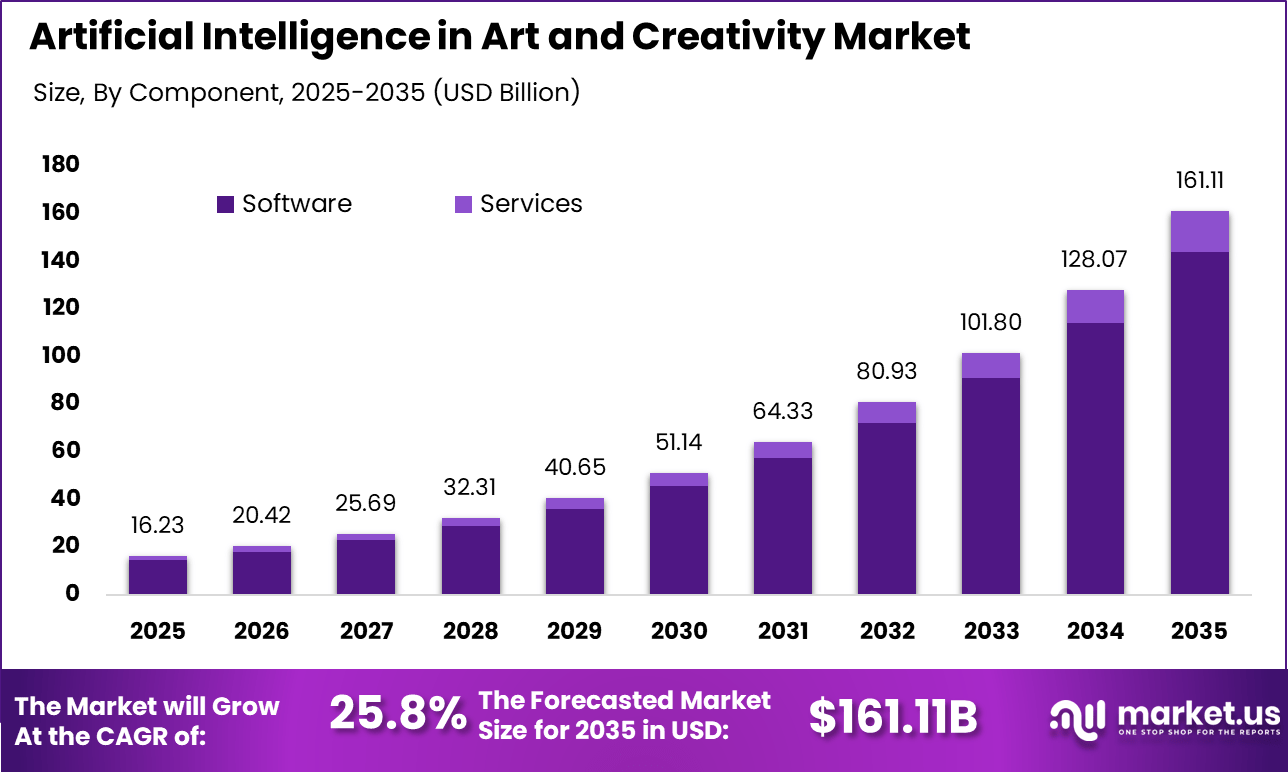
The global AI in Art and Creativity market was valued at USD 16.23 billion in 2025 and is expected to expand rapidly over the forecast period. The market is projected to reach approximately USD 161.11 billion by 2034, growing at a strong CAGR of 25.8% from 2025 to 2034. This growth is driven by rising adoption of AI tools in digital art, music composition, content creation, and creative design workflows. Increasing use of generative models is also reshaping how creative assets are produced and monetized.
The AI in art and creativity market refers to digital technologies that use artificial intelligence to generate, support, or enhance creative works such as visual art, music, writing, design, and multimedia content. These solutions include generative models, neural networks, natural language understanding, and pattern recognition that enable machines to produce original or semi-original creative outputs. Use cases span professional and amateur creators, digital agencies, media companies, and brands seeking innovative content production. Adoption includes AI art generators, intelligent design assistants, automated music composition tools, and tools for creative workflow augmentation.
Market Key Takeaways
- In 2025, software dominated the market with an 89.3% share, reflecting strong reliance on AI driven creative platforms that support content generation, editing, and workflow automation for artists and designers.
- Transformer based models led technology adoption with 52.7%, driven by their strong capability in handling complex generative tasks such as image synthesis, style transfer, and creative variation.
- Visual art and image generation accounted for a 61.8% share, highlighting the central role of AI in digital artwork creation, graphic design, and visual content production.
- Professional artists and creators represented 42.6% of total adoption, indicating growing acceptance of AI as a tool that enhances productivity, speeds up iteration, and supports creative experimentation.
- Cloud based deployment captured 83.5% share, supported by ease of access, scalable computing resources, and lower entry barriers for individual creators and small studios.
- The U.S. market reached USD 5.02 billion in 2025, expanding at a strong 22.33% growth rate, driven by rapid creator economy expansion and continuous AI innovation.
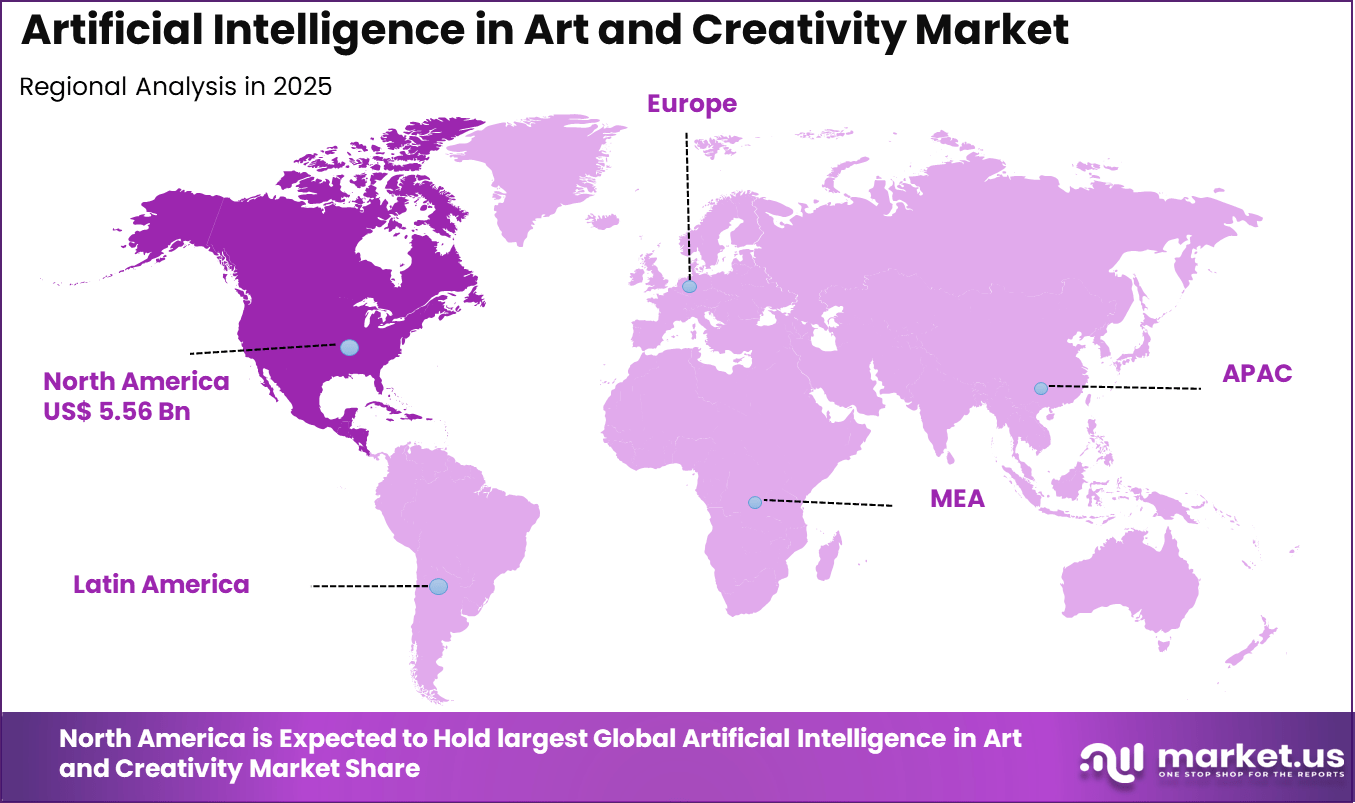
- North America held over 34.26% share, backed by advanced AI ecosystems, high adoption of creative technologies, and strong investment activity across digital art and media sectors.
Regional Analysis
North America held a dominant position in the global market, accounting for more than 34.26% of total revenue. The region generated around USD 5.56 billion, supported by strong presence of creative technology firms and early adoption of AI driven creative platforms. High investment in digital media, entertainment, and AI research further strengthened regional leadership. As a result, North America continues to play a central role in advancing AI based creativity solutions.
Drivers Impact Analysis
| Driver Category | Key Driver Description | Estimated Impact on CAGR Forecast (%) | Geographic Relevance | Impact Timeline |
|---|---|---|---|---|
| Generative AI Model Progress | Improvements in output quality, controllability, and processing speed are accelerating professional and commercial adoption. | ~6.2% | North America, Europe | Short to Mid Term |
| Creator Economy Expansion | Rising monetization of digital content is increasing demand for rapid and scalable creative production tools. | ~4.8% | Global | Short Term |
| Enterprise Adoption for Marketing | Businesses are scaling creative output using AI to shorten production cycles and improve campaign efficiency. | ~4.3% | North America, Europe | Short to Mid Term |
| Declining Generation Cost | Cloud optimization and model efficiency are reducing the cost per generated asset across platforms. | ~3.5% | Global | Mid Term |
| Workflow Integration | Embedded AI features within existing creative software are increasing daily usage and adoption frequency. | ~3.1% | Global | Short Term |
| Multimodal Content Demand | Growth in video, interactive, and mixed-media content formats is expanding the use of AI-driven creation tools. | ~2.7% | North America, Asia Pacific | Mid Term |
Restraint Impact Table
| Restraint Factor | Restraint Description | Impact on Market Expansion (%) | Most Affected Regions | Duration of Impact |
|---|---|---|---|---|
| Licensing Ambiguity | Unclear intellectual property and usage rights frameworks may slow enterprise level investment and adoption decisions. | ~2.8% | North America, Europe | Mid Term |
| Output Consistency | AI generated content often requires manual refinement to meet professional quality and brand standards. | ~2.1% | Global | Short Term |
| Adoption Resistance | Creative professionals may resist workflow changes due to trust, skill, or job security concerns. | ~1.7% | Global | Short to Mid Term |
| Data Privacy Concerns | Use of proprietary or sensitive content in AI systems raises confidentiality and compliance risks. | ~1.5% | Europe, North America | Mid Term |
| Compute Intensity | High quality video, image, and 3D generation demands significant computing power and infrastructure. | ~1.2% | Emerging Markets | Mid Term |
Top Driving Factors
One primary driver of the AI in art and creativity market is the exponential growth in digital content demand across platforms such as social media, streaming services, advertising, and gaming. Content producers face pressure to create novel, engaging material at scale to capture audience attention. AI tools that automate repetitive aspects of creation and offer rapid ideation support help creators meet volume and quality expectations. This demand for scalable creativity fuels adoption of AI solutions.
Another significant driver is the democratization of creative tools through intuitive AI interfaces. Individuals without formal artistic training can use AI art generators, music composition assistants, and writing enhancement platforms to produce compelling works. Lower barriers to entry expand the user base and shift creative experimentation into broader social and commercial contexts. Wider accessibility encourages experimentation and ongoing innovation.
Demand Analysis
Demand for AI in art and creativity solutions is influenced by the rise of personalised and interactive media experiences. Customers increasingly seek unique, custom content such as personalised playlists, branded visuals, and dynamic storytelling. AI enables tailored creative outputs that adapt to user preferences or context. This capability strengthens engagement and supports differentiated experiences in digital environments.
Demand is also shaped by the need for efficiency and cost management in creative production. Traditional content creation can involve substantial time, human resources, and financial investment. Organisations seek AI driven tools that reduce turnaround times and operational costs while supporting quality outcomes. As creative cycles become more iterative and time sensitive, demand for AI augmentation continues to grow.
Increasing Adoption Technologies
Generative adversarial networks (GANs), transformer based language models, and deep learning architectures are central to AI adoption in creative domains. These technologies learn patterns from large datasets of art, music, text, and design, enabling machines to generate novel outputs that emulate human creativity. Continuous improvements in model sophistication increase the fidelity and relevance of AI generated content. These advances support broader applicability across creative disciplines.
Cloud computing and API enabled services also accelerate adoption by providing scalable processing power and integration with creative workflows. Cloud based AI platforms enable real time content generation, storage, and collaboration without reliance on local hardware. This accessibility supports distributed creative teams and cross platform output. Cloud integration simplifies deployment and enhances collaborative innovation.
One key reason organisations adopt AI in art and creativity solutions is to improve creative productivity and innovation. AI assisted tools reduce manual effort required for tasks such as initial concept generation, editing, and iteration. Creators can focus more on strategic decisions and higher level refinement. This efficiency supports rapid experimentation and more diversified creative output.
Another reason is enhanced creative exploration and inspiration. AI generated suggestions, variations, and patterns can expose creators to ideas outside traditional human bias or routine practice. This augmentation expands creative horizons and fosters novel combinations. Organisations benefit from expanded ideation capacity that leads to more engaging and differentiated content.
Investment Opportunities
Investment opportunities in the AI in art and creativity market exist in platforms that offer end to end creative ecosystems combining generation, collaboration, and rights management. Solutions that support version control, multi user workflows, and asset library integration attract enterprise interest. Investors may focus on technologies that unify creative production pipelines and streamline distribution.
Another opportunity lies in vertical specific AI creative tools tailored to sectors such as advertising, gaming, film production, and education. Each vertical has unique creative needs – such as script writing tools for media, procedural content generation for games, or interactive learning content for education. Focused solutions that address domain specific challenges can achieve deeper market penetration. Strategic investment in sector aligned capabilities supports long term growth.
Business Benefits
Adoption of AI in art and creativity solutions improves operational efficiency by reducing time spent on repetitive creative tasks and providing instant ideation support. This allows creative teams to deliver more content with fewer resources. Improved efficiency strengthens competitiveness in fast paced content environments.
AI powered creative tools also support enhanced consistency and brand alignment. Automated templates, stylistic controls, and quality checks help ensure that creative outputs adhere to organisational guidelines. This consistency reduces rework and supports cohesive brand messaging. Organisations benefit from predictable creative quality at scale.
Regulatory Environment
The regulatory environment for the AI in art and creativity market is influenced by intellectual property, copyright protection, and licensing standards. AI generated content raises questions about ownership, authorship, and derivative use of training data. Platforms and users must navigate global laws governing creative rights and ensure lawful use of copyrighted materials in both training and output.
Data privacy and ethical guidelines also influence how AI models are trained and deployed. Models must safeguard personal data and respect privacy regulations when processing user inputs or usage analytics. Transparent policies on data handling, consent, and content provenance build trust and support responsible adoption. Regulatory alignment reduces legal risk and reinforces sustainable market participation.
Key Market Segments
By Component
- Software
- Services
By Technology
- Generative Adversarial Networks (GANs)
- Transformer-based Models
- Neural Style Transfer
- Creative Coding & AI-assisted Design Tools
- Others
By Application
- Visual Art & Image Generation
- Music & Audio Composition
- Writing & Story Generation
- Video & Animation Creation
- Game Asset & Design Creation
- Others
By End-User
- Professional Artists & Creators
- Media & Entertainment Companies
- Advertising & Marketing Agencies
- Hobbyists & Enthusiasts
By Deployment Mode
- Cloud-based
- On-premises
Top Key Players in the Market
- OpenAI, L.L.C.
- Midjourney, Inc.
- Stability AI, Ltd.
- Runway ML, Inc.
- Adobe, Inc.
- Shutterstock, Inc.
- Artbreeder
- Jasper, Inc.
- Writesonic, Ltd.
- AIVA Technologies SA
- DeepDream Generator
- Nvidia Corporation
- Others
Report Scope
| Report Features | Description |
|---|---|
| Market Value (2025) | USD 16.2 Bn |
| Forecast Revenue (2035) | USD 161.1 Bn |
| CAGR(2026-2035) | 25.8% |
| Base Year for Estimation | 2025 |
| Historic Period | 2020-2024 |
| Forecast Period | 2026-2035 |
| Report Coverage | Revenue forecast, AI impact on Market trends, Share Insights, Company ranking, competitive landscape, Recent Developments, Market Dynamics and Emerging Trends |
Discuss your needs with our analyst
Please share your requirements with more details so our analyst can check if they can solve your problem(s)