Table of Contents
Report Overview
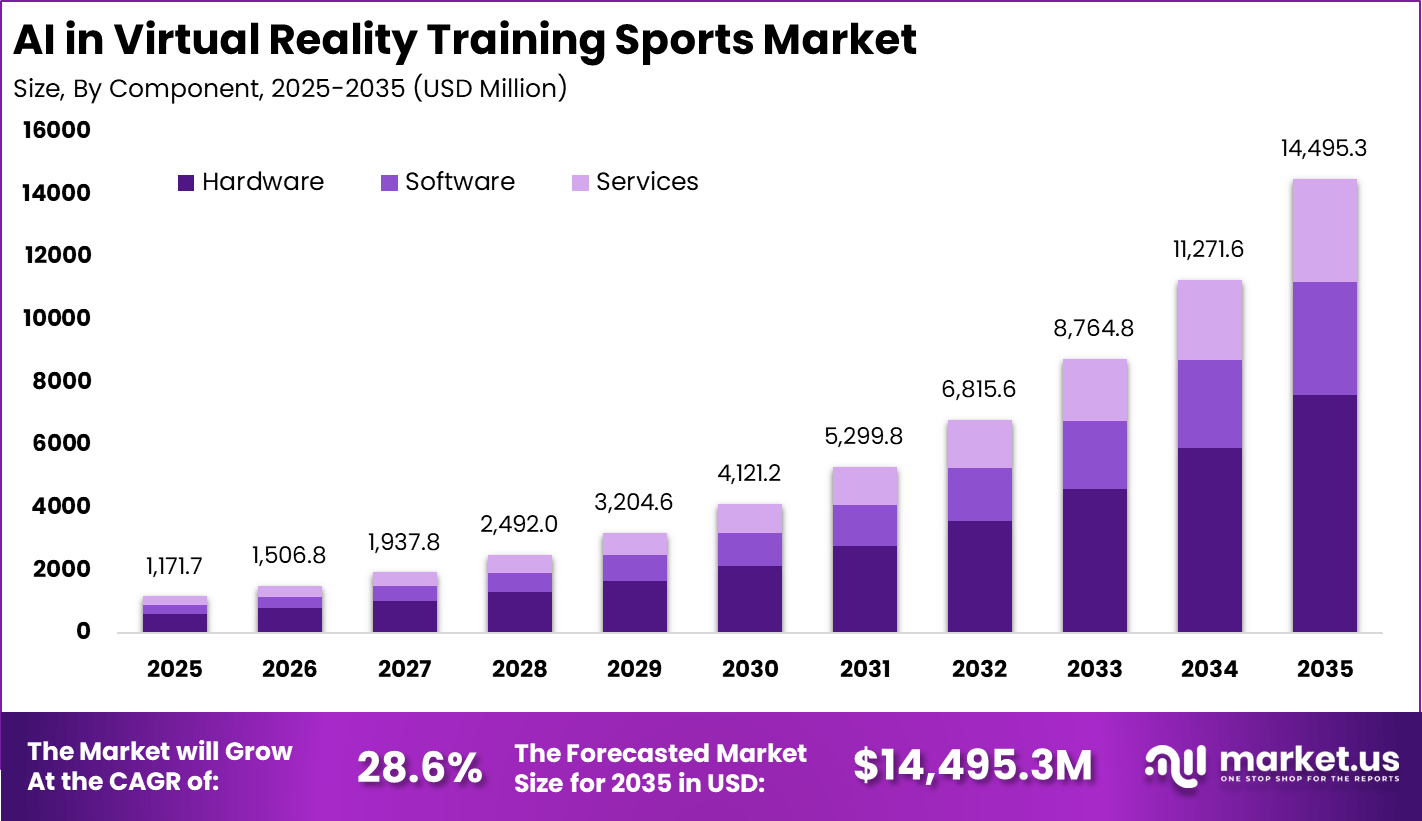
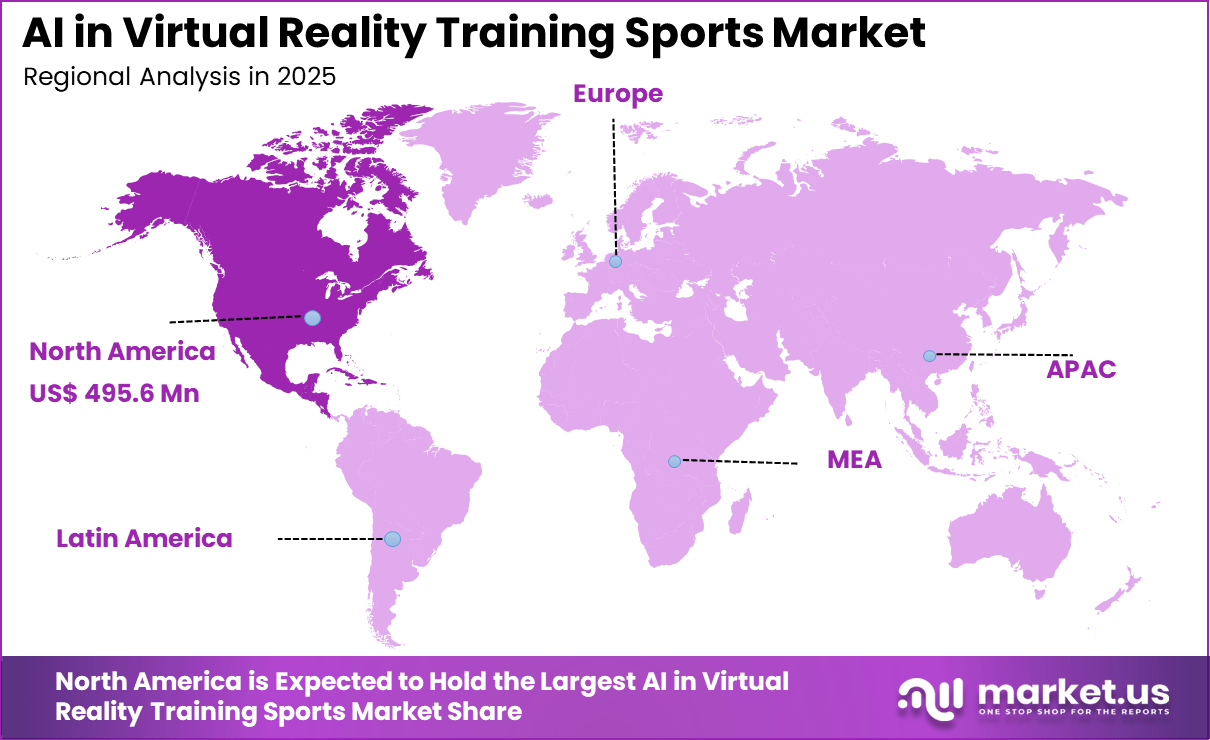
The Global AI in Virtual Reality Training Sports Market is witnessing rapid expansion, projected to grow from USD 1,171.7 million in 2025 to approximately USD 14,495.3 million by 2035, registering a strong CAGR of 28.6% over the forecast period. North America dominated the market, capturing more than 42.3% share and generating USD 495.6 million in revenue, highlighting robust adoption of AI-powered immersive training solutions across professional sports, athletics, and performance coaching.
The AI in virtual reality training sports market refers to technology solutions that combine artificial intelligence with immersive virtual reality environments to support sports training and performance development. These systems simulate realistic play scenarios and analyse athlete movements, decision making, and biomechanics in controlled digital settings. Performance feedback and skill refinement are generated through real-time data capture, enabling athletes and coaches to assess progress and adapt training more precisely.
Use of these technologies spans professional sports teams, training academies, and individual athletes seeking structured, measurable improvements in performance. This market is influenced by the broader trend of digital transformation in sports where data and technology are used to enhance competitiveness and athlete safety. Virtual reality environments allow repetition of complex scenarios without physical wear or injury risk. Artificial intelligence models interpret captured movement and behavioural data to adapt exercises and provide personalised guidance.
One primary driver of this market is the growing demand for performance optimisation in competitive sports. Coaches and trainers increasingly require precise analytical tools that can measure athlete response, technique, and tactical decision making under simulated pressure conditions. Virtual reality reduces dependence on physical partners and field availability by simulating opponents and environments, while AI enhances feedback with nuanced insights into performance patterns. This capability to tailor and intensify training without increasing risk has accelerated adoption across disciplines.
Another key factor is the need to reduce injury risk and accelerate skill acquisition. Traditional repetitive drills on physical fields can contribute to overuse injuries and fatigue. AI-powered VR systems allow athletes to practise complex movements repeatedly with minimal physical strain, tracking form and balance and alerting to potential biomechanical concerns. Training strategies informed by VR encounter fewer logistical constraints and support more consistent development pathways, making them attractive to both elite and amateur training centres.
Demand for AI in virtual reality training sports is shaped by its capacity to deliver measurable improvements in tactical awareness and decision accuracy. Recent studies have indicated that teams incorporating VR into training see enhancements in tactical effectiveness and situational response during actual competition settings, reflecting the fidelity of simulated practice environments. These outcomes suggest a shift in coaching behaviours towards technology-assisted preparation rather than exclusively physical drill sessions.
Key Takeaways
- Hardware accounted for 52.4% of the market in 2025, supported by rising use of VR headsets, sensors, and edge computing devices.
- Immersive VR training systems led with 70.3%, indicating strong preference for fully interactive and realistic training environments.
- On-premises deployment represented 62.8%, as sports organizations emphasized data control, low latency, and tailored training infrastructure.
- Computer vision held 41.7%, enabling accurate motion tracking, performance analysis, and real-time feedback.
- Football was the leading sport with 30.5% share, driven by high investment in tactical training and player development.
- Skill acquisition and performance enhancement accounted for 45.4%, reflecting focus on technique improvement, decision making, and reaction speed.
- Professional sports teams and clubs captured 52.9%, showing strong uptake among elite and competitive training programs.
- The US market reached USD 444.5 million in 2025, expanding at a 25.2% CAGR.
- North America led globally with over 42.3% share, supported by advanced sports infrastructure and early adoption of AI based training tools.
Key Insights Summary
Performance Outcomes by Sport
- Soccer players recorded a 15% improvement in passing accuracy and a 20% increase in tactical understanding through VR training.
- Basketball players achieved an 8% rise in shooting accuracy, supported by posture and movement optimization.
- Combat sports athletes improved reaction speed by 12% and tactical execution accuracy by 18%.
- Motorsports training reduced average lap times by 2.5 seconds and increased overtaking success rates by 15%.
- Gymnastics athletes improved execution quality by 15%, while routine error rates declined by 20%.
Core AI and VR Training Metrics
- Average athlete reaction times decreased by 85 milliseconds.
- Decision making accuracy improved by 22% with AI enhanced VR training.
- Injury incidence declined by 30% due to biomechanical risk detection.
- Cognitive focus levels were 35% higher during VR based training sessions.
- Knowledge retention reached 75%, outperforming traditional training methods.
Technology Benchmarks
- VR training platforms achieved 99.99% system availability.
- Network latency was maintained below 30 milliseconds, ensuring realistic motion response.
- AI performance prediction accuracy ranged between 65% and 78%.
- Deep learning movement tracking achieved 90% accuracy in detecting complex actions.
Drivers Impact Analysis
| Key Driver | Impact on CAGR Forecast (~%) | Geographic Relevance | Impact Timeline |
|---|---|---|---|
| Rising adoption of data-driven athlete performance training | +7.4% | North America, Europe | Short to medium term |
| Growing use of immersive VR simulations for skill development | +6.2% | North America, Asia Pacific | Medium term |
| Increasing investment by professional sports teams and academies | +5.6% | North America, Europe | Medium term |
| Expansion of esports and digital sports training ecosystems | +4.8% | Asia Pacific, North America | Medium to long term |
| Demand for injury reduction and safe training environments | +4.1% | Global | Long term |
Restraints Impact Analysis
| Key Restraint | Impact on CAGR Forecast (~%) | Geographic Relevance | Impact Timeline |
|---|---|---|---|
| High upfront cost of AI-enabled VR training systems | −4.9% | Emerging Markets | Short to medium term |
| Limited technical expertise among smaller sports organizations | −4.1% | Asia Pacific, Latin America | Medium term |
| Hardware dependency and maintenance complexity | −3.6% | Global | Medium term |
| Motion sickness and user adaptation challenges | −2.9% | Global | Short term |
| Data privacy concerns related to athlete performance metrics | −2.4% | Europe, North America | Medium to long term |
Investor Type Impact Matrix
| Investor Type | Growth Sensitivity | Risk Exposure | Geographic Focus | Investment Outlook |
|---|---|---|---|---|
| Sports technology companies | Very High | High | North America, Europe | Strong upside from elite training demand |
| VR platform and hardware investors | High | Medium | Global | Ecosystem expansion opportunity |
| Professional sports franchises | Medium | Low to Medium | North America, Europe | Strategic performance investment |
| Private equity firms | Medium | Medium | North America | Platform scaling and consolidation |
| Venture capital investors | Very High | Very High | North America, Asia Pacific | Early-stage innovation and rapid growth |
Investor interest is strongest where elite sports performance, analytics, and immersive training converge.
Technology Enablement Analysis
| Technology Enabler | Impact on CAGR Forecast (~%) | Primary Function | Geographic Relevance | Adoption Timeline |
|---|---|---|---|---|
| AI-driven motion tracking and biomechanics analysis | +7.1% | Precision performance insights | Global | Short to medium term |
| Real-time VR simulation engines | +6.0% | Immersive training scenarios | North America, Europe | Medium term |
| Computer vision for posture and movement correction | +5.2% | Technique optimization | Global | Medium term |
| Cloud-based analytics and athlete dashboards | +4.3% | Performance monitoring at scale | Global | Medium to long term |
| Wearable sensor integration with VR platforms | +3.6% | Physiological data fusion | North America | Long term |
Emerging Trend Analysis
A clear emerging trend in the AI in Virtual Reality Training Sports market is the growth of immersive, data driven practice environments that simulate real-game situations without the physical strain of live play. Athletes can wear headsets and use motion capture or VR overlays to improve decision making, motor skills, spatial awareness, and technique in a controlled virtual setting. Research indicates that VR training focused on visual perception and interactive scenarios can help athletes practise essential skills repeatedly in a risk free context.
In addition to skill rehearsal, the integration of real time performance metrics into VR environments is expanding. Technologies such as wearable sensors combined with virtual displays are being used to show metrics like swing speed or motion patterns during training sessions, which helps athletes adjust technique on the fly. These enhancements allow training feedback to be immediate and personalized, strengthening the link between virtual practice and performance outcomes.
Opportunity Analysis
An important opportunity in this market lies in expanding access through scalable, mobile VR training solutions. As smartphone based VR and more affordable headsets become capable of integrating AI feedback, lower cost entry points can emerge for youth sports, grassroots clubs, and individual athletes. This expansion beyond elite circles could broaden the user base and democratize high quality training tools.
There is also potential for specialised training modules tailored to sport specific needs such as decision making under pressure, tactical awareness, or sport psychology support within AI enhanced virtual environments. Customised programs can address unique athletic goals and support long-term development plans, making virtual training more relevant to varied athletic profiles.
Challenge Analysis
A major challenge for the AI in Virtual Reality Training Sports domain is ensuring that virtual improvements translate effectively to real world performance. While simulations can model game scenarios, the transfer of learned skills from a virtual environment to live play remains complex and requires careful validation to ensure true performance gains. Continued research and evidence based evaluations are essential to close this gap.
Data privacy and user trust issues also present challenges. AI driven VR systems collect and process sensitive biometric and performance data, raising concerns about how that data is stored, used, and shared. Protecting personal information and ensuring transparent data governance will be important for wider acceptance among athletes and organisations.
Regional Analysis
Key Market Segments
By Component
- Hardware
- Software
- Services
By Type
- Immersive VR Training Systems
- Non-Immersive VR Training Systems
- Semi-Immersive VR Training Systems
By Deployment Mode
- On-Premise
- Cloud-Based
By Technology
- Machine Learning
- Deep Learning
- Computer Vision
- Natural Language Processing
- Others
By Sport Type
- Football
- Basketball
- Cricket
- Tennis
- Golf
- Baseball
- Others (Hockey, Boxing, Athletics)
By Application
- Skill Acquisition and Performance Enhancement
- Injury Prevention and Rehabilitation
- Game Strategy Analysis
- Player Behavior and Biomechanics Monitoring
- Others
By End-User
- Professional Sports Teams and Clubs
- Sports Academies and Training Centers
- Individual Athletes
- Research Institutions
Top Key Players in the Market
- Strivr
- StatusPro
- Rezzil
- Sense Arena
- Beyond Sports
- Sportsbox AI
- GamePlan
- HOLOFIT
- Mighty Sports
- VR Motion Learning
- MIRACL
- META (Reality Labs)
- WIN Reality
- Golf+
- deeptrack
- Mobalytics
- Mune
- MVM
- Swish Analytics
- Others
Report Scope
| Report Features | Description |
|---|---|
| Market Value (2025) | USD 1,171.7 Mn |
| Forecast Revenue (2035) | USD 14,495.3 Mn |
| CAGR(2026-2035) | 28.6% |
| Base Year for Estimation | 2025 |
| Historic Period | 2020-2024 |
| Forecast Period | 2026-2035 |
| Report Coverage | Revenue forecast, AI impact on Market trends, Share Insights, Company ranking, competitive landscape, Recent Developments, Market Dynamics and Emerging Trends |
Discuss your needs with our analyst
Please share your requirements with more details so our analyst can check if they can solve your problem(s)