Table of Contents
AI-Powered Checkout Market Size
The global AI Powered Checkout market was valued at USD 6.67 billion in 2025 and is expected to expand rapidly over the forecast period. The market is projected to reach approximately USD 138.14 billion by 2035, growing at a strong CAGR of 35.4% from 2025 to 2035. This growth is driven by increasing adoption of automated retail technologies and rising demand for frictionless payment experiences. Retailers are leveraging AI powered checkout systems to reduce wait times, improve accuracy, and enhance customer satisfaction.
The AI powered checkout market refers to digital checkout systems that use artificial intelligence to automate and optimize the payment and transaction process. These solutions support features such as cashier-less checkout, fraud detection, personalized offers, and real-time payment validation. AI powered checkout systems are used across retail stores, e-commerce platforms, and self-service environments. They aim to reduce checkout time and improve transaction accuracy. Adoption spans physical retail, online commerce, and hybrid shopping models.
Market development has been influenced by changing consumer expectations around speed and convenience. Traditional checkout processes often involve waiting times and manual intervention. AI powered solutions streamline transactions through automation and data-driven decision making. Retailers seek frictionless payment experiences to improve customer satisfaction. This shift supports growing interest in intelligent checkout technologies.
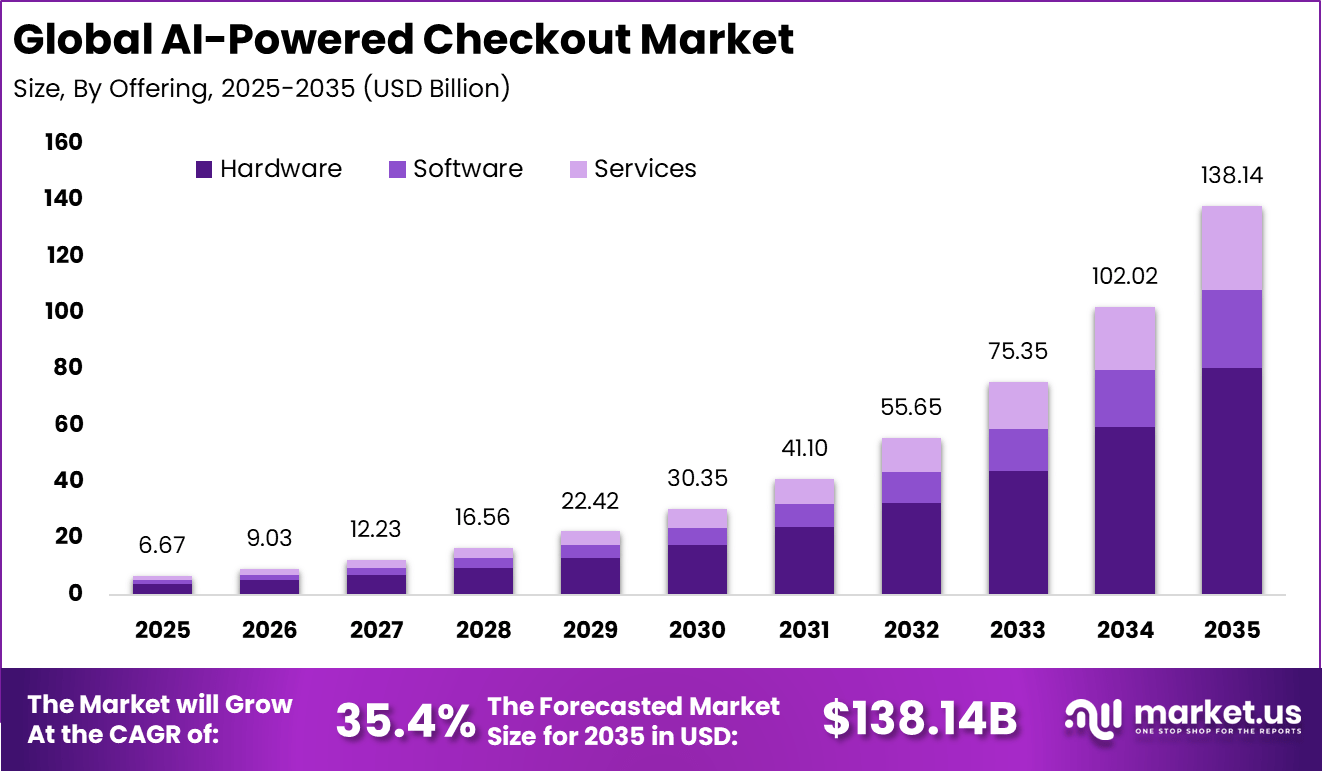
Key Takeaway
- In 2025, hardware led adoption with a 58.2% share, reflecting strong dependence on smart cameras, sensors, and edge devices for accurate item recognition and automated checkout.
- Cash-based checkout accounted for 55.3%, showing continued relevance of cash acceptance in AI-enabled checkout systems, particularly in high-traffic and hybrid payment environments.
- Machine learning and predictive analytics captured 38.9%, highlighting their importance in shopper behavior analysis, fraud detection, and real-time transaction validation.
- Standalone deployments held a 53.7% share, indicating retailer preference for independent AI checkout systems that require minimal changes to existing store infrastructure.
- The retail sector dominated end use with a 40.5% share, driven by the need to reduce checkout time, lower labor costs, and enhance in-store customer experience.
- The United States remained a key adoption market in 2025, supported by advanced retail digitization and early acceptance of AI-driven store technologies.
- North America led regionally with more than 37.4% share, supported by high technology readiness, strong investment capacity, and rapid scaling of AI checkout deployments.
Top Driving Factors
One major driving factor of the AI powered checkout market is the demand for faster and contactless payment experiences. Consumers prefer quick and seamless checkout without long queues or physical interaction. AI enables automated item recognition and payment processing. Reduced friction improves customer flow and satisfaction. Convenience-driven behavior supports adoption.
Another key driver is the need to reduce operational costs in retail environments. Staffing traditional checkout counters can be expensive and inefficient. AI powered systems reduce dependency on manual labor. Automation improves transaction throughput and accuracy. Cost optimization remains a strong driver.
Demand Analysis
Demand for AI powered checkout solutions is influenced by growth in omnichannel retail models. Retailers must deliver consistent checkout experiences across online and physical stores. AI powered systems support unified payment and customer data handling. Consistency improves brand experience. This requirement increases demand.
Demand is also shaped by rising transaction volumes and peak shopping periods. High traffic environments require scalable checkout solutions. AI systems handle large volumes without performance degradation. Reliable performance during peak times is critical. Scalability strengthens demand.
Increasing Adoption Technologies
Computer vision technologies play a key role in AI powered checkout adoption. These systems identify products automatically without barcode scanning. Accurate recognition improves transaction speed. Vision-based systems reduce manual input. Technology maturity improves reliability. Machine learning technologies also support adoption through fraud detection and personalization. Models analyze transaction patterns to detect anomalies. Personalized offers are generated based on behavior. Continuous learning improves outcomes. Intelligent processing increases system value.
One key reason retailers adopt AI powered checkout solutions is improved customer experience. Faster checkout reduces frustration and abandonment. Seamless transactions encourage repeat visits. Positive experiences support customer loyalty. Experience improvement drives adoption. Another reason is enhanced transaction accuracy and security. AI systems reduce human error in pricing and payment processing. Automated fraud detection improves protection. Secure transactions reduce losses. Reliability builds trust.
Investment and Business Benefits
Investment opportunities in the AI powered checkout market exist in cashier-less store technologies. Fully automated checkout environments attract strong interest. These systems redefine in-store shopping. Innovation potential is high. Investors focus on scalable solutions. Another opportunity lies in AI powered checkout integration for small and mid-sized retailers. Simplified and affordable platforms expand addressable markets. Cloud-based deployment reduces entry barriers. Broader adoption supports growth. This segment offers expansion potential.
AI powered checkout systems improve operational efficiency by reducing checkout bottlenecks. Faster transactions increase store throughput. Reduced staffing requirements lower costs. Efficiency improvements support profitability. Operations become more predictable. These systems also generate valuable transaction data. Retailers gain insights into purchasing behavior. Data supports pricing and merchandising decisions. Better insights improve performance. Analytics add strategic value.
Regional Analysis
North America held a dominant position in the global market, accounting for more than 35.4% of total revenue. The region generated around USD 2.49 billion, supported by early adoption of smart retail solutions and strong investment in AI driven commerce platforms. High penetration of digital payments and advanced retail infrastructure strengthened regional leadership. As a result, North America continues to influence innovation and adoption trends in the AI powered checkout market.
Driver Analysis
The AI-powered checkout market is being driven by the increasing imperative for seamless, fast, and frictionless payment experiences in both online and physical retail environments. Consumers today expect checkout processes that minimise delays and simplify transactions, particularly as e-commerce and omnichannel shopping continue to expand.
AI-enabled checkout solutions automate key functions such as fraud detection, personalised payment routing, predictive payment preference recognition, and dynamic error reduction to improve conversion rates and reduce cart abandonment. These capabilities align with broader enterprise strategies to enhance customer satisfaction and operational efficiency. The integration of artificial intelligence into checkout workflows enhances transaction reliability and supports real-time decision making that strengthens consumer trust in digital commerce systems.
Restraint Analysis
A significant restraint in the AI-powered checkout market relates to concerns over data privacy, security, and regulatory compliance. Checkout systems process highly sensitive financial and personal information, which elevates the risk profile of AI-driven payment technologies. Organisations must ensure that AI models and data handling procedures adhere to stringent data protection standards, security protocols, and industry-specific compliance requirements. Failure to address these concerns can undermine consumer confidence and expose merchants to legal liabilities. The complexity of implementing robust encryption, secure authentication, and governance frameworks can slow adoption among risk-averse retailers.
Opportunity Analysis
Emerging opportunities in the AI-powered checkout market are linked to the expansion of contextual commerce and personalised shopping experiences. AI can analyse customer behaviour patterns to predict preferred payment methods, optimise payment workflows, and tailor promotional offers at the point of transaction. This enables more intuitive and adaptive checkout journeys that align with individual shopper preferences.
There is also rising interest in voice-enabled checkout, biometric authentication, and AI-facilitated cross-border payment optimisation, which open new avenues for engagement and efficiency. Platforms that integrate these advanced capabilities can offer differentiated value to merchants seeking to elevate customer experience and loyalty.
Challenge Analysis
A central challenge facing this market relates to balancing automation with transparency and user control. While AI-powered systems can streamline checkout interactions and reduce friction, consumers and merchants alike demand clear visibility into how decisions are made, particularly for payment authorisation, fraud alerts, or dynamic routing actions.
Lack of interpretability in AI decisions can erode trust and lead to hesitancy in adoption. Ensuring that systems provide actionable explanations without compromising automation benefits requires thoughtful design and governance. Additionally, integrating AI checkout tools with diverse point-of-sale infrastructures and legacy payment systems presents technical and operational complexities.
Emerging Trends
Emerging trends in the AI-powered checkout landscape include predictive payment selection engines that analyse user behaviour and context to automatically present the most appropriate payment options. There is also a growing adoption of biometric and behavioural authentication to reduce reliance on passwords and enhance security.
AI-driven fraud detection and risk scoring mechanisms continue to evolve, enabling real-time threat assessment that minimises false declines without disrupting customer experience. Integration with conversational interfaces and smart devices is further expanding the scope of checkout environments beyond traditional screens.
Growth Factors
Growth in the AI-powered checkout market is anchored in the expanding volume of digital transactions and the heightened expectations for convenience and security in consumer payments. Retailers and service providers are investing in technologies that reduce cart abandonment, accelerate payment flow, and safeguard customer information to maintain competitive differentiation.
Advances in machine learning, data analytics, and secure authentication methods enhance the capability of AI-based checkout solutions to deliver reliable, context-aware experiences. The proliferation of mobile commerce, contactless payments, and omnichannel retail strategies continues to reinforce demand for intelligent checkout systems that support seamless transaction journeys.
Key Market Segments
By Offering
- Hardware
- Software
- Services
By Transaction Type:
- Cash
- Cashless
By Technology
- Machine Learning and Predictive Analytics
- Natural Language Processing
- Generative AI and Large Language Models
- Computer Vision (Image and Video)
- Chatbots and Virtual Assistants
- Others
By Model Type
- Standalone
- Countertop
- Mobile
By End-user Industry
- Retail
- Entertainment
- Travel
- Financial Services
- Healthcare
- Other End-user Industries
Top Key Players in the Market
- Diebold Nixdorf, Inc.
- Fujitsu Ltd.
- NCR Corporation
- ECR Software Corporation
- Toshiba Global Commerce Solutions
- ITAB Scanflow AB
- Pan-Oston Corporation
- DXC Technology
- Slabb Kiosks
- ShelfX Inc.
- Pegasus (Pegasus Turnkey Solution (OPC) Private Limited)
- Ombori
- Others
Report Scope
| Report Features | Description |
|---|---|
| Market Value (2025) | USD 6.6 Bn |
| Forecast Revenue (2035) | USD 138.1 Bn |
| CAGR(2026-2035) | 35.4% |
| Base Year for Estimation | 2025 |
| Historic Period | 2020-2024 |
| Forecast Period | 2026-2035 |
| Report Coverage | Revenue forecast, AI impact on Market trends, Share Insights, Company ranking, competitive landscape, Recent Developments, Market Dynamics and Emerging Trends |
Discuss your needs with our analyst
Please share your requirements with more details so our analyst can check if they can solve your problem(s)