Table of Contents
Market Overview
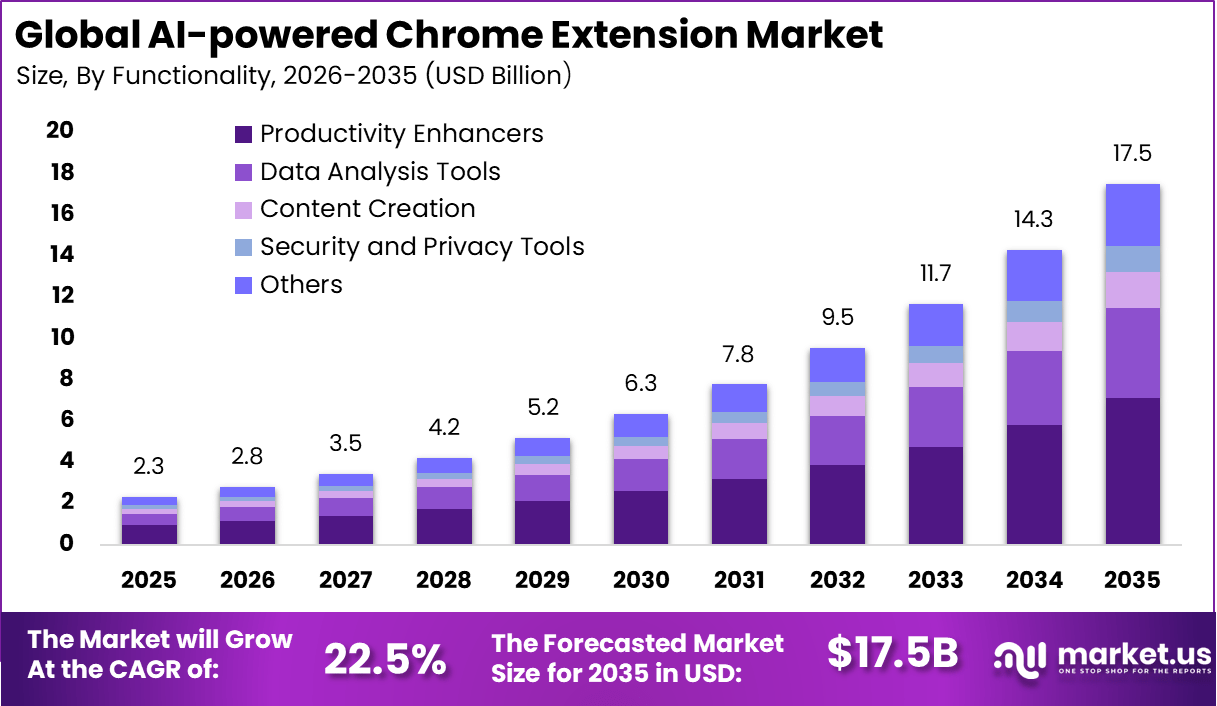
The global AI Powered Chrome Extension market was valued at USD 2.3 billion in 2025 and is expected to expand rapidly over the forecast period. The market is projected to reach approximately USD 17.5 billion by 2035, growing at a strong CAGR of 22.5% from 2025 to 2035. This growth is driven by rising demand for browser based productivity tools and increasing adoption of AI assisted workflows. Users across enterprises and individual segments are leveraging AI extensions to automate tasks and enhance efficiency.
The AI-Powered Chrome Extension Market encompasses software add-ons for the Google Chrome browser that integrate artificial intelligence to enhance user experiences, such as automating tasks, providing real-time insights, and personalizing browsing. This market has seen rapid expansion due to the widespread use of Chrome and the demand for intelligent tools in daily workflows.
Rising demand for productivity tools stands as a primary driver, as users seek automation for tasks like content summarization, tab management, and workflow optimization in remote and hybrid work environments. Advancements in AI technologies, including machine learning and natural language processing, enable more sophisticated features that integrate seamlessly into browsing sessions. Additionally, the shift toward personalized web experiences fuels growth, with extensions offering tailored recommendations and real-time analytics to meet individual user needs across professional and personal use.
Top Market Takeaways
- Individual users lead adoption with 55.4%, driven by demand for personal productivity and writing automation.
- Productivity enhancement dominates functionality with 40.7%, covering summarization, research, and task automation.
- Marketing and advertising account for 35.5%, supported by SEO analysis, ad copy creation, and campaign optimization.
- Freemium pricing models hold 62.3%, reflecting preference for low entry access with optional upgrades.
- Natural language processing underpins 62.8% of solutions, enabling text generation and conversational assistance.
- North America leads with 42.7%, supported by high browser usage and early AI adoption.
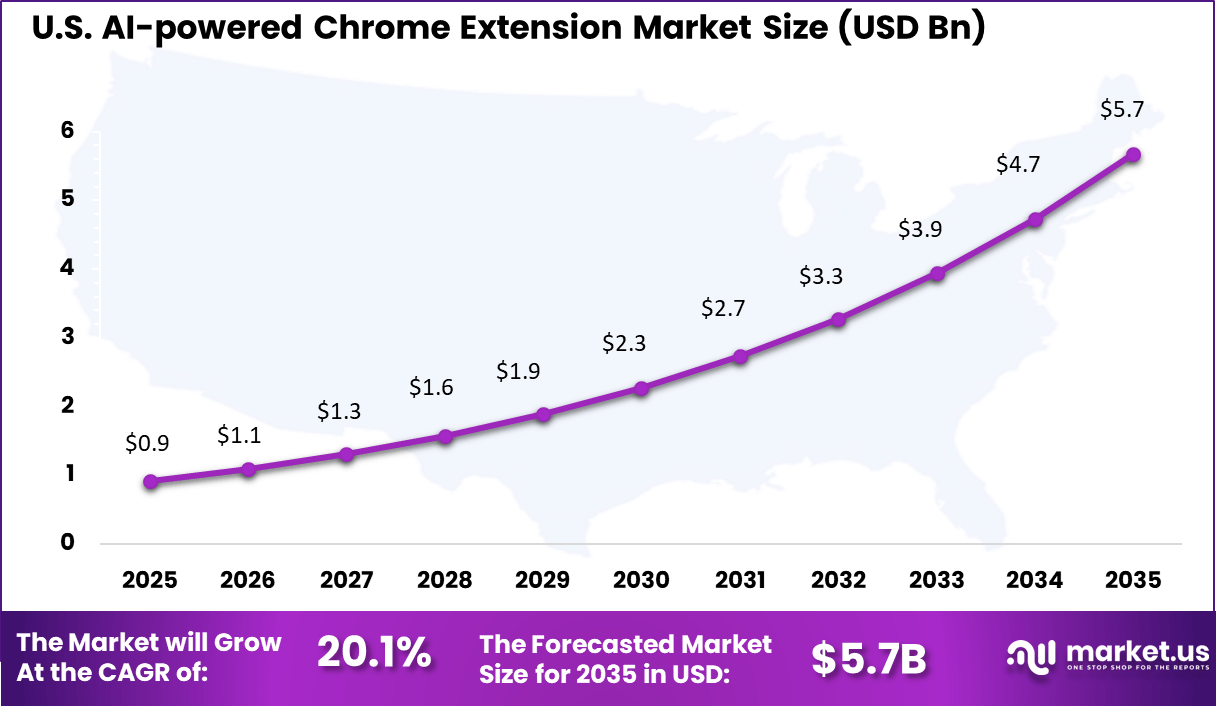
- The U.S. market reached USD 0.91 billion in 2024, growing at a 20.1% CAGR.
Key Statistics and Trends
- Leading AI-powered Chrome extensions serve tens of millions of users globally.
- Grammarly is used by over 40 million people worldwide and has more than 47 million Chrome users.
- Speechify exceeds 50 million global users, showing strong demand for AI-driven accessibility tools.
- Consumer AI familiarity is high, with 66% of users reporting regular AI use in 2025.
Productivity Impact
- Generative AI tools can improve work throughput by up to 66%.
- About 93% of Grammarly users report noticeable time savings.
- Text-to-speech users save up to 9 hours per week through faster content consumption.
Privacy and Security Concerns
- Around 67% of AI-powered Chrome extensions collect user data.
- About 41% collect personally identifiable information.
- Nearly 100 extensions request sensitive permissions exposing browsing or financial data.
- Malware incidents highlight the need for stricter security and permission controls.
Regional Analysis
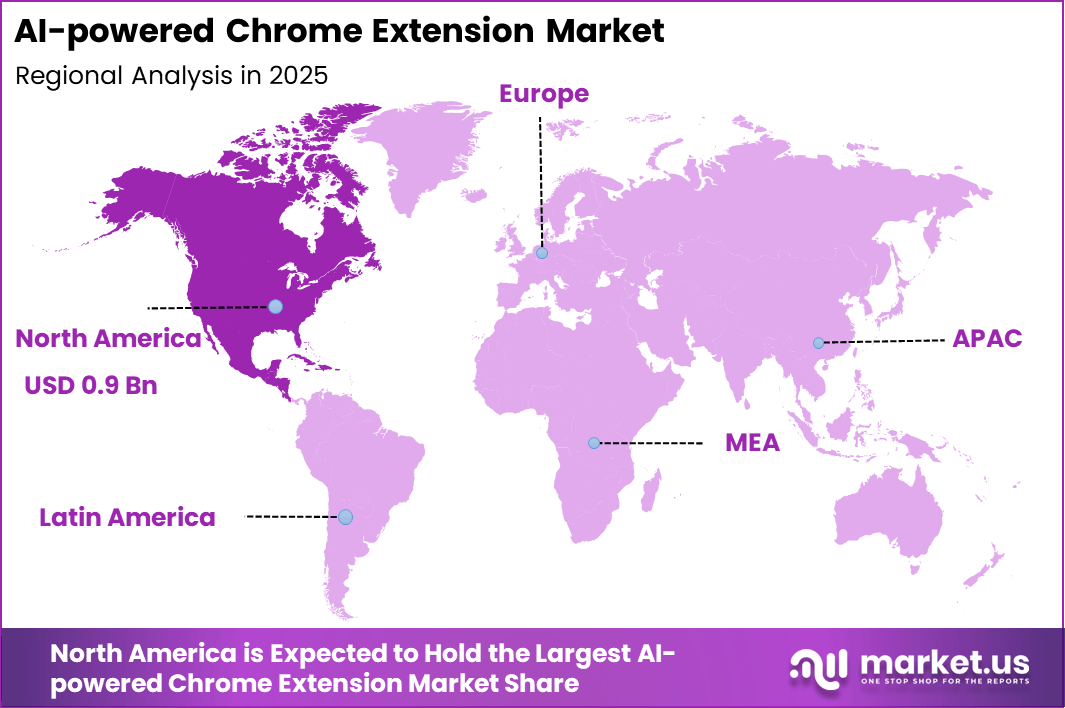
North America held a dominant position in the global market, accounting for more than 42.7% of total revenue. The region generated around USD 0.9 billion, supported by high adoption of AI tools and a strong digital services ecosystem. Early use of browser based AI solutions and strong developer activity strengthened regional leadership. As a result, North America continues to influence innovation and adoption trends in the AI powered Chrome extension market.
The United States reached USD 0.91 Billion with a CAGR of 20.1%, reflecting strong growth momentum. Expansion is driven by individual users and professional adoption
Driver Analysis
The AI-powered Chrome extension market is being driven by the widespread demand for enhanced productivity, personalised browsing experiences, and automated assistance within everyday web interactions. Users increasingly seek tools that can streamline tasks such as summarising content, generating text, translating language, automating repetitive actions, and offering intelligent recommendations directly within the browser environment.
Artificial intelligence enables these extensions to understand user intent, adapt to context, and provide real-time support without requiring users to switch applications or workflows. As remote work, digital learning, and online research continue to expand, AI-enabled extensions become valuable tools for improving efficiency, decision making, and content engagement across diverse use cases.
Restraint Analysis
A primary restraint in the AI-powered Chrome extension market relates to concerns about data privacy, user consent, and secure handling of sensitive information. Chrome extensions often require access to browser data, web page content, or user interactions to deliver intelligent functionality, which raises questions about how this data is collected, processed, and protected.
Users may be cautious about granting permissions that could expose personal or professional information, particularly when AI models are involved. Additionally, ensuring consistent performance across frequent browser updates and compatibility with the broader Chrome ecosystem requires ongoing development resources, which can slow adoption among smaller extension developers.
Opportunity Analysis
Emerging opportunities in the AI-powered Chrome extension market are linked to the growing need for task-specific automation and contextual intelligence that enhances user productivity. Extensions that integrate AI capabilities such as summarisation, sentiment analysis, intent recognition, content suggestion, and adaptive learning can address niche workflows in marketing, research, communication, e-commerce, and accessibility support.
There is also potential for integration with enterprise platforms and workflows, where browser-based AI tools can serve as lightweight assistants for customer support, sales enablement, and knowledge retrieval. By offering seamless, context aware features that reduce friction and improve user outcomes, AI-enabled extensions can attract both individual users and organisational deployments.
Challenge Analysis
A central challenge confronting this market involves balancing advanced AI functionality with user trust, transparency, and security. Users must understand how AI features operate, what data is accessed, and how insights are generated in order to adopt extensions confidently. Achieving clear explainability of AI behaviour, robust encryption of sensitive information, and adherence to privacy standards is essential to building trust. Developers must also ensure that AI outputs are reliable, relevant, and aligned with user expectations, which requires ongoing model training, quality control, and responsiveness to diverse browsing contexts.
Emerging Trends
Emerging trends in the AI-powered Chrome extension landscape include the rise of context-aware assistance that adapts suggestions based on active web content and past user behaviour. Extensions are increasingly incorporating natural language processing to summarise long-form text, generate contextual responses, and provide real-time language support.
Another trend involves intelligent automation of repetitive web tasks such as form filling, email drafting, and scheduling, which reduces cognitive load and accelerates routine work. Integration with cloud services and collaboration platforms is also expanding, enabling extensions to act as bridges between browser activity and broader productivity ecosystems.
Growth Factors
Growth in the AI-powered Chrome extension market is supported by expanding digital workflows, increased reliance on web-based applications, and the pervasive role of browsers in personal and professional activities. Users and organisations are prioritising tools that deliver immediate, context-specific intelligence without disrupting established routines.
Continued advancements in artificial intelligence, natural language understanding, and real-time processing enhance the capabilities and relevance of browser-embedded assistants. As remote engagement, content consumption, and browser-centric tasks continue to grow, AI-enabled extensions are positioned as strategic enablers of efficiency, accessibility, and smarter web experiences.
Key Market Segments
By User Type
- Individual Users
- Small Business Owners
- Enterprise Clients
- Educational Institutions
By Functionality
- Productivity Enhancers
- Data Analysis Tools
- Content Creation
- Security and Privacy Tools
- Others
By Industry
- Marketing & Advertising
- E-commerce
- Education
- Healthcare
- Others
By Pricing Model
- Free Extensions
- Freemium Models
- Subscription-Based
- One-Time Purchase
By Technology
- Natural Language Processing (NLP)
- Machine Learning Algorithms
- Cloud-Based Solutions
- Blockchain Technology
- Others
Top Key Players in the Market
- Jasper AI
- Synthesia
- Murf
- ChatSonic
- Compose AI
- YouTubeDigest
- AIPRM
- QuillBot
- TinEye
- Copyleaks
- Fireflies
- Grammarly
- ContentBot
- Voila AI
- Otter.Ai
- Writecream
- Vimeo
- Grammarly Chrome
- Others
Report Scope
| Report Features | Description |
|---|---|
| Market Value (2025) | USD 2.3 Bn |
| Forecast Revenue (2035) | USD 17.5 Bn |
| CAGR(2025-2035) | 22.5% |
| Base Year for Estimation | 2025 |
| Historic Period | 2020-2024 |
| Forecast Period | 2026-2035 |
| Report Coverage | Revenue forecast, AI impact on Market trends, Share Insights, Company ranking, competitive landscape, Recent Developments, Market Dynamics and Emerging Trends |
Discuss your needs with our analyst
Please share your requirements with more details so our analyst can check if they can solve your problem(s)