Table of Contents
Market Overview
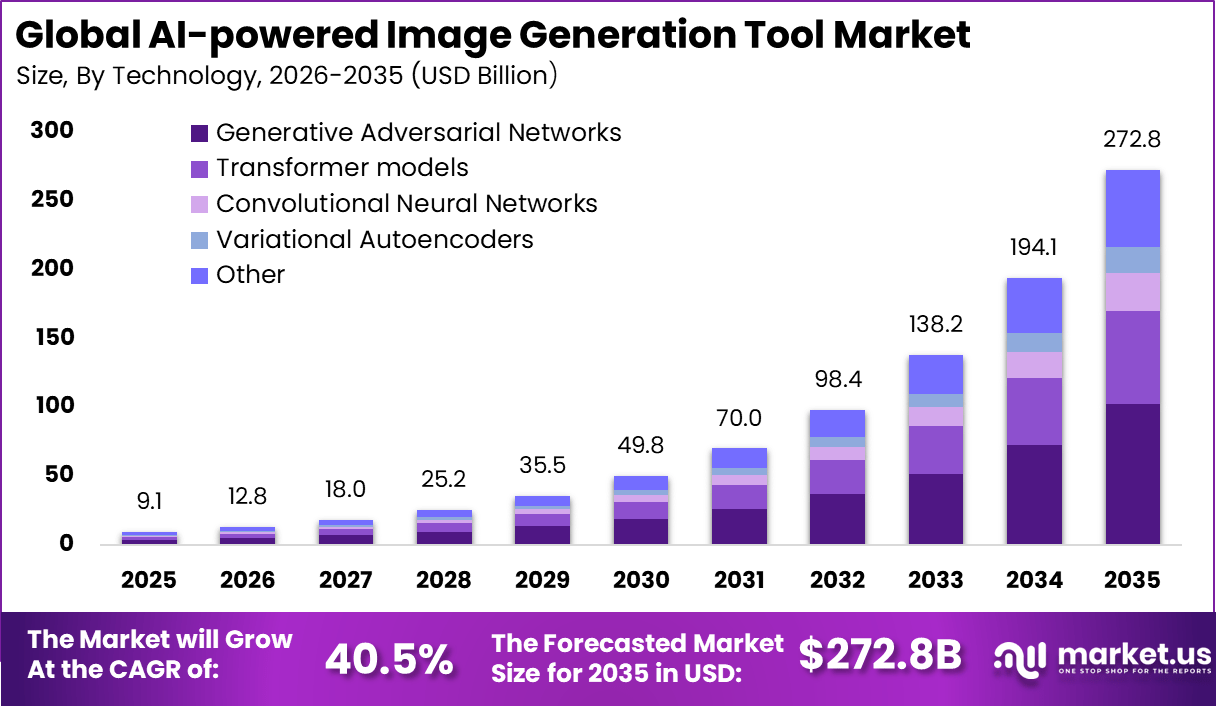
The global AI powered Image Generation Tool market was valued at USD 9.1 billion in 2025 and is expected to experience rapid expansion over the next decade. The market is projected to reach approximately USD 272.8 billion by 2035, growing at a CAGR of 40.5% during the forecast period from 2026 to 2035. This strong growth is supported by increasing use of AI generated visuals across advertising, media, gaming, and digital content creation. Continuous improvements in generative models are also accelerating adoption across both creative and commercial applications.
North America held a dominant position in the global market, accounting for more than 39.5% of total revenue. The region generated around USD 3.5 billion, supported by early adoption of advanced AI technologies and strong investment in digital innovation. High concentration of technology developers and creative industries further strengthened regional leadership. As a result, North America continued to shape innovation and commercial deployment within the AI powered image generation ecosystem.
Top Market Takeaways
- Software platforms led the market with a 76.5% share, supported by cloud-based deployment and strong adoption among creators, designers, and digital content teams.
- Generative Adversarial Networks accounted for 37.4% of technology usage, as they continue to deliver reliable image quality, realistic visuals, and advanced style generation capabilities.
- Image generation applications captured 40.6% of total usage, driven by growing demand for automated visual content in marketing, graphic design, and digital media workflows.
- Media and entertainment represented 36.2% of end-user adoption, supported by expanding use cases in content production, visual effects, animation, and digital storytelling.
- North America held a 39.5% share, backed by strong AI innovation ecosystems, high demand from creative industries, and early adoption of generative technologies.
- The U.S. market reached USD 3.07 billion in 2024 and is growing at a 35.6% CAGR, driven by rapid commercialization of generative AI tools and steady expansion of the creator economy.
Quick Market Facts
Adoption and Professional Use
- 62% of marketers use generative AI to create image assets.
- 76% of marketers use generative AI for general content creation.
- 83% of creative professionals use generative AI in their work.
- 71% of images shared on social media globally by late 2024 were AI generated.
Public Perception and Trust
- 48% of Millennials consider AI generated art to be real art.
- 42% of Gen Z consider AI generated art to be real art.
- Acceptance reaches 77% in India.
- Acceptance reaches 72% in China.
- Acceptance remains at 32% in the United States.
- 54% of people can distinguish between AI generated and human made art.
Corporate Adoption and Usage Rates
- 78% of global companies have adopted AI in at least one business function.
- 71% of organizations report regular use of generative AI.
- The professional and enterprise segment holds over 74% share in 2025.
- 89% of small businesses use AI tools for daily operations.
- Only 33% of companies have scaled AI across the full enterprise.
Sector Specific Adoption
- Marketing and advertising account for over 36% share in 2025.
- 62% of marketers use generative AI for image creation.
- 29% of digital artists have integrated AI into professional workflows.
- E commerce and retail adoption is growing at 39%.
- AI tools save e commerce teams an average of 6.4 hours per week.
Usage Frequency and Demographics
- 66% of marketers globally use AI tools daily.
- 74% of U.S. marketers use AI tools daily.
- 70% of Gen Z have experimented with or regularly use generative AI.
Production Volume and Impact
- Around 34 million AI generated images are created every day.
- Productivity improvements reach up to 25% among professionals.
- Positive peer feedback increases by 50%.
- 71% of all images shared on social media globally are AI generated.
Emerging Trend Analysis
The AI-powered image generation tool market is evolving with the increasing use of multimodal systems that can create images from text, sketches, and user-provided visual cues. These tools analyze inputs and generate consistent visuals that reflect style, composition, and context specified by the user. This capability supports a wider range of creative applications, from marketing collateral to personalized content creation. As adoption increases, image generation tools are being integrated into creative workflows rather than being used solely as standalone utilities.
Another trend gaining traction is the emergence of collaborative image generation features that allow teams to co-create and refine visuals in real time. Cloud-based platforms support shared editing, version history, and feedback loops that mirror collaborative design practices. These features encourage alignment among designers, content creators, and stakeholders during the creative process. The trend toward real-time collaboration reflects the demand for coordinated output in professional environments.
Driver Analysis
One primary driver of market growth is the expanding demand for high-quality digital visuals across industries such as advertising, e-commerce, media, and entertainment. Organizations increasingly rely on compelling imagery to engage audiences, differentiate brands, and support storytelling. AI-powered image generators reduce production time by automating core creative tasks, which can lower costs while improving output volume. This value proposition has attracted adoption in both enterprise and small business contexts.
Another driver is the rising accessibility of cloud-based AI platforms that provide powerful image generation capabilities without requiring significant local computing resources. Users can access sophisticated models through browser-based interfaces or application programming interfaces, which eliminates barriers for individuals and smaller teams. This ease of access supports broader adoption across geographic regions and user skill levels. As cloud infrastructure develops, performance and scalability continue to improve.
Restraint Analysis
One restraint on market expansion is concern about the ethical and legal implications of using AI-generated images, especially when models are trained on copyrighted content without clear user rights. Uncertainty over intellectual property ownership and licensing creates caution among businesses that require clear usage rights for commercial content. Platforms and users must navigate evolving legal frameworks to avoid disputes, which can slow adoption in regulated environments.
Another restraint arises from the technical limitations that can affect image consistency and accuracy. Some AI models struggle with fine details, complex scenes, or culturally specific visual elements, which can limit usefulness for certain professional applications. Users may still need manual refinement to achieve desired results, particularly for high-stakes visual content. These limitations temper expectations and encourage hybrid workflows that combine AI and human input.
Opportunity Analysis
There is significant opportunity in developing industry-specific image generation solutions that understand domain conventions and visual styles. For example, tools tailored for fashion design, architectural rendering, or scientific illustration can provide features that are tuned to particular professional needs. By aligning with sector requirements, niche solutions can deliver higher value and justify premium pricing. This specialization supports deeper integration into industry workstreams.
Another opportunity lies in advancing explainable and transparent AI models that provide users with insight into how visuals are generated. Tools that offer clear provenance and editable parameter guidance can build user trust and improve adoption among professional creators. Transparency in model behavior also supports training and learning, which can help users refine prompt strategies and improve outcomes. These capabilities enhance user experience and promote sustainable use of image generation technologies.
Challenge Analysis
A key challenge for the market is managing expectations about quality versus control. Users often want both high realism and precise customization, but balancing these objectives requires sophisticated model tuning and interface design. Without intuitive controls, users may feel constrained by automated outputs or overwhelmed by options. Tool developers must refine ergonomics to support both creativity and control for diverse users.
Another challenge is ensuring that generated images do not inadvertently reinforce harmful stereotypes or biases present in training datasets. AI models trained on uncurated data may produce content that reflects cultural or social biases, which can be problematic when deployed publicly. Providers must invest in dataset curation and bias mitigation measures to uphold ethical standards. Responsible model development is essential to sustain user confidence and meet diverse audience expectations.
Key Market Segments
By Component
- Software
- Cloud-Based
- On-Premises
- Services
- Professional Services
- Managed Services
By Technology
- Generative Adversarial Networks
- Transformer models
- Convolutional Neural Networks
- Variational Autoencoders
- Other
By Application
- Image Generation
- Semantic Image-To-Photo Translation
- Image-To-Image Conversion
- Image Resolution Increase 3D Shape Generation
- Others
By End-user
- Media & Entertainment
- Healthcare
- Fashion
- Social Media
- E-commerce
- Others
Top Key Players in the Market
- MICROSOFT
- AWS
- ADOBE
- NVIDIA
- DATABRICKS
- LIGHTRICKS
- MIDJOURNEY
- CANVA
- JASPER
- KREA AI
- SIMPLIFIED
- RUNWAY
- HYPOTENUSE AI
- WRITESONIC
- CASPA AI
- FACET AI
- INWORLD AI
- APPY PIE
- DESIGNS.AI
- FLEXCLIP
- WONDERSHARE
- Others
Report Scope
| Report Features | Description |
|---|---|
| Market Value (2025) | USD 9.1 Bn |
| Forecast Revenue (2035) | USD 272.8 Bn |
| CAGR (2026-2035) | 40.5% |
| Base Year for Estimation | 2025 |
| Historic Period | 2020-2024 |
| Forecast Period | 2026-2035 |
Discuss your needs with our analyst
Please share your requirements with more details so our analyst can check if they can solve your problem(s)