Table of Contents
AI-powered Sales Tool Market Size
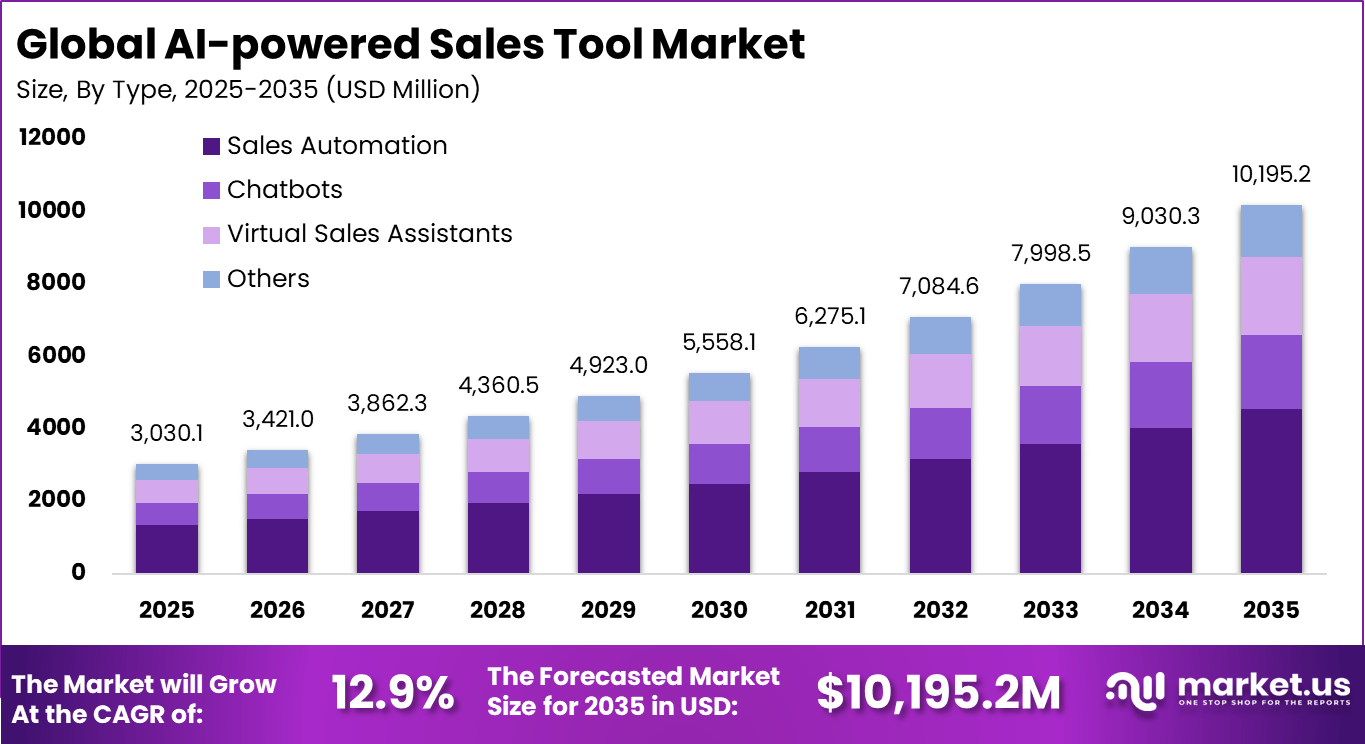
The Global AI-powered Sales Tool Market is positioned for sustained expansion, projected to grow from USD 3,030.1 million in 2025 to approximately USD 10,195.2 million by 2035, registering a CAGR of 12.9% during the forecast period. North America led the market, capturing more than 43.1% share and generating USD 1,305.9 million in revenue, reflecting strong enterprise adoption of AI-driven revenue intelligence, sales automation, and predictive analytics platforms.
The AI-powered sales tool market comprises software solutions that use artificial intelligence to enhance sales processes such as lead generation, customer engagement, pipeline management, forecasting, and performance analytics. These tools apply machine learning, natural language processing, and predictive analytics to interpret customer behaviour, prioritise opportunities, personalise outreach, and automate repetitive tasks. As selling environments become more complex with digital channels and dispersed teams, organisations adopt AI-driven sales tools to improve efficiency, alignment, and revenue outcomes.
Key driver factors shaping this market include rising demand for data driven decision making, increased pressure on sales teams to deliver predictable revenue, and rapid growth of digital and remote selling models. AI-powered sales tools help organisations accelerate deal cycles, reduce manual work, and provide insights that improve conversion rates and pipeline quality.
Key Insights Summary
- In 2025, Sales Automation led the market with a 44.7% share, supported by growing reliance on automated lead scoring, pipeline tracking, and predictive forecasting.
- Cloud-based deployment dominated with 96.3% share, reflecting enterprise preference for scalable, subscription-based, and easily integrated AI sales platforms.
- Large Enterprises accounted for 68.9% of total demand, driven by higher sales complexity, large customer databases, and structured digital transformation budgets.
- CRM-focused applications captured 51.3% of the market, underlining the importance of AI in enhancing customer intelligence, personalization, and retention strategies.
- The U.S. market reached USD 1,170.1 million in 2025 and is expanding at a CAGR of 9.3%, supported by steady AI integration across sales and marketing functions.
- North America led globally with more than 43.1% share, reflecting strong enterprise digitization and early adoption of AI-enabled sales technologies.
- Around 81% of sales teams have tested or fully deployed AI tools, signaling rapid mainstream adoption.
- Sales and marketing attract over 50% of corporate AI investments, positioning them as the most funded AI application areas.
- More than 56% of sales professionals use AI daily, and these users are twice as likely to exceed performance targets.
- Early AI adopters have reported win rate improvements exceeding 30%, strengthening competitive positioning.
- Sales teams leveraging AI are 1.3× more likely to achieve revenue growth compared with non-users.
- AI-driven lead prioritization has enabled up to 50% higher revenue growth among adopting organizations.
- Sales cycle duration has declined by up to 25%, with similar improvements observed in deal closure timelines.
- Sales representatives save an average of 2 hours and 15 minutes per day through automation of routine administrative tasks.
- AI can automate 30% to 40% of daily administrative activities, including CRM data entry and meeting documentation.
- With sales teams typically spending only 25% to 30% of their time on active selling, AI presents potential to significantly increase productive engagement time.
- Predictive lead scoring improves conversion rates by up to 28%, enhancing pipeline efficiency.
- AI-based forecasting models achieve 90% to 98% accuracy by the second week of a quarter, improving planning precision.
- Real-time AI call coaching improves win rates by approximately 19%, strengthening sales effectiveness.
- Nearly 70% of employees report lack of formal AI training, creating capability gaps within organizations.
- About 81% of companies experience data quality challenges that limit AI performance and return on investment.
- Approximately 43% of marketers remain uncertain about maximizing the value of existing AI tools, highlighting the need for strategic alignment and governance.
Drivers Impact Analysis
| Key Driver | Impact on CAGR Forecast (~) % | Geographic Relevance | Impact Timeline |
|---|---|---|---|
| Growing adoption of AI-driven sales automation and analytics | +3.8% | North America, Europe | Short to medium term |
| Rising need for data-driven customer engagement and personalization | +3.1% | Global | Medium term |
| Expansion of CRM platforms with embedded AI capabilities | +2.6% | North America, Europe | Medium term |
| Increasing pressure to improve sales productivity and conversion rates | +2.1% | Global | Short term |
| Adoption of remote and digital-first sales models | +1.3% | Global | Medium to long term |
Restraint Impact Analysis
| Key Restraint | Impact on CAGR Forecast (~) % | Geographic Relevance | Impact Timeline |
|---|---|---|---|
| High implementation and integration costs for advanced AI tools | -2.4% | Emerging Markets | Short to medium term |
| Limited AI expertise within small and mid-sized sales teams | -2.0% | Asia Pacific, Latin America | Medium term |
| Data quality and integration challenges across sales systems | -1.7% | Global | Medium term |
| User resistance to AI-driven sales decision support | -1.4% | Global | Short term |
| Data privacy and compliance concerns | -1.1% | Europe, North America | Medium to long term |
Emerging Trends Analysis
An emerging trend in the AI-powered sales tool market is use of conversational intelligence for performance feedback and coaching. These tools analyse sales calls and virtual meetings to identify sentiment, objection patterns, and opportunity signals. Insights help individual sellers refine skills and improve messaging. This trend moves AI beyond automation into performance development.
Another trend is the rise of prescriptive sales analytics. Instead of merely identifying patterns, platforms increasingly recommend specific actions, next steps, or communication strategies. Prescriptive insights help reduce decision fatigue and support consistent execution across teams.
Growth Factors Analysis
One of the key growth factors for the AI-powered sales tool market is increasing competition across industries. Organisations seek tools that improve conversion rates, pipeline accuracy, and forecast reliability. AI-driven insights support more effective sales execution under competitive pressure. Another growth factor is ongoing investment in artificial intelligence capabilities. Improvements in machine learning algorithms, natural language processing, and data orchestration enhance tool performance and user experience. As AI becomes more embedded in enterprise software, adoption of AI-powered sales tools expands across organisation sizes and sectors.
Opportunity Analysis
A significant opportunity in the AI-powered sales tool market lies in expanding capabilities for tailored buyer experiences. AI tools can personalise outreach content, timing, and channel selection based on individual preferences and historical behaviour. This level of personalisation increases engagement rates and supports higher conversion performance. Solutions that simplify and scale personalisation offer a competitive edge.
Another opportunity is integration with broader revenue and customer success platforms. Connecting AI sales tools with marketing automation, customer service systems, and billing platforms enables a unified customer view. This alignment improves cross functional collaboration, reduces data silos, and supports consistent customer journeys from prospecting through retention.
Challenge Analysis
A major challenge for the AI-powered sales tool market is maintaining accuracy and relevance as buyer behaviour evolves. AI models trained on historical data may underperform when patterns shift due to economic conditions, market changes, or product updates. Continuous model retraining and monitoring are necessary to ensure outputs remain reliable. Organisations must invest in model governance and quality assurance.
Another challenge is balancing automation with human judgement. While AI recommendations can accelerate tasks and prioritisation, sales professionals still require discretion in relationship driven decisions. Designing systems that support human leadership rather than replace it improves acceptance and effectiveness.
Key Market Segments
By Type
- Chatbots
- Virtual Sales Assistants
- Sales Automation
- Others
By Deployment Mode
- On-Premises
- Cloud-based
By Organization Size
- Small & Medium Enterprises (SMEs)
- Large Enterprises
By Application
- Customer Relationship Management
- Lead Generation
- Sales Forecasting
- Others
Top Key Players in the Market
- HubSpot
- Freshworks
- Adobe
- Gong.io
- Microsoft
- Chorus.ai
- Zoho
- Pipedrive
- Oracle
- Clari
- SAP
- InsideSales.com
- ActiveCampaign
- NICE
- Outreach
- Salesforce
- Others
Report Scope
| Report Features | Description |
|---|---|
| Market Value (2025) | USD 3,030.1 Million |
| Forecast Revenue (2035) | USD 10,195.2 Million |
| CAGR(2025-2035) | 12.9% |
| Base Year for Estimation | 2024 |
| Historic Period | 2020-2024 |
| Forecast Period | 2025-2035 |
| Report Coverage | Revenue forecast, AI impact on Market trends, Share Insights, Company ranking, competitive landscape, Recent Developments, Market Dynamics and Emerging Trends |
Discuss your needs with our analyst
Please share your requirements with more details so our analyst can check if they can solve your problem(s)