Table of Contents
Introduction
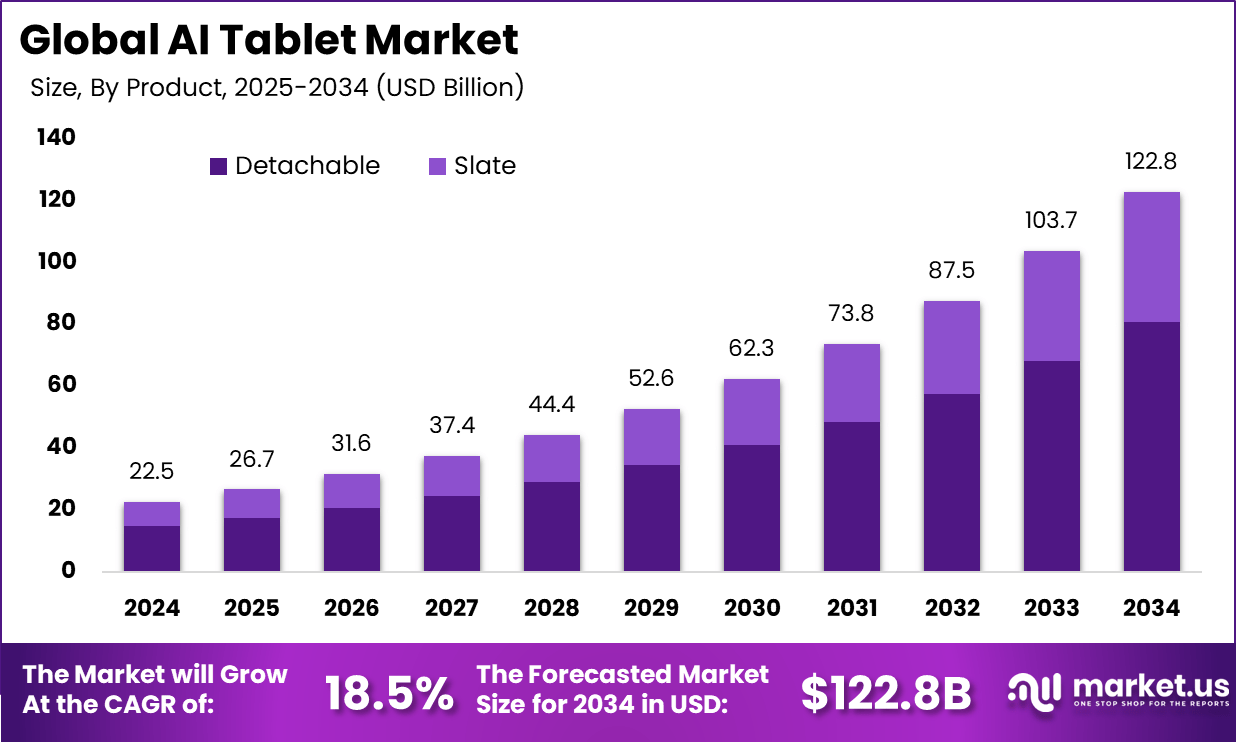
The Global AI Tablet Market is projected to reach USD 122.8 billion by 2034, rising significantly from USD 22.5 billion in 2024 at an impressive CAGR of 18.5%. Growth is fueled by rapid adoption of AI-driven productivity tools, edge-based processing, adaptive learning capabilities, and enhanced user experiences. In 2024, North America dominated the market with a 37.9% share and USD 8.52 billion revenue. Increasing demand for intelligent devices for education, business, entertainment, and healthcare continues accelerating AI tablet adoption worldwide, supported by advancements in processors, display technologies, and integrated AI ecosystems.
How Growth is Impacting the Economy
The AI tablet market’s strong expansion is contributing to global economic advancement by strengthening the digital ecosystem, increasing consumer spending on smart devices, and stimulating innovation in semiconductor and software development. As AI tablets become essential for professional workflows, education, and creative industries, they drive productivity gains and support digital transformation across economies.
This rapid adoption encourages investment in advanced manufacturing, AI chip production, and cloud services, creating new high-skilled employment opportunities and enhancing national competitiveness. The ripple effect extends to logistics, retail, and telecommunications sectors as demand for AI-enabled connectivity and cloud integration grows. Economies benefit from rising exports of advanced electronics, expansion of digital learning infrastructure, and improved access to intelligent mobility solutions, fostering long-term economic resilience.
➤ Smarter strategy starts here! Get the sample – https://market.us/report/ai-tablet-market/free-sample/
Impact on Global Businesses
Businesses face increased operational costs due to integration of advanced AI processors, premium components, and sophisticated software systems. Supply chains are shifting toward sourcing high-performance AI chips, neural processing units, and specialized sensors, requiring deeper collaboration with technology suppliers. Education, healthcare, retail, and manufacturing sectors benefit significantly from AI tablets as they enhance productivity, remote collaboration, diagnostics, and interactive learning. Companies adopting AI tablets gain competitive advantages through improved analytics, automation, and mobility. Digital-first organizations leverage these devices for workforce enablement, while creative industries utilize AI-enhanced tools for design, editing, and media production.
Strategies for Businesses
Businesses should invest in AI-driven device management, optimize workflows around intelligent applications, and choose tablets with scalable AI capabilities. Strengthening partnerships with AI software providers, enhancing cybersecurity frameworks, and adopting cloud-based collaboration tools will maximize value. Offering training to employees ensures stronger adoption and performance improvements.
Key Takeaways
- Market expected to reach USD 122.8 billion by 2034
- CAGR of 18.5% demonstrates strong long-term demand
- North America leads with 37.9% share
- AI-driven productivity, education, and mobility fuel adoption
- Supply chains evolving toward advanced AI components
➤ Unlock growth secrets! Buy the full report – https://market.us/purchase-report/?report_id=163675
Analyst Viewpoint
The AI tablet market is gaining strong traction as organizations and consumers increasingly seek intelligent, portable devices capable of delivering high performance and contextual decision-making. In the present landscape, powerful neural engines and optimized operating systems enhance efficiency. In the future, AI tablets will evolve with improved multimodal capabilities, generative AI integration, real-time translation, and advanced on-device learning. These innovations will expand adoption across industries, particularly in education, remote work, and healthcare diagnostics. The market outlook remains highly positive as manufacturers invest in lighter designs, better battery life, and deeper ecosystem integration.
Use Case and Growth Factors
| Use Case | Description | Growth Factors |
|---|---|---|
| Smart Education | Personalized learning with AI adaptive tools | Rising digital classrooms and remote learning adoption |
| Business Productivity | AI-enhanced workflows, note-taking, and automation | Demand for mobile workforce and workflow optimization |
| Creative Work | AI-supported editing, design, and illustration | Growth in content creation and multimedia industries |
| Healthcare Support | AI-driven diagnostics and patient monitoring | Increasing telehealth and digital health adoption |
Regional Analysis
North America leads the market with a 37.9% share due to high consumer spending, strong digital infrastructure, and rapid enterprise adoption of AI-driven devices. Europe follows with growing investments in digital education, enterprise mobility, and smart healthcare solutions. Asia-Pacific is expected to experience the fastest growth, driven by large population bases, expanding tech-savvy consumers, and government-led digital transformation initiatives. Latin America and the Middle East show increasing demand for AI tablets as connectivity improves and businesses adopt mobile-first strategies to enhance productivity and service delivery.
➤ Want more market wisdom? Browse reports –
- AI Legal Drafting Tools Market
- 3A Video Games Market
- Crime Analytics Market
- Smart Microloan Platforms Market
Business Opportunities
Manufacturers can capitalize on the rising demand for AI-enhanced education tools, enterprise productivity features, and creative software ecosystems. Growth opportunities lie in developing energy-efficient AI chips, integrating generative AI capabilities, and offering industry-specific tablet solutions. Emerging markets present strong potential for affordable AI tablets with multilingual support. Partnerships with educational institutions, healthcare providers, and enterprise software companies can expand adoption. Additionally, innovations in cloud gaming, augmented reality, and mobility tools create new revenue streams for AI tablet vendors globally.
Key Segmentation
Segmentation includes operating system, screen size, processor type, AI capability, and end-user categories. Operating systems range from Android and iOS to custom AI-optimized platforms. Screen sizes vary from compact tablets for mobility to larger displays for creative professionals. Processor categories include standard CPUs, AI-accelerated NPUs, and hybrid architectures. AI capabilities include adaptive learning, voice recognition, image enhancement, and automated task execution. End users include students, enterprises, healthcare professionals, creatives, and general consumers seeking smart entertainment and productivity tools.
Key Player Analysis
Key players focus on integrating advanced AI chips, expanding device ecosystems, and enhancing on-device learning capabilities. Investments prioritize neural processing performance, battery optimization, and improved display quality. Companies deploy strategies centered around seamless cloud integration, cross-device synchronization, and enhanced cybersecurity. They differentiate through stylus support, ergonomic design, and specialized AI features for education, business, and creative applications. Strong emphasis is placed on R&D, software optimization, and partnerships across hardware, software, and service providers to strengthen market positioning.
- Acer Inc.
- Apple Inc.
- ASUSTek Computer Inc.
- Dell Technologies Inc.
- Hewlett-Packard Company
- Huawei Technologies Co., Ltd. (Huawei Investment & Holding Co., Ltd.)
- Lenovo Group Limited
- Microsoft Corporation
- Nokia Corporation
- Panasonic Holdings Corporation
- Samsung Electronics Co. Ltd.
- Xiaomi Corporation
- Other Major Players
Recent Developments
- Launch of tablets featuring next-generation neural processing units
- Introduction of AI-enhanced operating systems for improved productivity
- Expansion of AI tablet lines targeting education and enterprise markets
- Development of real-time translation and generative AI tools for tablets
- Partnerships with cloud providers for integrated AI services
Conclusion
AI tablets are transforming global digital experiences through intelligent features, enhanced mobility, and advanced performance. With strong market growth, rising enterprise adoption, and ongoing technological innovation, AI tablets will continue shaping the future of education, business productivity, and smart personal computing.
Discuss your needs with our analyst
Please share your requirements with more details so our analyst can check if they can solve your problem(s)