Table of Contents
DataOps Market Overview
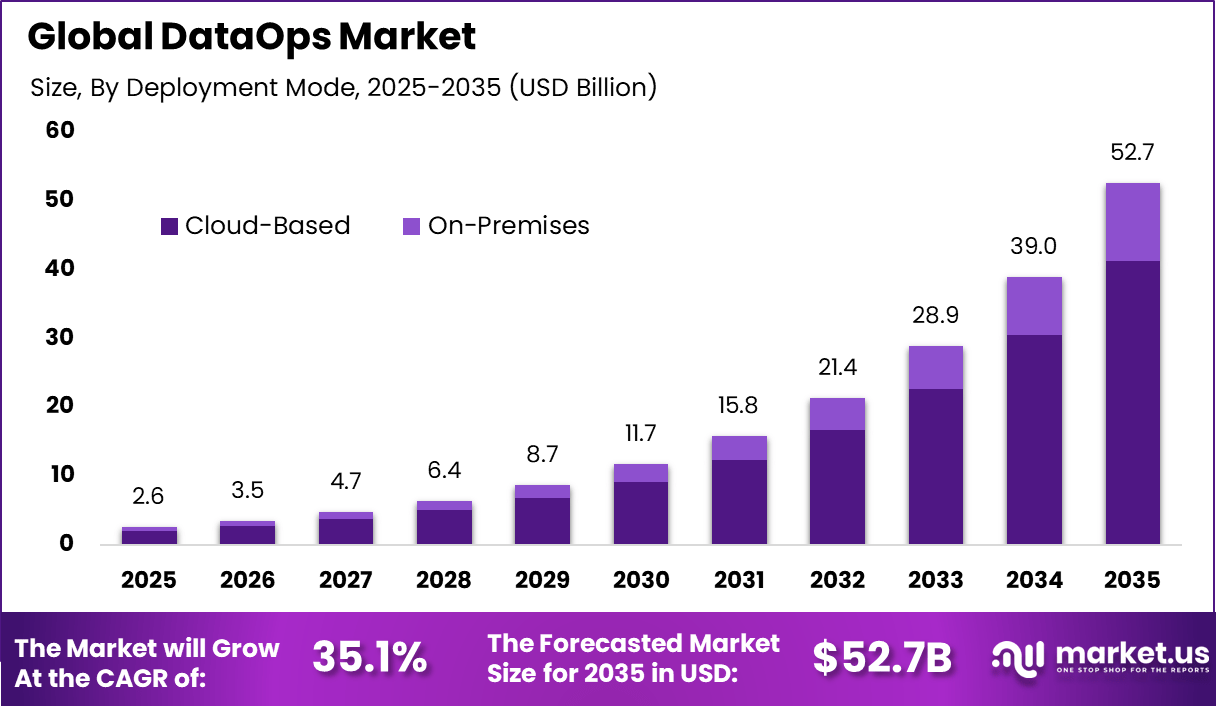
The Global DataOps Market is projected to reach approximately USD 52.7 billion by 2035, supported by increasing adoption of cloud-based data environments, real-time data processing, and enterprise-wide analytics initiatives. The market is expected to grow at a CAGR of 35.1%, reflecting sustained demand from organizations seeking improved data reliability, operational efficiency, and faster decision cycles. North America held a dominant market position, capturing more than 42.1% of global share and generating USD 1.0 billion in revenue, driven by early technology adoption and strong enterprise spending on data infrastructure solutions.
The DataOps market focuses on practices, platforms, and tools that streamline the development, deployment, and management of data pipelines across organizations. DataOps applies agile and DevOps principles to data engineering, analytics, and governance workflows, enabling faster and more reliable delivery of data for business use. As organizations increasingly rely on real time analytics and data driven decision making, traditional batch based and siloed data management approaches are proving insufficient.
Key driver factors shaping this market include rising data volume and complexity, growing demand for real time insights, and the need to improve data quality, reliability, and collaboration between data teams. DataOps is increasingly viewed as a foundational capability that supports analytics, artificial intelligence, and digital transformation initiatives.
Top Market Takeaways
- DataOps platforms and automation tools accounted for 42.8% of adoption, supported by the need for standardized data workflows and lower manual effort in data operations.
- Cloud based deployment dominated with a 78.4% share, driven by scalability, faster rollout, and improved collaboration across distributed data teams.
- Large enterprises represented 71.6% of total adoption, reflecting higher data complexity, stronger governance requirements, and greater spending capacity.
- Data pipeline automation and monitoring led application usage at 58.3%, as organizations focused on improving data reliability and delivery speed.
- IT and telecommunications held a 38.7% share, supported by high data volumes, real time analytics needs, and continuous service monitoring.
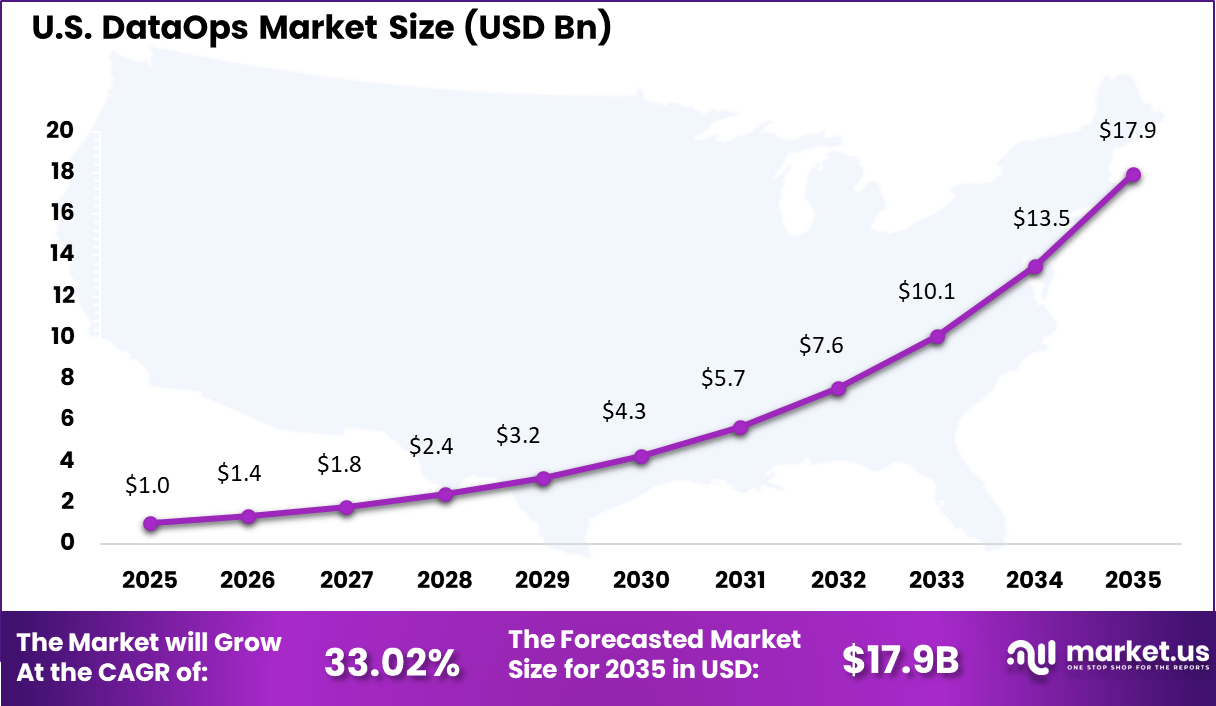
- North America accounted for 42.1% of the market, with the US valued at USD 1.02 billion and recording a CAGR of 33.02%, supported by strong cloud adoption and mature data engineering practices.
Key Insights
- Around 70% of companies have active plans to hire dedicated DataOps professionals, indicating strong workforce demand.
- Global data volume is expected to reach 180 zettabytes by 2025, increasing pressure to manage large and complex data environments efficiently.
- Organizations adopting DataOps have reduced late delivery of analytics outputs by 49%, improving operational reliability.
- Automated DataOps practices can deliver up to 87% savings in development costs by reducing manual design and rework.
- Data engineers spend nearly 18% of their time on troubleshooting, which DataOps automation aims to redirect toward higher value tasks.
- Continuous testing and monitoring under DataOps have reduced production errors from about 10 per week to almost zero in some organizations.
- Between 60% and 85% of big data projects fail due to siloed teams and weak collaboration, highlighting the need for integrated DataOps models.
- Nearly 88% of collected data remains unused, pointing to major efficiency gaps that DataOps solutions aim to address.
- As 75% of databases move to cloud platforms, about 70% of organizations report cloud security breaches, accelerating the adoption of DataSecOps practices.
Driver Analysis
A primary driver of the DataOps market is the rapid growth in data sources and data velocity. Organizations collect data from applications, sensors, digital platforms, and external partners, often in real time. Managing this data through manual or fragmented processes increases error rates and delays insight delivery. DataOps frameworks automate pipeline testing, monitoring, and deployment, enabling faster and more consistent data availability.
Another important driver is business demand for timely and trustworthy analytics. Decision makers expect dashboards and reports to reflect current conditions, not outdated snapshots. DataOps improves pipeline reliability and reduces data downtime, ensuring analytics teams can deliver insights with confidence. This focus on operationalizing analytics drives adoption across industries.
Restraint Analysis
A key restraint in the DataOps market is organizational and cultural resistance. DataOps requires close collaboration between data engineers, analysts, operations teams, and business stakeholders. In organizations with siloed structures, aligning responsibilities and workflows can be challenging. Resistance to process change may slow implementation and limit benefits.
Another restraint relates to the complexity of integrating DataOps practices with existing data architectures. Legacy data warehouses, custom scripts, and fragmented tooling can complicate automation and standardization efforts. Organizations may need phased adoption strategies, which can delay full value realization.
Opportunity Analysis
A significant opportunity in the DataOps market lies in supporting artificial intelligence and machine learning initiatives. These initiatives depend on high quality, continuously updated data pipelines. DataOps provides the operational discipline required to deliver reliable training and inference data at scale. As AI adoption increases, demand for DataOps capabilities grows in parallel.
Another opportunity is the expansion of cloud based data platforms. Cloud environments enable scalable data processing and integration, aligning well with automated DataOps workflows. Organizations migrating to cloud data stacks often adopt DataOps practices to maximize agility and control. This alignment creates strong momentum for market growth.
Challenge Analysis
A major challenge for the DataOps market is ensuring consistent data governance and compliance alongside speed. Automated pipelines must still enforce data quality rules, access controls, and regulatory requirements. Balancing rapid data delivery with strong governance requires careful design. Failure to manage this balance can expose organizations to compliance risks.
Another challenge is measuring return on investment from DataOps initiatives. Benefits such as reduced downtime, improved trust, and faster analytics delivery can be difficult to quantify. Without clear metrics, executive support may weaken. Demonstrating operational and business impact remains essential.
Emerging Trends Analysis
An emerging trend in the DataOps market is increased use of observability for data pipelines. Monitoring tools now track data freshness, volume anomalies, and schema changes in near real time. This proactive visibility allows teams to detect and resolve issues before they impact users. Data observability is becoming a core DataOps capability.
Another trend is closer integration between DataOps and DevOps practices. Organizations are aligning data pipeline deployment with application release cycles. Shared tooling and automation improve coordination and reduce friction between software and data teams. This convergence strengthens overall operational efficiency.
Growth Factors Analysis
One of the key growth factors for the DataOps market is the expanding role of data in strategic decision making. Organizations increasingly treat data as a critical asset that must be delivered reliably and quickly. DataOps supports this shift by operationalizing data delivery. Demand grows as data becomes central to business performance.
Another growth factor is the increasing complexity of modern data ecosystems. Multi cloud environments, diverse data sources, and advanced analytics require disciplined operational frameworks. DataOps addresses this complexity by standardizing processes and improving resilience. This structural need supports long term market expansion.
By Region
North America accounts for 42.1%, reflecting strong adoption of DataOps practices across enterprises. Organizations in the region focus on improving data reliability and speed. Cloud infrastructure maturity supports large-scale DataOps deployment. Enterprises prioritize automation to manage complex data environments. The region remains a key contributor to market development.
| Region | Primary Growth Driver | Regional Share (%) | Regional Value (USD Bn) | Adoption Maturity |
|---|---|---|---|---|
| North America | Advanced cloud and analytics ecosystems | 42.1% | USD 1.02 Bn | Advanced |
| Europe | Regulatory driven data governance initiatives | 27.8% | USD 0.74 Bn | Advanced |
| Asia Pacific | Rapid enterprise digitalization | 20.4% | USD 0.54 Bn | Developing |
| Latin America | Growing cloud adoption | 5.6% | USD 0.15 Bn | Developing |
| Middle East and Africa | Early stage analytics modernization | 4.1% | USD 0.11 Bn | Early |

The US market reached USD 1.02 Billion with a CAGR of 33.02%, indicating rapid growth momentum. Expansion is driven by rising demand for real-time analytics. Enterprises invest in automated data pipelines and monitoring tools. Data-driven decision-making continues to gain importance. Market growth remains strong and sustained.
Key Market Segments
By Component
- DataOps Platforms and Automation Tools
- Data Quality and Observability Tools
- Data Pipeline Orchestration Tools
- Testing and Versioning Tools
- Professional and Managed Services
By Deployment Mode
- Cloud-Based
- On-Premises
By Organization Size
- Large Enterprises
- Small and Medium-sized Enterprises
By Application
- Data Pipeline Automation and Monitoring
- Data Quality Management and Governance
- Collaboration and Self-Service Data Access
- DevOps Integration for Data Systems
By End-User Industry
- IT and Telecommunications
- Banking, Financial Services, and Insurance
- Retail and E-commerce
- Healthcare and Life Sciences
- Manufacturing
- Others
Report Scope
| Report Features | Description |
|---|---|
| Market Value (2025) | USD 2.6 Bn |
| Forecast Revenue (2035) | USD 52.7 Bn |
| CAGR(2026-2035) | 35.1% |
| Base Year for Estimation | 2025 |
| Historic Period | 2020-2024 |
| Forecast Period | 2026-2035 |
| Report Coverage | Revenue forecast, AI impact on Market trends, Share Insights, Company ranking, competitive landscape, Recent Developments, Market Dynamics and Emerging Trends |
Discuss your needs with our analyst
Please share your requirements with more details so our analyst can check if they can solve your problem(s)