Table of Contents
- Fintech Paas Platforms Market Size
- Key Takeaway
- Market Overview
- Top Driving Factors
- Demand Analysis
- Increasing Adoption of Technologies
- Key Reasons for Adoption
- Investment Opportunities
- Business Benefits
- Regulatory Environment
- Key Market Segments
- Emerging Trend Analysis
- Driver Analysis
- Restraint Analysis
- Opportunity Analysis
- Challenge Analysis
- Report Scope
Fintech Paas Platforms Market Size
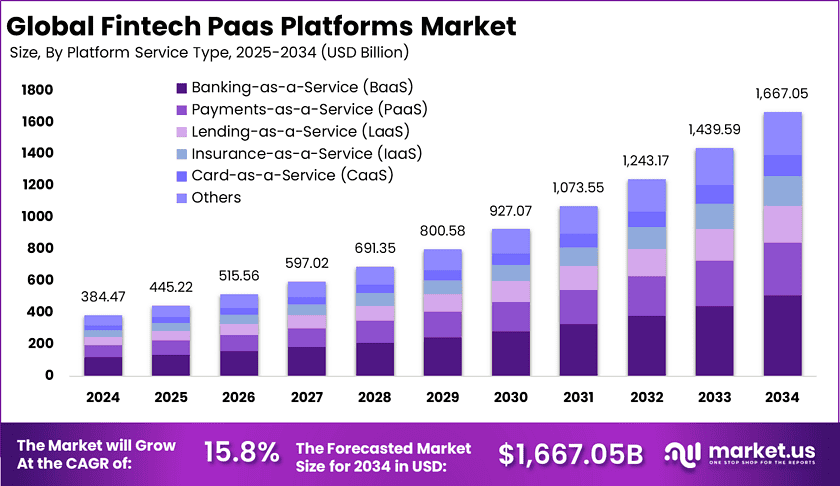
The global fintech PaaS platforms market was valued at USD 384.47 billion in 2024 and is projected to reach approximately USD 1,667.05 billion by 2034, expanding at a CAGR of 15.8% during the forecast period from 2025 to 2034. In 2024, North America led the market with more than 40.3% share, generating around USD 154.94 billion in revenue, supported by strong adoption of cloud based financial services and digital banking platforms.
Key Takeaway
- Banking-as-a-Service led with 30.6%, reflecting growing adoption of modular banking platforms that allow non-bank players to launch digital financial products quickly.
- Payment and fund transfer solutions accounted for 32.5%, supported by rising demand for real-time, API-enabled payment capabilities across digital ecosystems.
- Non-financial businesses operating B2B2C models captured 51.4%, highlighting the expansion of embedded finance across retail, e-commerce, and technology platforms.
- The U.S. market was valued at USD 141.31 billion in 2024 and is growing at a 13.4% CAGR, driven by fintech innovation, supportive regulation, and expanding digital banking partnerships.
- North America held a leading 40.3% global share, supported by mature financial infrastructure, high digital adoption, and a strong fintech service provider ecosystem.
Market Overview
The fintech PaaS platforms market refers to the provision of platform as a service solutions that enable financial technology offerings to be developed, deployed, and managed with reduced infrastructure burden. These platforms provide modular services such as payment processing, compliance modules, risk engines, and API driven connectivity for financial service providers. Adoption is driven by the need for scalable, cost efficient technology stacks that can support rapid innovation and customer experience enhancement. Providers in this market serve banks, neobanks, lenders, insurers, and digital wallet operators.
Fintech PaaS platforms support digital transformation efforts by abstracting complex backend processes into reusable services. This facilitates acceleration of product launches and improved integration between legacy and modern systems. The market is shaped by regulatory changes, evolving customer expectations for seamless digital experiences, and competitive pressures. Continued growth is expected as financial institutions increasingly pursue agile development and cloud based infrastructure strategies.
Top Driving Factors
One principal driver of the fintech PaaS platforms market is the increased demand for digital financial services across consumer and business segments. Consumers expect real time, seamless access to banking and payment services through mobile and web applications. Financial institutions are responding by leveraging PaaS solutions to accelerate service delivery and reduce time to market. These solutions allow institutions to innovate without extensive investment in underlying infrastructure.
Another significant driver is the rise of open banking initiatives and API led ecosystems. Regulatory frameworks in many regions require banking data portability and interoperability with third party services. Fintech PaaS platforms offer APIs that support secure data exchange and developer friendly integration. This encourages ecosystem growth and stimulates demand for modular fintech services.
Demand Analysis
Demand for fintech PaaS platforms is strong among traditional banks seeking to modernize legacy systems. Banks face pressures to digitize services and remain competitive with agile fintech startups. PaaS solutions offer a pathway to introduce new products such as digital wallets, instant loans, and real time payments without full system overhauls. The ability to innovate quickly and cost effectively is a compelling value proposition.
Startup fintech companies also drive demand as they require scalable technology infrastructure without heavy upfront capital expenditure. Startups leverage PaaS platforms to build customer centric solutions while accessing compliance and risk management modules. This enables focus on differentiation and customer experience. Investor interest in fintech innovation further reinforces demand for underlying platform services.
Increasing Adoption of Technologies
Cloud native technologies are increasingly adopted within fintech PaaS platforms to support scalability and resilience. Cloud computing enables elastic resource allocation and high availability for critical financial services. Organizations can deploy solutions across regions with minimal operational overhead. This approach also supports disaster recovery and continuous delivery practices.
Artificial intelligence and machine learning are integrated into many platform services to enhance analytics, fraud detection, and personalized experiences. AI driven modules provide insights into customer behavior and risk profiles. These capabilities improve decision making and operational performance. Adoption of secure API frameworks supports open banking and third party ecosystem integration.
Key Reasons for Adoption
A key reason for the adoption of fintech PaaS platforms is the reduction of technology complexity for financial institutions. PaaS abstracts infrastructure and common service requirements, allowing teams to focus on core business logic and user experience. This reduces development cycles and accelerates product iteration. Organizations benefit from reusable components and standardized service offerings.
Another reason for adoption is improved cost predictability and efficiency. Traditional on premise infrastructure requires significant capital investment and maintenance effort. PaaS platforms operate on subscription or usage based pricing models that align costs with actual consumption. This financial flexibility supports budget planning and resource optimization.
Investment Opportunities
Investment opportunities in the fintech PaaS platforms market exist in specialized vertical solutions. Platforms designed to serve niche needs such as embedded finance, insuretech, and regtech can attract targeted segments. Investors may find potential in PaaS providers that offer differentiated analytics, compliance automation, or sector specific modules. Focused solutions can command premium pricing and loyalty.
Emerging market expansion also presents investment potential. Many regions are undergoing rapid digital financial services adoption but lack mature technology infrastructure. PaaS platforms tailored to local regulatory environments and language support can gain significant traction. Strategic investments in partnerships with regional financial institutions may accelerate market penetration.
Business Benefits
Organizations adopting fintech PaaS platforms benefit from accelerated innovation cycles and reduced operational risk. By utilizing pre built services and APIs, businesses can launch new financial products with greater speed and reduced complexity. This supports competitiveness in fast evolving markets. Enhanced integration capabilities also improve customer experiences across channels.
Cost efficiencies represent another business benefit. The shift from capital intensive infrastructure to operational expenditure models reduces financial barriers for growth. PaaS platforms also support predictable budgeting and scalable resource allocation. Long term savings arise from reduced maintenance demands and improved technology utilization.
Regulatory Environment
The regulatory environment affecting fintech PaaS platforms is shaped by data protection and financial services compliance standards. Providers must ensure secure handling of sensitive customer information and adherence to privacy laws across jurisdictions. Compliance with anti money laundering and know your customer regulations is often embedded within platform services. Regulatory alignment increases trust and facilitates institutional adoption.
Regulations promoting open banking and financial inclusion influence platform design and interoperability. Standards require secure APIs and transparent data usage practices. PaaS providers need to adapt to evolving compliance requirements to support clients operating in regulated markets. Continuous monitoring of legal frameworks is essential to maintain certification and market access.
Key Market Segments
By Service Type
- Banking-as-a-Service (BaaS)
- Payments-as-a-Service (PaaS)
- Lending-as-a-Service (LaaS)
- Insurance-as-a-Service (IaaS)
- Card-as-a-Service (CaaS)
- Others
By Application
- Banking
- Insurance
- Investment & Wealth Management
- Lending & Financing
- Payment & Fund Transfer
- Regulatory & Compliance
- Others
By End-User
- Financial Institutions (B2B)
- FinTechs & Neobanks (B2B2C)
- Non-Financial Businesses (B2B2C)
- E-commerce & Retail
- Gig Economy & On-Demand Platforms
- Telecoms
- Travel & Hospitality
- Real Estate
- Healthcare
- Others
Top Key Players in the Market
- Rapyd
- Solid
- Unit
- Cross River Bank
- Stripe
- Mastercard
- Fiserv
- Block Inc.
- Envestnet
- Rapyd
- Upstart
- Fiserv
- Adyen
- Paypal
- Worldline
- Square
- Intuit
- Others
Emerging Trend Analysis
The Fintech Platform-as-a-Service (PaaS) Market is being shaped by the increasing adoption of modular, API-driven financial services that enable rapid integration of banking, payments, lending, and compliance capabilities into third-party applications. These platforms allow fintech startups and enterprises to embed financial functionality without building core infrastructure from scratch. As a result, speed of deployment and innovation cycles are accelerating, supporting more agile product launches. The trend reflects a shift toward composable fintech systems that are tailored to evolving business needs.
Another emerging trend is the growth of cloud-native fintech ecosystems that leverage scalable infrastructure for global reach and operational resilience. Cloud-based PaaS platforms are enabling firms to manage fluctuating demand, handle large transaction volumes, and maintain high-availability services with minimal on-premises hardware. This capability supports expansion into new markets while lowering total cost of ownership. The rise of digital wallets, embedded finance solutions, and real-time payment models reinforces the emphasis on cloud-centric platform frameworks.
Driver Analysis
The market is being driven by rising demand for digital financial services from both consumers and businesses seeking seamless, real-time experiences. Fintech PaaS platforms empower firms to offer features such as instant payments, mobile banking interfaces, and automated compliance workflows, which align with modern user expectations. As traditional financial institutions face competitive pressure from digitally native challengers, investment in PaaS solutions increases to retain customers and innovate service offerings. This demand for enhanced customer experience is a core growth driver.
Another driver is the regulatory focus on open banking and financial data interoperability in many regions. Policies that promote secure data sharing and competition create opportunities for fintech PaaS platforms to serve as compliant hubs for integrated services. By providing standardized APIs and secure data access, these platforms support compliance and expand partner ecosystems. Regulatory encouragement of innovation fuels platform adoption by reducing barriers to entry for new market participants.
Restraint Analysis
One restraint affecting market growth is the challenge of ensuring robust security and risk management as platforms handle sensitive financial data. Fintech PaaS providers must implement advanced encryption, access controls, and fraud detection mechanisms to protect against breaches that could undermine trust. Security requirements increase operational complexity and necessitate ongoing investment in threat intelligence and compliance monitoring. Concerns about data privacy and cyber risk can deter adoption among risk-averse organizations.
Another restraint stems from the fragmentation of regulatory frameworks across different jurisdictions. Financial regulations vary widely among countries and regions, requiring tailored compliance strategies that can complicate cross-border service delivery. Fintech PaaS platforms must adapt solutions to meet diverse local requirements, which can increase development and operational costs. This regulatory complexity slows global expansion efforts and adds uncertainty for platform providers and their clients.
Opportunity Analysis
There is significant opportunity in expanding embedded finance offerings that integrate financial services directly within non-financial applications, such as retail, travel, and healthcare platforms. Fintech PaaS platforms can enable businesses to offer payments, credit, insurance, and savings features within their customer journeys, creating new revenue streams. This embedded finance potential extends the relevance of PaaS beyond traditional financial institutions. As demand for seamless user experiences grows, embedded financial services are expected to become a major value driver.
Another opportunity exists in leveraging artificial intelligence and analytics to enhance personalization and risk assessment within fintech PaaS ecosystems. Predictive models can improve credit scoring, fraud detection, and recommendation engines, enabling platforms to deliver smarter, context-aware services. These advanced capabilities allow clients to tailor offerings to individual user profiles, increasing engagement and conversion rates. AI-driven innovation is positioned to deepen platform differentiation and expand market reach.
Challenge Analysis
A key challenge for the market is balancing innovation speed with regulatory compliance and risk governance. Fintech PaaS providers must iterate rapidly to remain competitive, yet they must also ensure that new features adhere to evolving financial and data protection regulations. Maintaining this balance requires investments in compliance frameworks and automated controls that can slow feature deployment. Difficulty reconciling pace and prudence poses a strategic challenge.
Another challenge is ensuring seamless interoperability between disparate financial systems, legacy infrastructure, and emerging technologies. Many financial institutions still operate on legacy cores that do not readily integrate with modern API-centric platforms. Bridging this technology gap requires sophisticated middleware, transformation layers, and extensive testing to avoid disruptions. Interoperability challenges increase implementation timelines and technical complexity.
Report Scope
| Report Features | Description |
|---|---|
| Market Value (2024) | USD 384.4 Bn |
| Forecast Revenue (2034) | USD 1,667.0 Bn |
| CAGR(2025-2034) | 15.8% |
| Base Year for Estimation | 2024 |
| Historic Period | 2020-2023 |
| Forecast Period | 2025-2034 |
Discuss your needs with our analyst
Please share your requirements with more details so our analyst can check if they can solve your problem(s)