Table of Contents
Strategic Investment Perspective
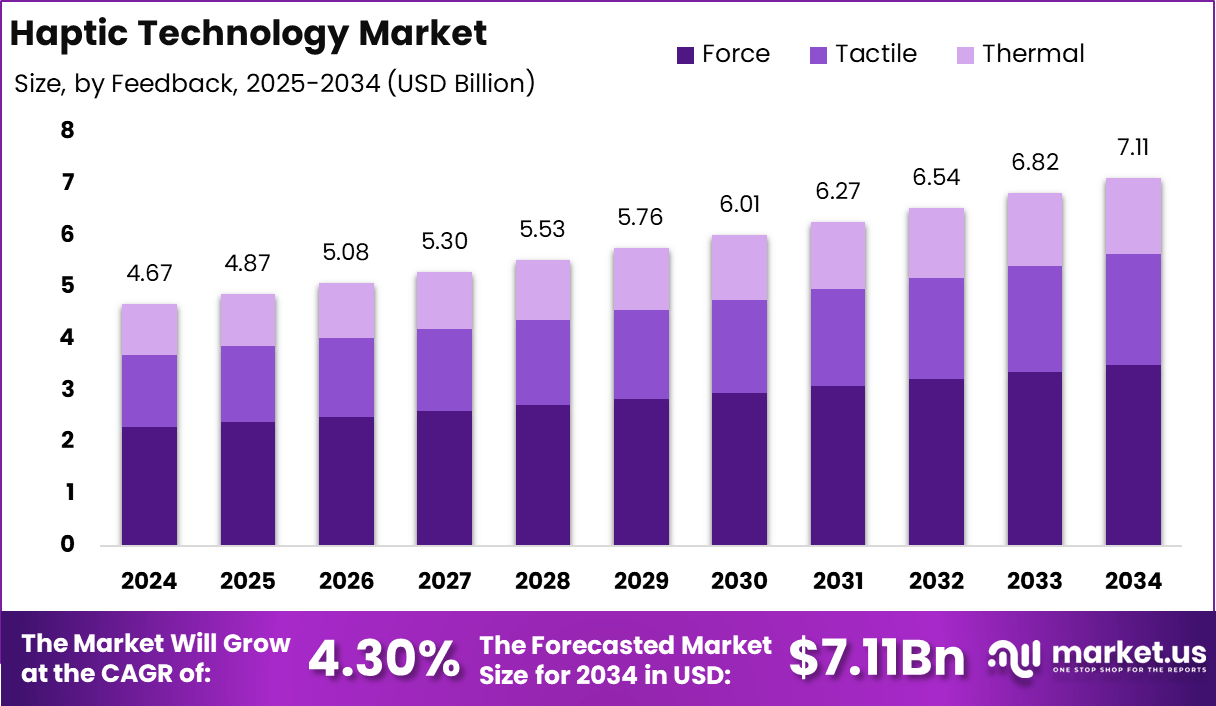
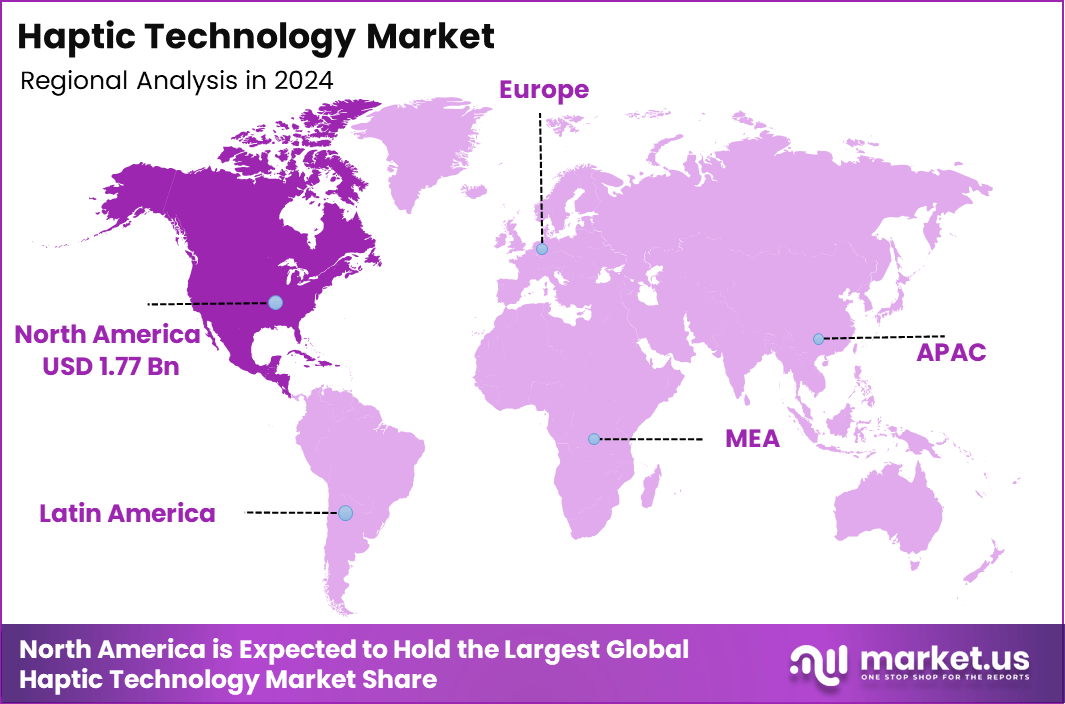
The Global Haptic Technology Market offers a compelling investment opportunity, growing from USD 4.67 billion in 2024 to nearly USD 7.11 billion by 2034 at a CAGR of 4.3%. Supported by increasing deployment of haptic feedback in smartphones, wearables, automotive systems, and medical devices, the market is positioned for long-term growth. North America’s leadership, with 38% market share and USD 1.77 billion in revenue in 2024, reinforces the region’s role as a key innovation and revenue hub for investors.
Haptic technology refers to systems that create the sense of touch or tactile interaction between users and digital systems by using controlled forces, vibrations, or motions. This form of tactile interface enables feedback that mimics physical sensations, adding a touch dimension to digital experiences such as virtual environments, remote operations, and interactive interfaces. The technology plays a central role in bridging the physical and digital worlds by allowing users to feel virtual objects or responses during interaction. Haptics is increasingly found in consumer devices as well as in professional and industrial applications, expanding its influence across sectors.
The underlying components of haptic systems include sensors, actuators, and control algorithms that translate digital signals into physical sensations. Advances in hardware and software have enabled more precise, responsive, and reliable tactile feedback, supporting its use beyond simple vibration cues. This expanded capability has driven interest in human computer-interaction applications that require rich sensory feedback. As a result, the market for haptic solutions continues to evolve with integration into more complex systems and use cases.
Key Takeaways
- The haptic technology market is expected to grow at a 4.3% CAGR from 2024 to 2034, supported by wider use of tactile feedback in consumer electronics, automotive systems, and healthcare devices.
- North America accounted for 38% of the global market in 2024, led by strong adoption in the US across smartphones, wearables, and advanced vehicle control systems.
- By component, hardware represented 67.3% share, driven by high demand for actuators, sensors, and drivers that enable accurate and responsive feedback.
- By feedback type, force feedback held 49.2%, supported by its use in simulation, robotics, and AR and VR applications where realistic resistance is required.
- By usage type, graspable interfaces accounted for 43.1%, reflecting growing demand in VR gaming, medical training, and robotic control for more realistic interaction.
- By application, consumer electronics led with 27.8% share, driven by continued smartphone innovation, touch based displays, and enhanced wearable experiences.
Top Driving Factors
A key driver for the Haptic Technology Market is the expanding demand for immersive user experiences in digital interfaces. Interactive technologies such as virtual and augmented reality, gaming environments, and interactive training platforms rely on tactile feedback to create realism and engagement for users. As these digital experiences become more widespread across entertainment and professional sectors, haptic feedback is increasingly recognized as essential for intuitive interaction. This has encouraged broader adoption and refinement of tactile feedback solutions
Another driving factor is the integration of haptic feedback into everyday consumer electronics. Devices such as smartphones, wearables, and tablets leverage haptic interfaces to enhance touch responsiveness and user satisfaction. This integration improves usability by providing tactile confirmation of interactions, which can lead to faster adoption and stronger user engagement. Increasing expectations for natural and interactive device feedback are reinforcing the importance of tactile technology in product design.
Demand Analysis
Demand for haptic technology is tied to the growth of human machine interfaces that benefit from sensory feedback. Industries that require precise interaction or enhanced simulation, such as healthcare training, remote manipulation systems, and design visualization tools, are adopting tactile systems to improve outcomes. This trend reflects a shift from visual only interfaces toward multi sensory engagement to improve efficiency and user comprehension. As use cases expand across sectors, overall demand for haptic feedback systems continues to broaden.
The rise of immersive technologies such as virtual reality and augmented reality amplifies this demand. When users interact in virtual environments without physical cues, haptic feedback provides critical sensory information that supports natural motion, depth perception, and object manipulation. This is particularly important in applications like surgical simulation, remote teleoperation, and virtual prototyping. Users benefit from tactile cues that approximate real world sensations, which enhances the fidelity and effectiveness of interactive systems.
Increasing Adoption Technologies
Advances in actuator and sensor systems have significantly enhanced the adoption of haptic technology. Modern actuators are capable of producing precise force, vibration, and motion feedback that more accurately reflects the intended tactile experience. Sensors embedded within interfaces detect user inputs and adjust feedback in real time, creating responsive systems that support complex interactions. These technological improvements make haptic feedback more applicable to a wider range of devices and environments.
Software and control algorithms have also evolved to support richer haptic interactions. Intelligent feedback systems can interpret user motion and context to adjust haptic responses that feel natural and informative. Integration with 3D environments and simulation platforms allows tactile cues to complement visual and auditory information. These capabilities are particularly beneficial for applications requiring precision and intuitive control.
Investment Opportunities
Investment opportunities in the Haptic Technology Market originate from demand for enhanced user interfaces across consumer and professional domains. As immersive digital experiences gain traction, systems that include tactile feedback are attracting interest from developers and solution providers. Investments in component development, integration platforms, and user interface design tools support innovation and adoption across applications. These areas are contributing to a stronger foundation for future tactile system deployments.
Additional opportunities arise from applications in simulation and training environments. Professional sectors such as healthcare training and remote operations benefit from realistic sensory feedback that can improve competency and safety outcomes. Haptic systems that can simulate force and resistance are especially valuable for tasks that require dexterity or muscle memory development. These specialized investment avenues offer potential for technology maturation and differentiation.
Business Benefits
Haptic technology enhances user experience by providing tactile feedback that makes digital interactions feel more intuitive and responsive. This sensory dimension can improve user satisfaction by confirming actions and reducing ambiguity in interface interactions. Such improvements are particularly valuable in devices where touch is a primary input method, leading to stronger adoption and retention. Business solutions that include haptic feedback can differentiate offerings in competitive markets.
In professional and industrial settings, haptic systems improve training effectiveness and operational precision. For example, tactile feedback in simulation tools supports realistic practice without risk, while remote manipulation systems benefit from sensory cues that guide user actions. This leads to reduced errors and improved performance in critical tasks. As a result, enterprises can achieve measurable gains in efficiency and quality of outcomes.
Regional Analysis
In North America, application of haptic technology is driven by strong development of immersive technologies and advanced user interface design. The presence of innovation ecosystems encourages integration of tactile feedback into devices and professional systems. This region benefits from early adoption trends and user familiarity with interactive technologies. These factors contribute to a stable environment supportive of ongoing haptic integration.
Asia Pacific shows growing interest in haptic solutions as manufacturing and consumer electronics sectors expand. Lower production costs, large consumer bases, and investments in digital devices support broader adoption. Many applications target smartphones and wearables that incorporate tactile feedback as a standard feature. The region’s diverse technology landscape creates opportunities for localized innovation and customized deployments.
Use Case Analysis
One significant use case for haptic technology is virtual reality and augmented reality interaction. In these environments, tactile feedback provides essential sensory confirmation that enhances immersion and task performance. Users can feel textures, resistance, or motion that correspond to virtual stimuli, which supports engagement and learning. This capability is valuable for entertainment, training, and design applications.
Another important use case lies in remote operation and telepresence systems where physical presence is limited. Haptic feedback allows operators to sense force and motion during remote manipulation tasks, such as robotic control or equipment handling. These tactile cues improve precision and situational awareness. As a result, haptics supports safer and more effective interactions in environments that are difficult or hazardous for direct human operation.
Risk Analysis
A primary risk in the Haptic Technology Market is technical complexity and integration difficulty. Building systems that deliver realistic tactile sensations requires careful calibration of sensors, actuators, and control algorithms. Inadequate integration can produce unnatural feedback or unreliable responses, reducing user trust and acceptance. These challenges are greater in applications requiring high fidelity or multi modal feedback.
Another risk is the cost associated with advanced haptic components. High-precision actuators and sensing systems can be expensive to produce and integrate, making some solutions less accessible for cost-sensitive applications. Long development cycles and specialized expertise can also increase upfront investment needs. These factors may slow adoption in markets with limited budgets or price sensitivity.
Regulatory Environment Overview
Regulatory frameworks for haptic technology are shaped by safety and interoperability requirements in sectors such as healthcare and industrial systems. Devices that deliver physical feedback must comply with general safety standards to ensure they do not inadvertently cause harm to users. This includes limits on force output, response latency, and electrical safety in wearable or handheld devices. Compliance with recognized safety guidelines helps build trust and supports wider adoption.
In professional and medical contexts, additional regulation may govern devices used for training, rehabilitation, or clinical interactions. These standards aim to ensure that systems operate within defined parameters and provide reliable performance. Developers must demonstrate adherence to applicable safety and quality requirements before deployment. This regulatory oversight encourages responsible design and protects end users from unintended outcomes.
Buyer Decision Criteria
Buyers of haptic solutions prioritize performance reliability and user experience quality. Decision makers examine how accurately a system delivers tactile feedback and whether it meets application requirements. Compatibility with existing systems and ease of integration are also essential considerations. Infrastructure that minimizes disruption during deployment is typically preferred.
Cost effectiveness and long term support are other key criteria. Buyers assess total cost of ownership, including maintenance and upgrades, to ensure sustainable operations. Support for customization and future technology evolution influences purchasing decisions. Buyers seek solutions that balance current needs with future adaptability.
Key Market Segments
By Component
- Hardware
- Software
By Feedback
- Force
- Tactile
- Thermal
By Usage Type
- Graspable
- Touchable
- Wearable
By Application
- Consumer Electronics
- Gaming
- Automotive
- Healthcare
- Robotics
- Others
Top Key Players in the Market
- Immersion Corporation
- Imagis Co., Ltd.
- Nidec Corporation
- Onsemi
- Johnson Electric Holdings Limited
- Microchip Technology Incorporated
- AAC Technologies
- Aito BV
- Force Dimension
- Geomagic, Inc.
- Others
Report Scope
| Report Features | Description |
|---|---|
| Market Value (2024) | USD 4.67 Billion |
| Forecast Revenue (2034) | USD 7.11 Billion |
| CAGR(2025-2034) | 4.30% |
| Base Year for Estimation | 2024 |
| Historic Period | 2020-2023 |
| Forecast Period | 2025-2034 |
Discuss your needs with our analyst
Please share your requirements with more details so our analyst can check if they can solve your problem(s)