Table of Contents
Overview
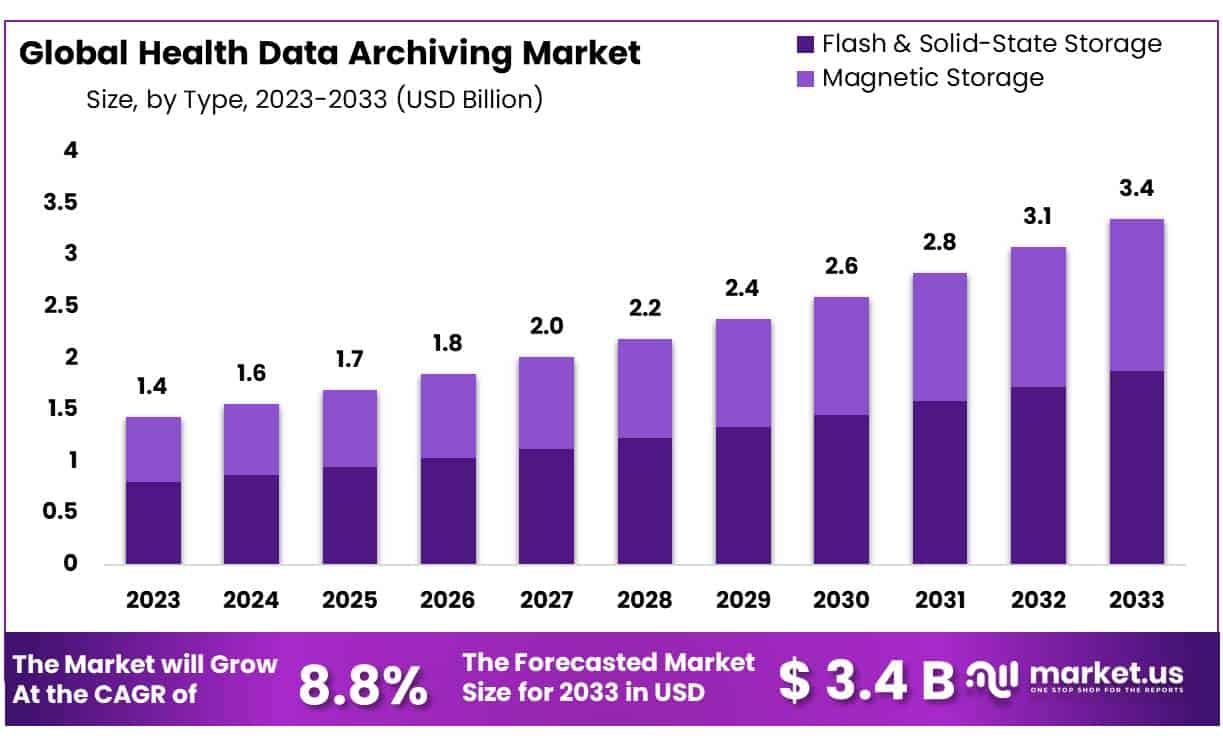
New York, NY – Jan 23, 2026 – Global Health Data Archiving Market size is expected to be worth around USD 3.4 Billion by 2033 from USD 1.4 Billion in 2023, growing at a CAGR of 8.8% during the forecast period from 2024 to 2033.
Health data archiving has emerged as a critical component of modern healthcare systems, supporting the secure storage, management, and long-term preservation of clinical and administrative data. As healthcare organizations continue to generate large volumes of digital information, structured health data archiving is being adopted to ensure data integrity, regulatory compliance, and operational efficiency.
Health data archiving refers to the systematic process of transferring inactive or less frequently accessed health records from primary systems to secure storage environments. These archives are designed to maintain data accuracy, confidentiality, and accessibility over extended periods. The process supports compliance with healthcare regulations related to data retention, patient privacy, and audit readiness.
The adoption of health data archiving is being driven by several factors, including the rapid growth of electronic health records (EHRs), increasing regulatory requirements, and the need to optimize storage costs. Archived data can be retrieved when required for clinical reference, legal inquiries, research activities, or population health analysis, without burdening active systems.
Modern health data archiving solutions commonly integrate encryption, role-based access controls, and automated retention policies. Cloud-based and hybrid archiving models are also gaining traction, as they offer scalability, cost efficiency, and enhanced disaster recovery capabilities.
Overall, health data archiving is recognized as a foundational element in healthcare data management strategies. By ensuring secure, compliant, and efficient long-term data storage, health data archiving supports continuity of care, protects sensitive patient information, and enables healthcare organizations to operate with greater confidence in an increasingly data-driven environment.
Key Takeaways
- Market Size: The health data archiving market is projected to reach approximately USD 3.4 billion by 2033, rising from USD 1.4 billion in 2023.
- Market Growth: The market is anticipated to expand at a compound annual growth rate (CAGR) of 8.8% over the forecast period from 2024 to 2033.
- Type Analysis: Flash and solid-state storage solutions represent the leading segment, accounting for 56% of the total market share.
- Storage System Analysis: Direct-attached storage (DAS) has emerged as a key segment, capturing 34% of the market share in 2023.
- Deployment Analysis: Cloud-based deployment models dominated the market, holding a 36% share in 2023.
- Architecture Analysis: Object storage architecture accounted for the largest portion of the market, with a 38% share in 2023.
- End-Use Analysis: Hospitals and clinics constituted the largest end-user segment, representing 27% of the market share in 2023.
- Regional Analysis: North America maintained a leading position in the global health data archiving market, accounting for 36% of the market share in 2023.
How Does Artificial Intelligence Help to Improve the Health Data Archiving Market?
Artificial intelligence helps improve the health data archiving market by enhancing data management efficiency, accuracy, and accessibility across healthcare systems. AI-powered algorithms enable automated data classification, indexing, and tagging, which simplifies the organization of large volumes of structured and unstructured health data. This improves data retrieval speed and reduces manual intervention.
Machine learning models support intelligent data lifecycle management by identifying inactive or low-value data for archiving, thereby optimizing storage utilization and lowering operational costs. AI also strengthens data security by enabling anomaly detection, automated threat monitoring, and predictive risk assessment, which help prevent unauthorized access and data breaches.
Additionally, natural language processing supports the extraction of valuable insights from archived clinical notes and historical records, improving clinical decision-making and research outcomes. Overall, the integration of artificial intelligence enhances compliance, scalability, and long-term value creation, supporting sustained growth of the health data archiving market.
Regional Analysis
In 2023, North America holds a dominant 36% market share in the health data archiving market, driven by advanced healthcare infrastructure and stringent regulatory requirements for data retention. The region’s significant investment in healthcare IT and widespread adoption of electronic health records (EHRs) contribute to its leadership position.
Key players in the market, robust R&D activities, and the presence of major pharmaceutical and biotechnology firms further bolster North America’s dominance. Additionally, increasing awareness about data security and the need for efficient data management solutions are propelling the growth of the health data archiving market in this region.
key use cases of Health Data Archiving
- Long-Term Legal and Regulatory Compliance: Health data archiving ensures that inactive patient records and clinical information are preserved securely for the duration required by law. Many healthcare regulations mandate data retention periods ranging from 7 to 25 years, depending on the data type and jurisdiction. This archival process supports audit readiness and protects institutions from sanctions or legal penalties.
- Cost Reduction and IT Efficiency: Archiving removes older records from active systems and places them in low-cost storage environments. Healthcare organizations that implement archival strategies can reduce data storage expenses by 30–70 % compared to maintaining all records in primary systems. This also decreases the workload on production servers, leading to faster system performance and fewer IT resources spent on legacy data maintenance.
- Support for EHR Migration and System Modernization: When a healthcare provider upgrades or replaces its Electronic Health Record (EHR) system, archived data preserves historical records that are no longer needed in daily operations but remain essential for continuity of care. Archiving prevents data loss, ensures smooth transition, and reduces dependency on outdated software. Clinical teams retain seamless access to past health information without maintaining legacy systems.
- Improved Clinical Decision-Making and Patient Safety: Archived historical health records provide clinicians with complete patient histories during follow-ups or emergency care. Nearly 70 % of health data becomes inactive within two years but still holds value for care planning and treatment decisions. By making this data searchable and accessible, archived information enhances clinical accuracy and reduces the risk of medical errors.
- Data Governance, Security, and Secondary Use: Archiving enforces structured governance and security controls around sensitive health information. Archived repositories use encryption and access controls to protect data integrity and privacy. Beyond compliance, archived data becomes a resource for analytical purposes such as population health studies, retrospective research, or quality improvement initiatives, adding strategic value to the healthcare organization.
Frequently Asked Questions on Health Data Archiving
- Why is health data archiving important for healthcare providers?
Health data archiving is important as it helps healthcare providers manage growing data volumes efficiently. It improves system performance, lowers storage costs, supports compliance requirements, and enables secure access to legacy patient information. - What types of data are stored in health data archiving systems?
Health data archiving systems store electronic health records, medical images, billing data, laboratory results, and historical clinical documents. These datasets are preserved for legal, clinical, research, and operational purposes over extended retention periods. - How does health data archiving support regulatory compliance?
Health data archiving supports compliance by enabling secure retention, audit trails, and controlled access to sensitive patient information. It helps healthcare organizations meet regulatory mandates such as HIPAA, GDPR, and national health data retention laws. - What factors are driving the growth of the health data archiving market?
The growth of the health data archiving market is driven by rising healthcare data volumes, widespread EHR adoption, regulatory requirements, and the need for cost-efficient storage solutions that maintain data integrity and accessibility over time. - How does cloud adoption impact the health data archiving market?
Cloud adoption positively impacts the market by enabling scalable, flexible, and cost-effective archiving solutions. Cloud-based platforms reduce infrastructure costs, enhance disaster recovery capabilities, and support remote access while maintaining data security standards. - Which end users are the primary adopters in the health data archiving market?
Hospitals, diagnostic centers, ambulatory care facilities, and healthcare payers are primary adopters. These organizations require reliable archiving solutions to manage large datasets, ensure compliance, and optimize clinical and administrative system performance.
Conclusion
Health data archiving has become an essential pillar of modern healthcare data management. The growing volume of digital health records, strict regulatory requirements, and rising focus on data security are accelerating its adoption across healthcare organizations.
By enabling secure, compliant, and cost-efficient long-term storage, health data archiving supports operational efficiency, clinical continuity, and informed decision-making. The increasing integration of cloud technologies and artificial intelligence is further enhancing scalability, automation, and data value extraction.
With steady market growth, strong adoption by hospitals and clinics, and continued technological advancements, health data archiving is expected to remain a strategic investment for healthcare systems worldwide.
Discuss your needs with our analyst
Please share your requirements with more details so our analyst can check if they can solve your problem(s)