Overview
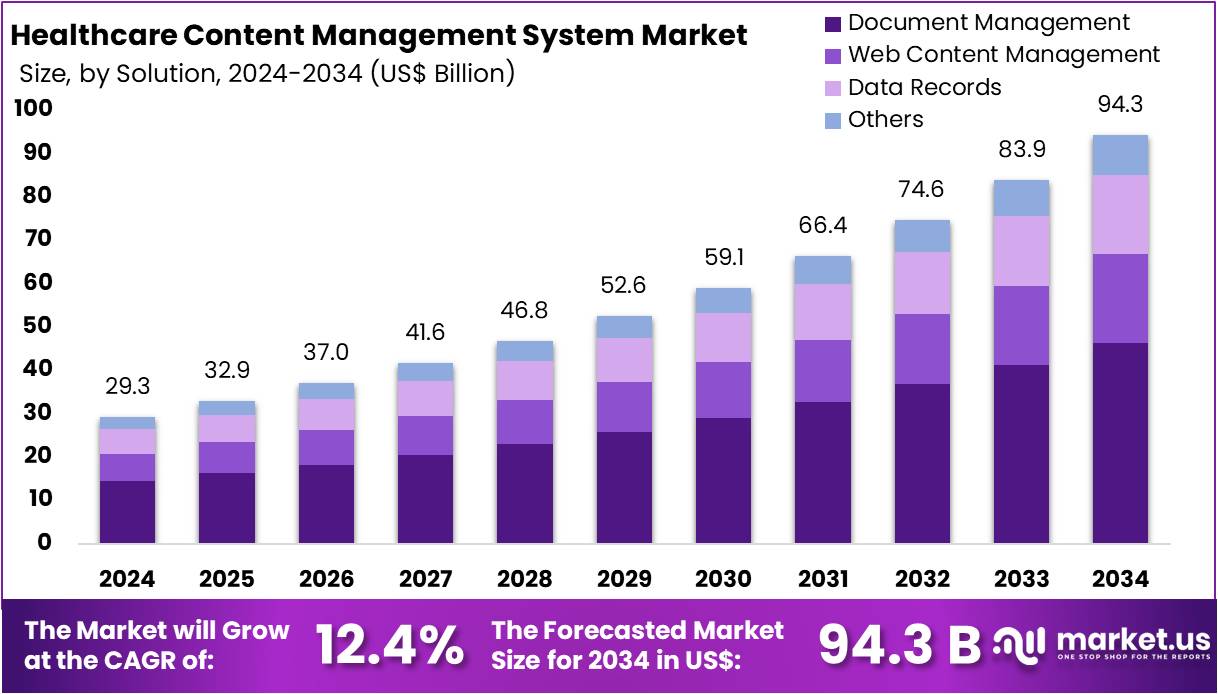
New York, NY – April 22, 2026 – The Global Healthcare Content Management System Market Size is expected to be worth around US$ 94.3 Billion by 2034, from US$ 29.3 Billion in 2024, growing at a CAGR of 12.4% during the forecast period from 2025 to 2034. North America held a dominant market position, capturing more than a 42.2% share and holds US$ 12.3 Billion market value for the year.
A Healthcare Content Management System (HCMS) is a specialized digital platform designed to create, manage, store, and distribute healthcare-related content efficiently across multiple channels. These systems are increasingly being adopted by hospitals, clinics, pharmaceutical companies, and healthcare organizations to streamline information workflows and enhance patient engagement.
The growth of HCMS adoption can be attributed to the rising need for accurate, compliant, and easily accessible medical information. Regulatory requirements and data privacy standards have intensified the demand for secure content management solutions. HCMS platforms are typically equipped with features such as document management, version control, workflow automation, and integration with electronic health records (EHR) systems.
From an operational perspective, healthcare organizations benefit from improved efficiency and reduced administrative burden. Content standardization ensures consistency in communication, while automated workflows minimize manual errors. Additionally, these systems support multi-channel content delivery, enabling organizations to distribute information via websites, mobile applications, and patient portals.
Market trends indicate a steady increase in digital transformation initiatives within the healthcare sector. The integration of advanced technologies such as artificial intelligence and cloud computing is further enhancing the capabilities of HCMS platforms. These innovations are expected to improve content personalization, data analytics, and real-time access to critical information.
Overall, Healthcare Content Management Systems are positioned as essential tools in modern healthcare infrastructure, supporting improved communication, regulatory compliance, and patient-centric service delivery.
Key Takeaways
- The global Healthcare Content Management System market is projected to reach approximately US$ 94.3 billion by 2034, increasing from US$ 29.3 billion in 2024.
- A compound annual growth rate (CAGR) of 12.4% is anticipated over the forecast period from 2025 to 2034.
- Document management solutions held a dominant position in 2024, contributing over 38.2% of the total solution segment share.
- Hospitals and clinics accounted for the largest end-user segment in 2024, with a market share exceeding 45.2%.
- North America led the regional landscape in 2024, capturing 42.2% of the market and generating approximately US$ 12.3 billion in revenue.
Regional Analysis
In 2024, North America maintained a leading position in the healthcare content management system market, accounting for over 42.2% share and generating approximately US$ 12.3 billion in revenue. This leadership is driven by the extensive adoption of digital health infrastructure across the region. Healthcare providers, particularly hospitals and clinics in the United States and Canada, are increasingly deploying CMS platforms to enhance data management and streamline administrative processes.
Supportive regulatory frameworks have significantly accelerated adoption. The Health Insurance Portability and Accountability Act (HIPAA) has created strong demand for secure content management solutions, ensuring the protection and accessibility of electronic health records, billing data, and patient documentation. Additionally, initiatives by the Centers for Medicare & Medicaid Services (CMS) have encouraged digital transformation through incentive programs.
High healthcare expenditure, combined with a well-established network of medical institutions, has further strengthened market growth. The continued focus on patient engagement and integrated care delivery is expected to sustain regional dominance.
Emerging Trends
- Adoption of cloud-based platforms: Cloud deployment is increasing rapidly, accounting for over 53% market share, driven by scalability, remote access, and cost efficiency across healthcare organizations.
- Integration of artificial intelligence (AI): AI-enabled document processing and content classification are expanding at over 10% CAGR, improving automation, search accuracy, and clinical decision support efficiency.
- Rising demand for interoperability: Healthcare providers are focusing on interoperable systems to integrate EHR, imaging, and lab data, ensuring seamless information exchange across platforms and improving care coordination.
- Focus on data security and compliance: Growing regulatory requirements and cyber risks are increasing investment in secure content management systems, ensuring privacy, audit trails, and compliance with healthcare regulations.
Use Cases
- Clinical document management: HCMS systems are used to store and manage patient records, imaging files, and clinical notes, improving accessibility, accuracy, and operational efficiency in hospitals.
- Workflow automation and collaboration: These systems streamline administrative and clinical workflows, enabling real-time collaboration between healthcare professionals and reducing manual paperwork.
- Claims and payer data processing: Healthcare payers utilize HCMS to manage claims documentation, risk data, and policy records, improving processing speed and reducing errors.
- Regulatory and compliance management: HCMS platforms help organizations maintain compliance by managing audit trails, legal documentation, and regulatory reporting requirements efficiently.
Frequently Asked Questions on Healthcare Content Management System
- What are the key features of a Healthcare Content Management System?
Key features include document digitization, secure storage, workflow automation, regulatory compliance management, interoperability with electronic health records, and role-based access control, which collectively enhance operational efficiency, reduce paperwork, and ensure accurate and timely access to critical healthcare information. - How does an HCMS improve patient care?
Improved patient care is achieved through faster access to accurate medical records, reduced administrative delays, and enhanced collaboration among healthcare professionals, enabling informed clinical decision-making, minimizing errors, and supporting continuity of care across multiple departments and healthcare facilities. - What role does compliance play in HCMS adoption?
Compliance plays a critical role, as healthcare organizations must adhere to stringent regulations regarding patient data privacy and security, and HCMS solutions are designed to ensure audit trails, data encryption, and standardized processes that align with regional and international healthcare compliance frameworks. - What are the deployment models available for HCMS?
Deployment models typically include on-premise, cloud-based, and hybrid solutions, with cloud deployment gaining traction due to scalability, cost efficiency, and remote accessibility, while on-premise systems are preferred by organizations requiring greater control over sensitive healthcare data. - Which regions are leading in the HCMS market?
North America leads the market due to advanced healthcare infrastructure and strong regulatory frameworks, while Europe follows closely; meanwhile, Asia-Pacific is emerging as a high-growth region driven by healthcare digitalization initiatives and increasing investments in healthcare IT infrastructure. - What are the major trends shaping the market?
Key trends include the shift toward cloud-based solutions, integration of artificial intelligence for data analytics, increased focus on interoperability, and growing adoption of mobile-enabled platforms, all contributing to enhanced efficiency, scalability, and user accessibility within healthcare organizations. - Who are the major end-users in this market?
Major end-users include hospitals, physician practices, diagnostic laboratories, and healthcare payers, with hospitals accounting for a significant share due to high data volumes, complex workflows, and the need for integrated systems to manage clinical and administrative content effectively.
Conclusion
The Healthcare Content Management System market is expected to witness sustained growth, driven by increasing digital transformation, regulatory compliance requirements, and rising healthcare data volumes. The market is projected to reach US$ 94.3 billion by 2034, expanding at a CAGR of 12.4%, reflecting strong adoption across healthcare organizations.
Cloud-based solutions, AI integration, and interoperability capabilities are enhancing system efficiency and scalability. North America continues to dominate due to advanced infrastructure and supportive regulations, while emerging regions show high growth potential. Overall, HCMS platforms are becoming essential for improving operational efficiency, ensuring compliance, and enabling patient-centric healthcare delivery.
Discuss your needs with our analyst
Please share your requirements with more details so our analyst can check if they can solve your problem(s)