Table of Contents
- Report Overview
- Top Driving Factors
- Market Key Takeaways
- Demand Analysis
- Increasing Adoption Technologies
- Key Reasons for Adopting These Solutions
- Investment Opportunities
- Business Benefits
- Regulatory Environment
- Regional Analysis
- Driver Analysis
- Restraint Analysis
- Opportunity Analysis
- Challenge Analysis
- Key Market Segments
- Report Scope
Report Overview
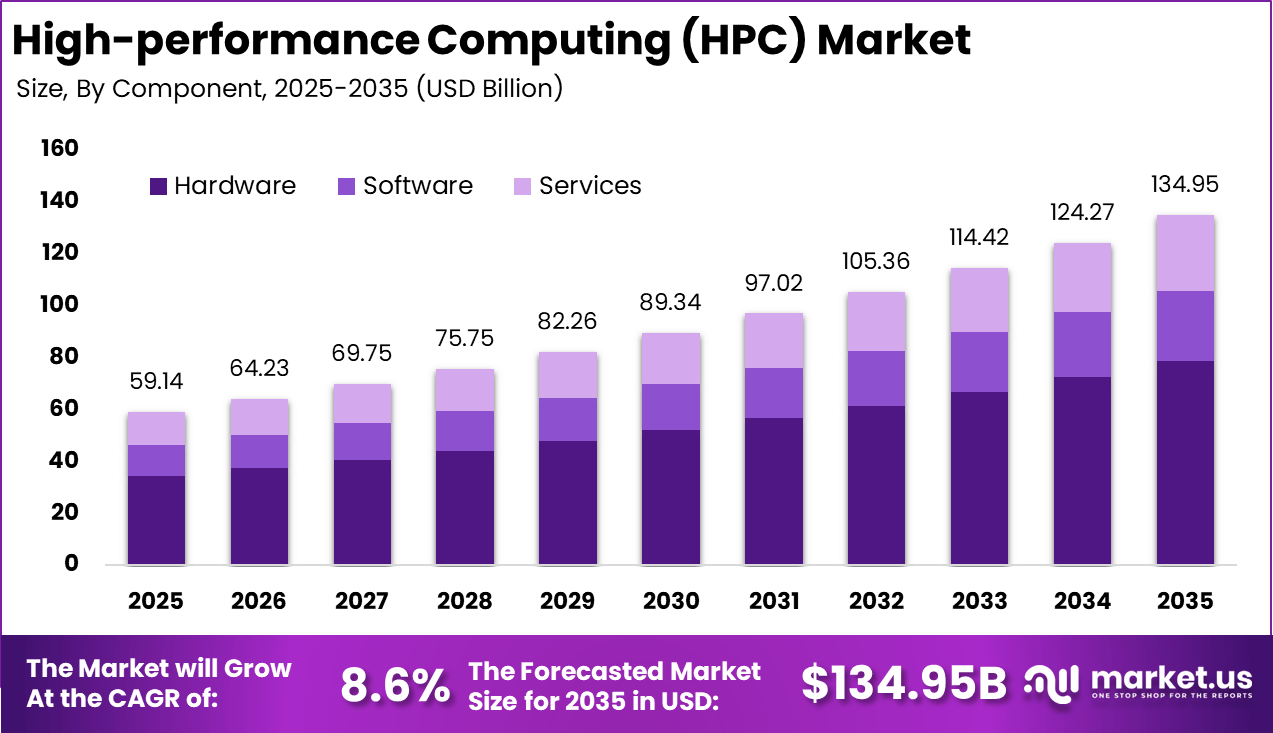
The global High Performance Computing (HPC) market was valued at USD 59.14 billion in 2025 and is expected to grow steadily over the forecast period. The market is projected to reach approximately USD 134.95 billion by 2035, expanding at a CAGR of 8.6% from 2025 to 2035. This growth is driven by rising demand for complex simulations, data intensive workloads, and advanced analytics across research and enterprise environments. Increased use of HPC in artificial intelligence, scientific research, and industrial modeling is further supporting market expansion.
The high performance computing market refers to computing systems and solutions designed to process large volumes of data and perform complex calculations at very high speeds. HPC systems combine powerful processors, high-speed networks, and advanced storage to solve tasks that are beyond the capability of standard computing systems. These systems are widely used in scientific research, engineering simulations, financial modeling, and large-scale data analysis. Adoption spans government agencies, research institutions, enterprises, and academic organizations.
Market development has been driven by the growing need for faster data processing and accurate simulation across industries. Traditional computing environments are often unable to handle complex workloads within acceptable time frames. HPC enables parallel processing and efficient workload distribution, improving accuracy and productivity. As data intensity increases, HPC has become a critical foundation for advanced computing environments.
Top Driving Factors
One major driving factor of the HPC market is the rapid growth in data generation and computational complexity. Industries such as healthcare, climate research, manufacturing, and finance require massive computational power to analyze large datasets. HPC systems support complex modeling, simulations, and real-time analysis that traditional systems cannot manage. This demand for advanced computation continues to support market growth.
Another key driver is increased investment in research and innovation. Governments and enterprises rely on HPC to support scientific discovery, product development, and technological advancement. Advanced simulations reduce the need for physical testing, lowering development costs and time. This efficiency makes HPC a preferred solution for research-driven environments.
Market Key Takeaways
- In 2025, hardware formed the core of the HPC market with a dominant 58.4% share, reflecting continued dependence on advanced processors, accelerators, and high performance system architectures to support compute intensive workloads.
- On premises deployment retained leadership with a 52.7% share in 2025, as organizations prioritized performance control, data security, and low latency for mission critical computing tasks.
- Large enterprises represented the strongest adoption base, capturing 82.6% of total usage. This dominance highlighted the importance of scale, capital investment, and long term digital infrastructure planning in HPC deployment decisions.
- Simulation and modeling applications led with a 38.9% share, driven by their central role in scientific research, engineering simulations, and complex system analysis.
- The government and defense sector accounted for 31.8% share, emphasizing the strategic role of HPC in national security programs, public research laboratories, and high reliability analytics.
- North America maintained regional leadership with more than a 41.62% share in 2025, supported by strong research ecosystems, early technology adoption, and sustained investment in advanced computing infrastructure.
Demand Analysis
Demand for HPC solutions is influenced by the expansion of artificial intelligence, machine learning, and data analytics workloads. These applications require high processing power, memory bandwidth, and low-latency communication. Organizations adopt HPC to train complex models and process unstructured data efficiently. As AI adoption grows, HPC demand remains strong.
Demand is also shaped by national and institutional priorities in science and technology development. Universities and research centers depend on HPC systems to support academic research and innovation programs. Public sector initiatives often rely on HPC for weather forecasting, defense analysis, and energy research. This institutional reliance sustains long-term demand.
Increasing Adoption Technologies
Advances in processor architectures and accelerator technologies support increased HPC adoption. Modern HPC systems integrate CPUs with GPUs and other accelerators to improve parallel processing efficiency. These technologies enable faster computation while optimizing energy consumption. Improved hardware performance directly enhances system capability.
High-speed interconnects and advanced storage technologies also play a critical role. Fast networking reduces communication delays between computing nodes, while high-performance storage supports rapid data access. These technologies ensure smooth data flow across large systems. Improved infrastructure increases overall system reliability and scalability.
Key Reasons for Adopting These Solutions
One key reason organizations adopt HPC solutions is the ability to reduce computation time significantly. Tasks that previously required days or weeks can be completed within hours. Faster results support better decision-making and accelerate innovation cycles. This performance advantage provides measurable operational value.
Another reason is improved accuracy and simulation quality. HPC enables high-resolution models and detailed analysis that improve prediction reliability. This is especially important in fields such as engineering design and scientific research. Accurate results reduce risk and support confident planning.
Investment Opportunities
Investment opportunities in the HPC market exist in energy-efficient computing solutions. As power consumption becomes a concern, systems that deliver high performance with lower energy usage gain attention. Innovations in cooling, processor design, and workload optimization support this trend. These areas attract both public and private investment.
Another opportunity lies in managed and cloud-based HPC services. Organizations increasingly seek flexible access to HPC without owning physical infrastructure. Service-based models reduce capital costs and simplify deployment. This shift expands HPC accessibility across enterprise sizes.
Business Benefits
HPC adoption improves productivity by enabling faster analysis and simulation. Organizations can test more scenarios and optimize outcomes within shorter timeframes. This capability improves competitiveness and operational planning. Faster insights support better strategic decisions.
HPC systems also support collaboration and innovation. Shared computing environments allow teams to work on complex problems simultaneously. Centralized platforms improve data consistency and workflow coordination. These benefits enhance research efficiency and organizational performance.
Regulatory Environment
The regulatory environment for the HPC market includes data protection and security standards. HPC systems often process sensitive scientific, financial, or personal data. Compliance with data privacy laws and security frameworks is essential. Secure access controls and encryption are standard requirements.
Export controls and technology governance policies also influence HPC deployment. Certain high-performance systems may be subject to trade restrictions or national security regulations. Organizations must ensure compliance with applicable laws during procurement and deployment. Regulatory adherence supports responsible and lawful HPC usage.
Regional Analysis
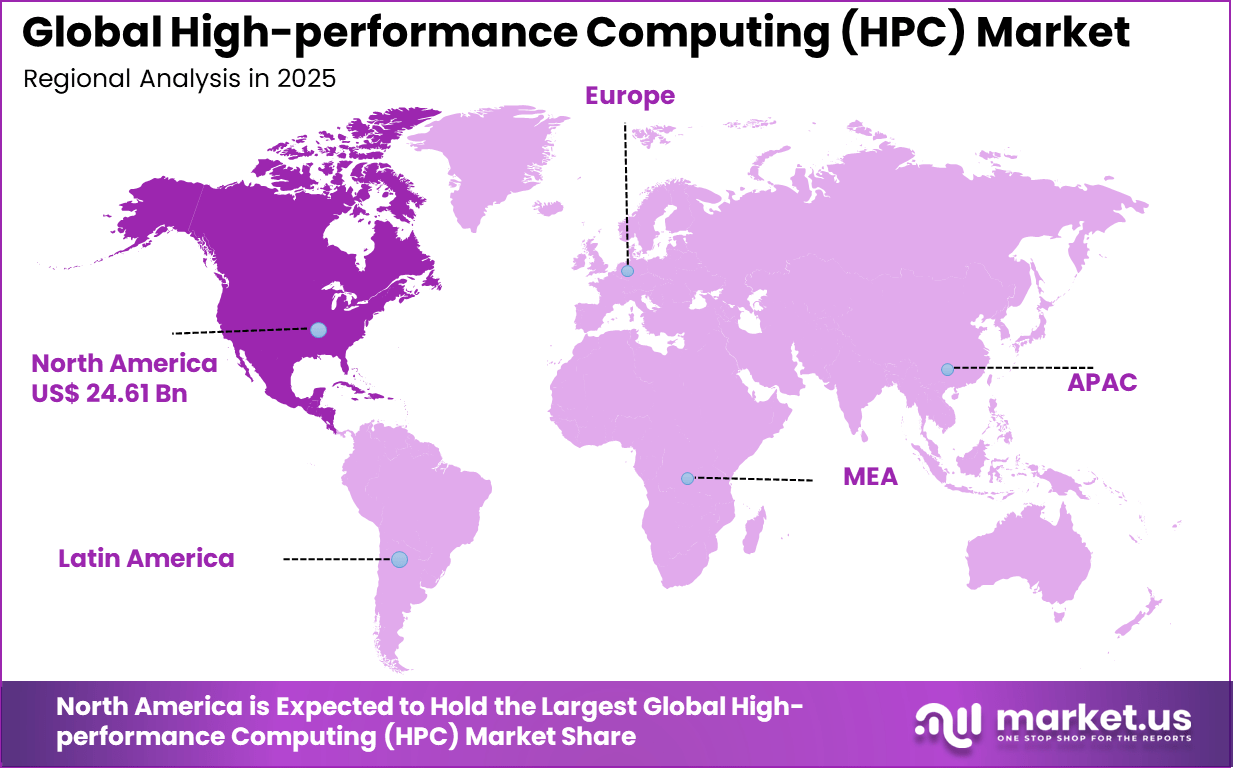
North America held a dominant position in the global market, accounting for more than 41.62% of total revenue. The region generated around USD 24.61 billion, supported by strong investment in research infrastructure and advanced computing systems. Early adoption of supercomputing technologies and high concentration of technology driven industries strengthened regional leadership. As a result, North America continues to shape innovation and adoption trends in the HPC market.
Driver Analysis
The high-performance computing market is being driven by the escalating demand for processing power to handle increasingly complex digital workloads and large datasets across industries. High-performance computing systems provide the computational capacity required for advanced simulations, scientific research, weather prediction, and big data analytics.
These capabilities enable organizations to gain deeper insights, accelerate innovation, and support decision-making with substantial compute-intensive tasks that standard computing systems cannot address. The convergence with artificial intelligence and machine learning further amplifies the need for robust HPC infrastructures capable of training models and processing vast volumes of data efficiently. This trend underscores a foundational requirement for high-performance computing solutions in research and commercial environments.
Restraint Analysis
A notable restraint within the high-performance computing market is the complexity and cost associated with HPC deployment and integration. HPC systems often require substantial investment in specialized hardware, advanced cooling solutions, and skilled personnel to configure and manage operations effectively.
Organizations may encounter challenges integrating HPC into existing IT frameworks due to compatibility issues or a shortage of expertise in parallel computing, system optimization, and infrastructure management. These factors can slow adoption, particularly among smaller enterprises with limited technical resources. Ensuring operational efficiency and cost containment remains a critical concern for stakeholders exploring HPC investment.
Opportunity Analysis
Opportunities in the high-performance computing market are emerging from the expansion of cloud-based HPC services and hybrid deployment models that combine on-premise systems with scalable cloud resources. Cloud-enabled HPC expands access to high compute power without requiring significant upfront infrastructure investment, making advanced computing capabilities more accessible to organizations of varied sizes.
This flexibility supports real-time analytics, collaborative research, and resource optimization by provisioning computing power when and where it is needed. The evolution of HPC as a service, alongside the integration with artificial intelligence and machine learning workloads, enhances the potential for innovation and industry-specific offerings that align with digital transformation strategies.
Challenge Analysis
A central challenge confronting the high-performance computing market is managing the complexity of system operation, energy consumption, and evolving computational requirements. HPC environments demand significant power and cooling resources, and maintaining resilience and efficiency at scale can be difficult.
Parallelizing applications to fully leverage HPC architectures requires specialized programming expertise, and ensuring data security in large-scale processing contexts adds to operational burdens. These technical and resource constraints can hinder performance optimization and complicate long-term planning for organizations relying on HPC systems for mission-critical workloads.
Key Market Segments
By Component
- Hardware
- Servers
- Storage
- Networking Equipment
- Cooling Systems
- Others
- Software
- Operating Systems & Middleware
- Application Software
- Cluster Management Software
- Performance Optimization Tools
- Others
- Services
- Deployment & Integration
- Managed Services
- Support & Maintenance
- Others
By Deployment
- On-premises
- Cloud-based
- Hybrid
By Organization Size
- Large Enterprises
- Small and Medium-sized Enterprises
By Application
- Simulation & Modeling
- Data Analytics & Artificial Intelligence
- Research & Development
- Engineering & Design
- Weather & Climate Forecasting
- Others
By End-User Industry
- Government & Defense
- Academic & Research
- Manufacturing
- Banking, Financial Services, and Insurance
- Healthcare & Life Sciences
- Media & Entertainment
- Energy & Utilities
- Others
Top Key Players in the Market
- Hewlett Packard Enterprise Company
- Dell Technologies, Inc.
- International Business Machines Corporation
- Lenovo Group Limited
- Fujitsu Limited
- NEC Corporation
- Atos SE
- Sugon Information Industry Co., Ltd.
- Inspur Electronic Information Industry Co., Ltd.
- NVIDIA Corporation
- Advanced Micro Devices, Inc.
- Intel Corporation
- Microsoft Corporation
- Amazon Web Services, Inc.
- Google LLC
- Others
Report Scope
| Report Features | Description |
|---|---|
| Market Value (2025) | USD 59.1 Bn |
| Forecast Revenue (2035) | USD 134.9 Bn |
| CAGR(2026-2035) | 8.6% |
| Base Year for Estimation | 2025 |
| Historic Period | 2020-2024 |
| Forecast Period | 2026-2035 |
| Report Coverage | Revenue forecast, AI impact on Market trends, Share Insights, Company ranking, competitive landscape, Recent Developments, Market Dynamics and Emerging Trends |
Discuss your needs with our analyst
Please share your requirements with more details so our analyst can check if they can solve your problem(s)