Table of Contents
Infrastructure Solution Market Size
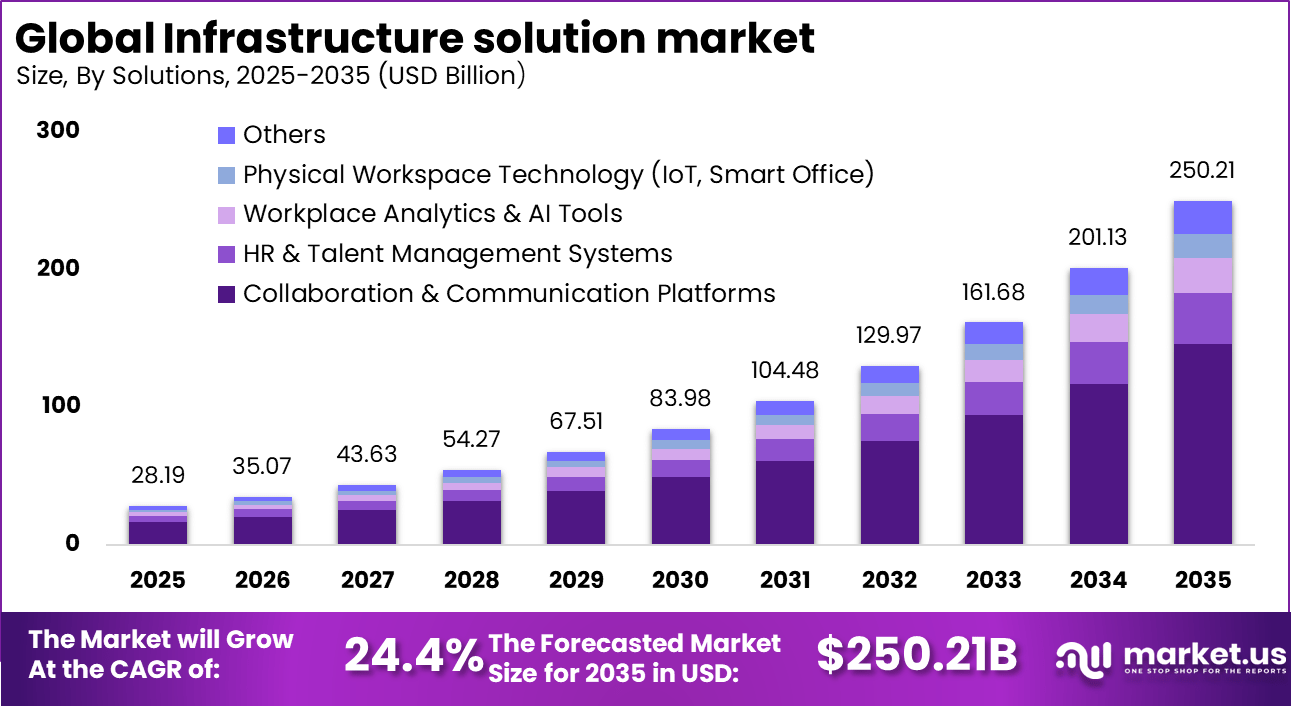
The global Infrastructure Solution market was valued at USD 28.19 billion in 2025 and is expected to expand rapidly over the forecast period. The market is projected to reach approximately USD 250.21 billion by 2035, growing at a strong CAGR of 24.4% from 2025 to 2035. This growth is driven by rising investments in digital infrastructure, cloud modernization, and large scale enterprise transformation initiatives. Increasing demand for scalable, secure, and resilient infrastructure platforms is further supporting market expansion.
The infrastructure solution market covers technologies, systems, and services that support the development, operation, and maintenance of physical and digital infrastructure. This includes transport networks, power systems, water management, telecom networks, data centers, and enterprise infrastructure platforms. Infrastructure solutions combine hardware, software, engineering services, and integration capabilities to ensure reliability and long-term performance. Adoption is seen across government bodies, utilities, enterprises, and public private partnership projects.
Market development is driven by rising infrastructure demand caused by urban growth, industrial expansion, and digital transformation. Traditional infrastructure systems are increasingly combined with digital monitoring and control tools to improve efficiency and service continuity. Organizations focus on solutions that improve visibility, reduce downtime, and support long-term asset performance. As infrastructure becomes more interconnected, integrated solution models gain importance.
One major driving factor is the need to upgrade aging infrastructure assets. Many roads, power grids, water pipelines, and public facilities require modernization to maintain safety and reliability. Infrastructure solutions help extend asset life through monitoring, rehabilitation, and system optimization. This modernization requirement supports continuous market demand.
Another key driver is increasing demand for digital infrastructure across industries. Businesses rely on reliable networks, data centers, and cloud connectivity to support operations and customer services. Infrastructure solutions that combine physical assets with digital control systems improve operational continuity. This shift toward digitally enabled infrastructure supports sustained adoption.
Key Takeaways
- Collaboration and communication platforms led the solution landscape with a 58.3% share, as enterprises focused on unified tools to enable hybrid work, real time collaboration, and digital workplace modernization.
- Technology integration services accounted for 48.6%, reflecting strong demand for linking cloud platforms, legacy systems, security frameworks, and enterprise applications into a cohesive operating environment.
- Large enterprises dominated adoption with a 68.9% share, driven by the need to manage complex IT ecosystems, large user bases, and geographically distributed infrastructure.
- The IT and telecommunications sector generated 41.7% of total demand, supported by ongoing investments in network modernization, data centers, and scalable digital infrastructure.
- The U.S. infrastructure solution market reached USD 8.65 billion in 2025, expanding at a robust 23.51% growth rate, fueled by accelerated digital transformation and cloud migration programs.
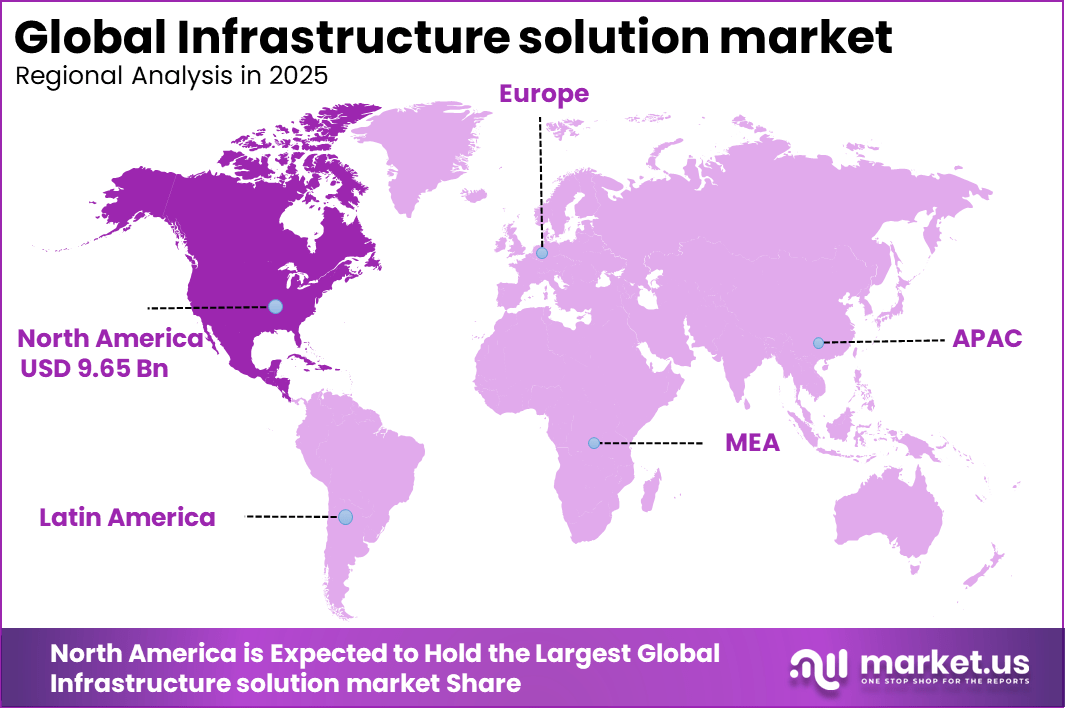
- North America maintained regional leadership with more than 34.26% share, underpinned by advanced IT infrastructure, early technology adoption, and sustained enterprise spending.
Regional Analysis
North America held a dominant position in the global market, accounting for more than 34.26% of total revenue. The region generated around USD 9.65 billion, supported by advanced IT infrastructure and high enterprise technology spending. Early adoption of cloud, edge computing, and integrated infrastructure solutions strengthened regional leadership. As a result, North America continues to influence infrastructure solution adoption and innovation trends.
Demand Analysis
Demand for infrastructure solutions is influenced by population growth and urban expansion. Cities require improved transportation, energy distribution, sanitation, and connectivity to support rising population density. Governments and private investors prioritize large-scale projects that require integrated infrastructure planning and execution. This creates steady demand across regions.
Demand is also shaped by enterprise focus on operational reliability and cost control. Industries such as manufacturing, logistics, and utilities require infrastructure that supports continuous operations with minimal disruption. Solutions that provide monitoring, predictive maintenance, and centralized control are preferred. This operational focus strengthens demand for advanced infrastructure solutions.
Increasing Adoption Technologies
Cloud computing is playing a major role in infrastructure solution adoption. Cloud platforms allow centralized data management, remote monitoring, and scalable system control without heavy on-site infrastructure. These capabilities improve flexibility and reduce capital expenditure. Cloud-based infrastructure management supports faster deployment and easier upgrades.
Data analytics and automation technologies are also supporting adoption. Sensors and monitoring tools collect real-time data from infrastructure assets, which is analyzed to identify performance issues. Automated systems help optimize energy use, maintenance schedules, and resource allocation. These technologies improve operational efficiency and decision accuracy.
Key Reasons for Adopting These Solutions
One key reason for adoption is improved reliability and service continuity. Infrastructure failures can disrupt business operations and public services. Integrated solutions provide early detection of faults and support timely intervention. This reduces downtime and service interruptions.
Another reason is better lifecycle management of assets. Infrastructure solutions provide data-driven insights into asset condition, usage, and maintenance needs. This helps organizations plan repairs and replacements more effectively. Improved lifecycle planning reduces unexpected costs and improves long-term value.
Investment Opportunities
Investment opportunities exist in smart infrastructure platforms that combine monitoring, analytics, and automation. Solutions that support intelligent traffic systems, energy management, and utility monitoring attract strong interest. These platforms help improve efficiency while reducing operational costs. Investors focus on scalable and interoperable solutions.
Another opportunity lies in renewable energy and grid modernization solutions. Infrastructure supporting clean energy generation, storage, and distribution is expanding. Systems that improve grid stability and demand management are gaining attention. These solutions support long-term sustainability goals.
Business Benefits
Infrastructure solutions improve operational efficiency by enabling better control and coordination of assets. Organizations benefit from reduced maintenance costs and improved resource utilization. Centralized monitoring supports faster response to issues. This leads to improved performance and service quality.
These solutions also support compliance and reporting requirements. Infrastructure data can be used to demonstrate adherence to safety, environmental, and operational standards. Better reporting improves transparency and stakeholder confidence. Compliance support reduces regulatory risk.
Driver Analysis
A key driver underpinning the infrastructure solution market is the accelerated need for scalable, resilient, and flexible digital and physical infrastructure to support contemporary business operations. Enterprises across industries are increasingly dependent on advanced infrastructure technologies capable of handling dynamic workloads, managing data volumes, and enabling hybrid and multi-cloud environments.
Modern infrastructure solutions are structured to provide centralized control of compute, storage, and networking resources, which enhances agility and operational performance. This demand is further reinforced by digital transformation initiatives that require robust systems to support internet-connected devices, real-time data processing, and automated management capabilities, promoting ongoing investment in infrastructure technologies and services.
Restraint Analysis
A persistent restraint in the infrastructure solution market is the complexity associated with integration and compatibility with existing legacy systems. Many organizations operate entrenched infrastructure frameworks that are built on older architectures and technologies. Transitioning these environments to modern solutions involves significant technical challenges, prolonged deployment cycles, and heightened risk of operational disruption.
Compatibility issues can lead to increased costs, project delays, and the necessity for specialized skills to navigate complex system architectures. The shortage of professionals with expertise in contemporary infrastructure frameworks and integration practices exacerbates this constraint, limiting the pace at which organizations adopt advanced infrastructure solutions.
Opportunity Analysis
Emerging opportunities within the infrastructure solution market are aligned with expanding digital ecosystems and the proliferation of connected devices. Infrastructure technologies that support real-time analytics, data centre integration, and edge computing offer tangible benefits by enabling faster processing closer to the point of data generation.
Additionally, infrastructure service offerings that facilitate seamless hybrid cloud architectures present opportunities for vendors to deliver differentiated solutions tailored to diverse operational requirements. The transformation of infrastructure management through automation, AI, and predictive analytics further opens avenues for innovation by reducing manual intervention, enhancing resource optimization, and strengthening system resilience.
Regulatory Environment
The regulatory environment includes safety standards, environmental regulations, and public infrastructure policies. Infrastructure projects must comply with construction codes, operational guidelines, and inspection requirements. Solutions that support documentation and compliance tracking are highly valued.
Data protection and cybersecurity regulations also influence infrastructure solutions that include digital systems. Organizations must ensure secure handling of operational and user data. Compliance with regional data protection laws is essential. Regulatory alignment supports secure and lawful infrastructure operations.
Key Market Segments
By Solutions
- Collaboration & Communication Platforms
- HR & Talent Management Systems
- Workplace Analytics & AI Tools
- Physical Workspace Technology (IoT, Smart Office)
- Others
By Service Type
- Consulting Services
- Digital Strategy & Roadmapping
- Change Management
- Workplace Experience Design
- Technology Integration Services
- Unified Communications Deployment
- Cloud Migration & Management
- Security & Compliance Integration
- Managed Services
- IT Support & Maintenance
- End-User Computing Management
- Analytics & Continuous Optimization
- Others
By Organization Size
- Large Enterprises
- Small & Medium Businesses
By End-User Industry
- IT & Telecommunications
- Banking, Financial Services, and Insurance (BFSI)
- Healthcare & Life Sciences
- Retail & Consumer Goods
- Manufacturing & Industrial
- Government & Public Sector
- Others
Top Key Players in the Market
- Accenture plc
- Deloitte Touche Tohmatsu Limited
- International Business Machines Corporation
- Microsoft Corporation
- Cisco Systems, Inc.
- Hewlett Packard Enterprise Company
- Citrix Systems, Inc.
- VMware, Inc.
- Google LLC
- Adobe Inc.
- Salesforce, Inc.
- ServiceNow, Inc.
- Atlassian Corporation
- Slack Technologies, LLC
- Zoom Video Communications, Inc.
- Others
Report Scope
| Report Features | Description |
|---|---|
| Market Value (2025) | USD 28.1 Bn |
| Forecast Revenue (2035) | USD 250.2 Bn |
| CAGR(2026-2035) | 24.4% |
| Base Year for Estimation | 2025 |
| Historic Period | 2020-2024 |
| Forecast Period | 2026-2035 |
| Report Coverage | Revenue forecast, AI impact on Market trends, Share Insights, Company ranking, competitive landscape, Recent Developments, Market Dynamics and Emerging Trends |
Discuss your needs with our analyst
Please share your requirements with more details so our analyst can check if they can solve your problem(s)