Table of Contents
- KNX Home Automation Market Overview
- Top Market Takeaways
- Top Driving Factors
- Demand Analysis
- Drivers Impact Analysis
- Risk Impact Analysis
- Restraint Impact Table
- Increasing Adoption Technologies
- Key Reasons for Adopting These Solutions
- Investment Opportunities
- Business Benefits
- Regulatory Environment
- Key Market Segments
- Report Scope
KNX Home Automation Market Overview
The KNX home automation market refers to technologies and systems based on the KNX open standard that enable intelligent control of devices within residential and smart living environments. These systems integrate lighting, climate control, security, energy management, and multimedia functions to create connected and automated homes. KNX solutions support interoperability among devices from multiple manufacturers, allowing centralized and decentralized control strategies. Adoption spans new constructions, retrofits, and luxury residential segments seeking advanced comfort and efficiency.
According to Market.us, The global KNX Home Automation market was valued at USD 11.1 billion in 2024 and is expected to grow steadily over the forecast period. The market is projected to reach approximately USD 25.9 billion by 2034, expanding at a CAGR of 8.9% from 2025 to 2034. This growth is supported by rising demand for energy efficient buildings and increased adoption of standardized home automation systems. Growing focus on smart homes and integrated building management is also contributing to market expansion.
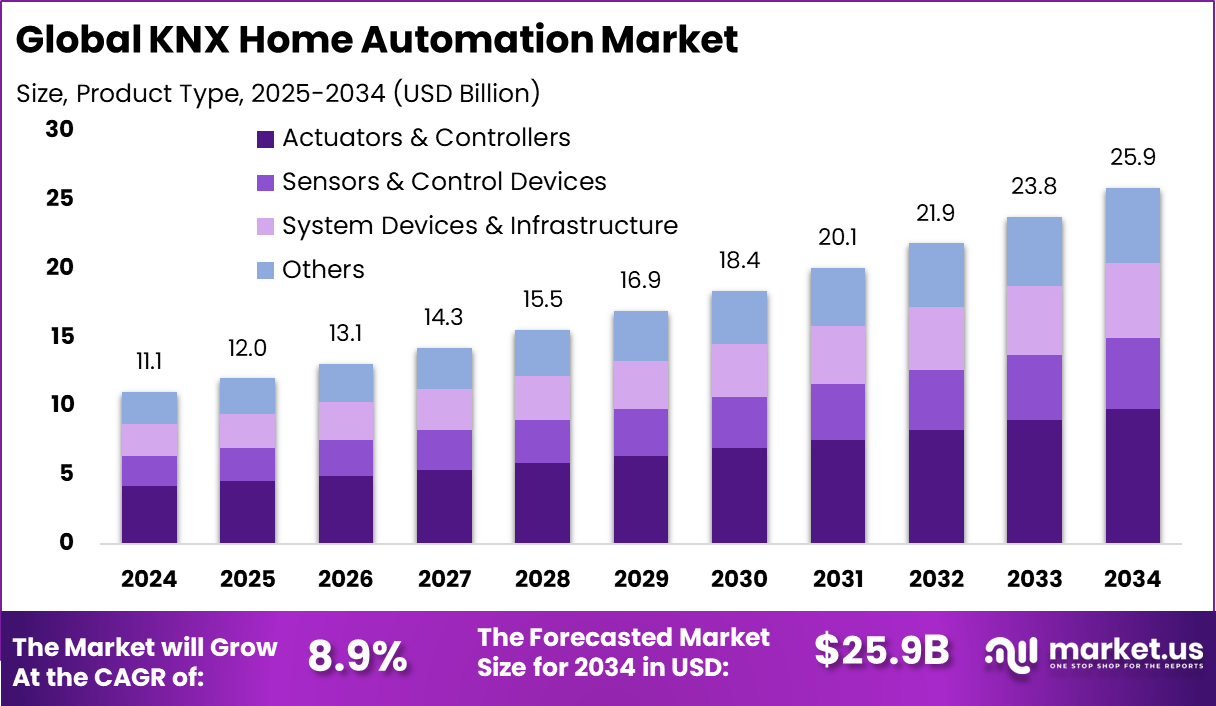
Growth in this market has been influenced by rising consumer demand for smart, energy efficient, and integrated living spaces. As homeowners seek greater control over comfort, convenience, and utility costs, KNX solutions provide standardized and scalable automation capabilities. The open nature of the KNX protocol fosters innovation and reduces dependency on proprietary systems. Strategic emphasis on sustainable living and connected homes has strengthened market momentum.
Top Market Takeaways
- Actuators and controllers led with a 37.8% share, as they play a central role in controlling, coordinating, and executing functions across KNX-based building systems.
- Lighting control accounted for 30.6%, supported by rising demand for centralized, automated, and energy-efficient lighting management in modern buildings.
- The commercial sector dominated with 58.3% adoption, reflecting strong use across offices, hotels, retail spaces, and public infrastructure projects.
- Europe held a 51.3% share, driven by early standardization, mature building automation practices, and widespread professional adoption of KNX solutions.
- Germany remained a key contributor, supported by advanced building standards, skilled system integrators, and strong expertise in KNX integration.
- Around 63% of system integrators and installers actively use KNX, making it a common choice for smart home and building automation projects.
- The KNX ecosystem includes nearly 120,000 certified partners across 190 countries, highlighting strong global reach and professional support.
- More than 8,000 certified KNX devices are available, enabling multi-vendor interoperability and flexible system design options.
- Mid-range residential KNX installations are positioned in the premium segment, reflecting higher upfront costs balanced by long-term reliability and performance.
- KNX adoption aligns closely with sustainability goals, especially as building energy regulations become stricter across major regions.
- KNX-based automation can reduce annual building energy consumption by up to 60%, through intelligent and coordinated control systems.
- Lighting automation can deliver energy savings of up to 60%, by optimizing usage and minimizing unnecessary power consumption.
- HVAC and room control systems can achieve savings of up to 50%, through adaptive temperature and occupancy management.
- Shading and blind automation can cut energy demand by up to 40%, by managing daylight and reducing heat gain.
- Nearly 50% of smart home projects now include automated energy management, reinforcing KNX’s strength in efficiency-focused applications.
Top Driving Factors
One major driver of the KNX home automation market is the increasing focus on energy efficiency and cost savings. Homeowners and property developers are prioritizing solutions that reduce power consumption while enhancing comfort. KNX systems enable intelligent scheduling, real time monitoring, and adaptive control of lighting and HVAC systems, which contributes to lower utility expenses. Regulatory pressures and incentives for energy conservation further encourage adoption.
Another significant driver is the desire for enhanced comfort, convenience, and safety within the home environment. Smart living systems allow residents to automate routines, customize settings, and receive alerts for security or maintenance issues. Integration with voice assistants and mobile applications enhances user experience. These lifestyle benefits support wider uptake among tech-aware consumers.
Demand Analysis
Demand for KNX home automation solutions is shaped by demographic trends such as urbanization and rising disposable incomes in key regions. Middle and upper income households are more likely to invest in smart living technologies that deliver long term value. Developers also incorporate home automation into premium residential projects to differentiate offerings. This has expanded demand for KNX based systems in both primary residences and second homes.
Demand is additionally influenced by rising adoption of IoT devices that can be integrated with KNX networks. As smart sensors, actuators, and connected appliances proliferate, homeowners seek platforms that unify control and data flows. The ability of KNX to connect diverse devices through a standardized protocol supports seamless expansion of smart home ecosystems. These trends reinforce sustained demand for modular and interoperable automation solutions.
Drivers Impact Analysis
| Driver Category | Key Driver Description | Estimated Impact on CAGR (%) | Geographic Relevance | Impact Timeline |
|---|---|---|---|---|
| Energy efficiency demand | Households seeking reduced power consumption | ~2.3% | Europe, Asia Pacific | Short to Mid Term |
| Smart home adoption | Rising installation of connected home systems | ~2.0% | Global | Short Term |
| Building automation standards | Preference for interoperable automation protocols | ~1.7% | Europe | Mid Term |
| Growth in residential construction | Expansion of urban housing projects | ~1.5% | Asia Pacific | Mid Term |
| Integration with IoT devices | Seamless control across home ecosystems | ~1.4% | Global | Long Term |
Risk Impact Analysis
| Risk Category | Risk Description | Estimated Negative Impact on CAGR (%) | Geographic Exposure | Risk Timeline |
|---|---|---|---|---|
| High installation cost | Initial deployment expense limiting adoption | ~2.1% | Emerging Markets | Short Term |
| Skilled installer shortage | Limited certified KNX professionals | ~1.8% | Global | Mid Term |
| Technology competition | Alternative automation protocols | ~1.5% | Global | Mid Term |
| Cybersecurity concerns | Risks from connected home systems | ~1.2% | Global | Long Term |
| Economic slowdown | Delays in residential investment | ~0.9% | Global | Short Term |
Restraint Impact Table
| Restraint Factor | Restraint Description | Impact on Market Expansion (%) | Most Affected Regions | Duration of Impact |
|---|---|---|---|---|
| High upfront investment | Cost sensitivity among homeowners | ~2.4% | Asia Pacific, Latin America | Short to Mid Term |
| Retrofit complexity | Difficulty upgrading existing homes | ~1.9% | Europe | Mid Term |
| Limited consumer awareness | Low understanding of KNX benefits | ~1.6% | Emerging Markets | Short Term |
| Long ROI cycles | Slow payback from automation systems | ~1.2% | Global | Mid Term |
| Supply chain variability | Component availability fluctuations | ~0.8% | Global | Short Term |
Increasing Adoption Technologies
Wireless communication technologies have accelerated adoption of KNX home automation by facilitating easier installation and reduced wiring requirements. Wireless KNX devices allow retrofit deployments without extensive renovation, lowering barriers for existing homes to transition to smart environments. These capabilities expand market potential beyond new builds to the retrofit segment.
Integration of artificial intelligence and machine learning functions is also shaping market growth. AI enabled control systems can learn occupant preferences and optimize routines for comfort and efficiency. Predictive insights drive dynamic adjustments to lighting, heating, and shading based on occupancy patterns and environmental conditions. These intelligent enhancements strengthen the value proposition of KNX automation solutions.
Key Reasons for Adopting These Solutions
One key reason for adopting KNX home automation systems is improved energy management and sustainability outcomes. Automated control of electrical systems reduces waste and supports environmentally responsible living. Homeowners can monitor usage in real time and implement strategies that lower utility bills. This operational transparency contributes to tangible cost savings and carbon footprint reduction.
Another reason is enhanced comfort and quality of life for residents. Home automation allows personalization of environmental settings such as temperature, lighting scenes, and entertainment schedules. These capabilities support convenience in daily routines and remote control of systems when away from home. Improved living experiences drive preference for well-integrated smart home systems.
Investment Opportunities
Investment opportunities in the KNX home automation market exist in development of advanced user interfaces and control platforms that simplify interactions. Solutions that provide intuitive mobile apps, voice control integration, and seamless updates can attract broader consumer adoption. Innovations that enhance user experience and reduce complexity may increase conversion among less tech-savvy households.
Another opportunity lies in services that support lifecycle management, installation, and after sales support. As installations become more complex, demand grows for professional integration, commissioning, and maintenance services. Partnerships with builders, architects, and home technology integrators can expand channel reach. Service oriented investment strategies can create recurring revenue streams.
Business Benefits
Adoption of KNX home automation solutions enables homeowners and developers to differentiate properties through advanced functionality and future proof design. Smart homes command higher market value and appeal to buyers seeking modern living features. This value creation supports competitive positioning in residential real estate markets.
These systems also support operational efficiency for service providers and integrators. Standardized KNX protocols reduce training complexity and allow use of a wide range of compatible devices. Efficient project delivery and reduced custom engineering efforts improve margins. Consistent interoperability fosters scalability across projects of varying sizes.
Regulatory Environment
The regulatory environment for the KNX home automation market includes energy performance and building efficiency standards that influence system design and deployment. National and regional regulations increasingly mandate measures to reduce energy consumption in residential properties. Automation systems that enable monitoring and efficient control help demonstrate compliance with these requirements.
Data privacy and network security regulations also shape how KNX systems are configured and managed. Home automation networks often collect environmental and occupancy data that must be protected under privacy laws. Manufacturers and integrators must ensure secure communication protocols and data handling practices. Compliance with these frameworks is essential to build consumer confidence and meet legal obligations.
Key Market Segments
By Product Type
- Actuators & Controllers
- Sensors & Control Devices
- System Devices & Infrastructure
- Others
By Application
- Lighting Control
- Blinds & Shutter Control
- HVAC (Heating, Ventilation, Air Conditioning) Control
- Security & Monitoring
- Energy Management
- Others
By End-Use Sector
- Residential
- Commercial
- Office Buildings
- Hotels & Hospitality
- Retail Spaces
- Hospitals & Healthcare
- Others
- Others
Top Key Players in the Market
- Schneider
- ABB
- Siemens
- Hager (Berker)
- Legrand
- Somfy
- JUNG
- GIRA
- HDL
- STEINEL
- Urmet
- GVS
- E.G.
- Bonzi
- JOBO Smartech
- Tiansu
- Theben AG
- Rishun Technology
- Others
Report Scope
| Report Features | Description |
|---|---|
| Market Value (2024) | USD 11.1 Bn |
| Forecast Revenue (2034) | USD 25.9 Bn |
| CAGR(2025-2034) | 8.9% |
| Base Year for Estimation | 2024 |
| Historic Period | 2020-2023 |
| Forecast Period | 2025-2034 |
| Report Coverage | Revenue forecast, AI impact on Market trends, Share Insights, Company ranking, competitive landscape, Recent Developments, Market Dynamics and Emerging Trends |
Discuss your needs with our analyst
Please share your requirements with more details so our analyst can check if they can solve your problem(s)