Table of Contents
Marketing Analytics Market Size
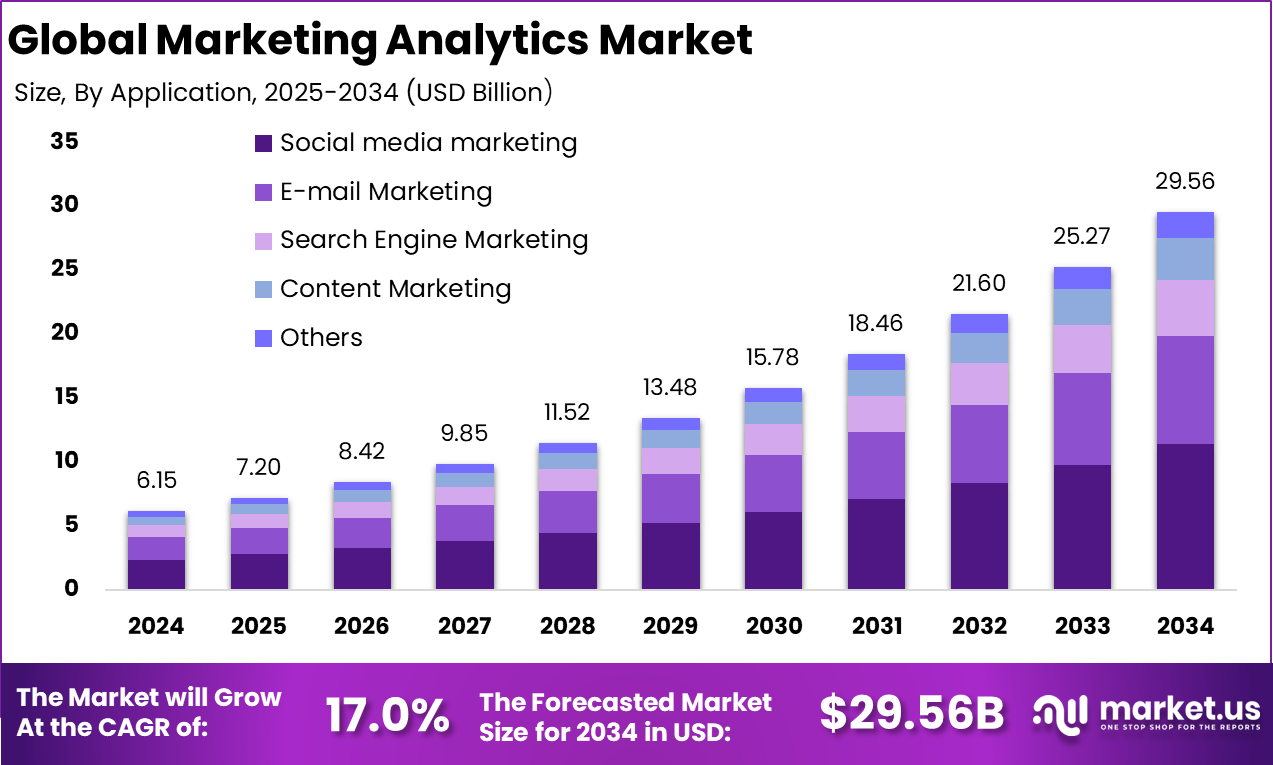
The global marketing analytics market was valued at USD 6.15 billion in 2024 and is projected to reach approximately USD 29.56 billion by 2034, expanding at a CAGR of 17.0% during the forecast period from 2025 to 2034. In 2024, North America led the market with more than 37.2% share, generating around USD 2.28 billion in revenue, supported by strong adoption of data driven marketing and advanced analytics tools.
The Marketing Analytics Market refers to software and analytical tools that help organizations measure, manage, and improve their marketing performance. These solutions collect data from multiple marketing channels such as digital advertising, social media, email, and websites. Marketing analytics tools convert this data into insights that support better planning and execution of marketing strategies. The market includes platforms for reporting, attribution, customer analysis, and campaign performance tracking.
Marketing analytics plays a central role in data-driven marketing operations. It helps organizations understand customer behavior and marketing effectiveness. These tools support both strategic and operational decision making. As marketing activities become more digital, analytics has become a core business function.
Key Takeaway
- Social media marketing led application usage with a 38.7% share.
- On premises deployment accounted for 55.4% of total adoption.
- Large enterprises represented 68.2% of overall adoption.
- Retail and consumer goods captured a 36.8% share.
- North America held a 37.2% share.
- The U.S. marketing analytics market reached USD 1.96 billion in 2024.
- The U.S. market is expanding at a 14.7% growth rate.
Performance and ROI Benchmarks
- Global e commerce conversion rates remain below 2%.
- B2C email delivers an average conversion rate of 2.8%.
- B2B email delivers an average conversion rate of 2.4%.
- Short form video is identified as the highest ROI format by 21% of marketers.
- Email segmentation improves open rates by 30%.
- Email segmentation increases click through rates by 50%.
- 86% of executives using predictive analytics for over two years report improved ROI.
Current Challenges
- 98% of marketers acknowledge the need for a unified cross channel view.
- 71% of marketers still measure performance in isolated silos.
- Only 33% of marketers can access insights quickly enough to act.
- Just 1.9% of companies are confident they have the right analytics talent.
- 87% of marketers identify data as their most under utilized asset.
Emerging Trends in 2025
- 19.65% of marketers plan to deploy AI agents in 2025.
- First party data adoption is increasing as third party cookies decline.
- Digital audio advertising spend is expected to exceed USD 12.16 billion in 2025.
Demand Analysis
Demand for marketing analytics solutions is driven by the growing complexity of marketing channels and customer journeys. Organizations operate across multiple platforms and need unified visibility into performance. Manual analysis is often insufficient to handle large and fast-moving data sets. Marketing analytics tools address this need by providing structured and automated insights.
Another factor supporting demand is the increasing focus on return on marketing investment. Businesses are under pressure to justify marketing spend with measurable outcomes. Analytics enables tracking of campaign impact and customer engagement. This demand is strong across both large enterprises and small businesses seeking efficiency.
Increasing Adoption Technologies
Marketing analytics solutions use technologies such as data analytics, machine learning, and artificial intelligence. These technologies help identify patterns in customer behavior and predict future outcomes. Automation supports real-time analysis and faster decision making. Advanced visualization tools also improve insight interpretation.
Cloud computing supports adoption by enabling scalable data processing and integration. Marketing analytics platforms often connect with customer relationship management systems and advertising platforms. Identity resolution and data management technologies improve accuracy across channels. These technologies together enhance the value of analytics solutions.
One key reason for adopting marketing analytics is improved campaign performance. Organizations can identify what works and what does not across channels. This allows better allocation of marketing budgets. Data-driven decisions reduce guesswork in marketing planning. Another reason is improved customer understanding. Analytics tools help segment audiences and personalize messaging. This leads to more relevant customer interactions. Adoption also supports faster response to market trends and customer preferences.
Emerging Trend Analysis
The Marketing Analytics Market is being shaped by the growing use of artificial intelligence to generate predictive insights that guide campaign strategy. This shift allows organizations to forecast customer behavior and optimize marketing spend with greater precision. Tools that blend machine learning with customer data are increasingly adopted to identify trends and anticipate future demand. As a result, marketing decisions are becoming more proactive and outcomes are aligned more closely with business performance metrics.
Another emerging trend is the integration of real-time analytics with omnichannel marketing platforms. Marketers are seeking unified views of customer interactions across web, mobile, social media, and in-store channels. Real-time analytics supports dynamic personalization and immediate response to consumer signals. This capability enhances customer engagement and enables rapid adjustment of campaigns to maximize relevance and impact.
Driver Analysis
A primary driver of market growth is the increasing volume of consumer data generated across digital touchpoints. Social media interactions, e-commerce behavior, and mobile engagement provide rich datasets that can be analyzed to reveal patterns and preferences. Organizations are investing in analytics solutions that can harness this data to inform segmentation, targeting, and performance measurement. The availability of detailed customer insights supports efficient allocation of marketing budgets.
Another driver is the pressure on businesses to demonstrate return on investment from marketing activities. Traditional measures of success are being replaced with data-driven performance indicators that can be quantified and reported. Marketing analytics tools provide robust measurement frameworks that link activities to revenue outcomes. As accountability becomes more central to marketing strategy, investment in analytics technologies continues to increase.
Restraint Analysis
One restraint on market growth is the complexity of integrating disparate data sources into a unified analytics framework. Many organizations operate multiple systems for customer relationship management, advertising, sales, and service. Aggregating this data into a consistent format for analysis requires significant technical effort. Resource constraints and limited integration expertise can slow implementation and reduce the effectiveness of analytics initiatives.
Another restraint stems from concerns over data privacy regulations that limit access to certain types of consumer information. Laws such as data protection regulations impose restrictions on data collection, storage, and use. Compliance requirements can limit the ability of analytics platforms to access complete datasets. As marketers navigate privacy constraints, the depth and accuracy of insights may be affected.
Opportunity Analysis
Significant opportunity exists in the application of advanced analytics to support hyper-personalization at scale. By leveraging customer profiles, predictive models, and real-time behavior signals, organizations can deliver tailored experiences that increase loyalty and conversion. This level of personalization fosters stronger customer relationships and enhances lifetime value. As personalization becomes a competitive differentiator, analytics solutions that enable these capabilities are expected to gain traction.
Another opportunity lies in the convergence of marketing analytics with artificial intelligence to automate routine decision tasks. AI-driven analytics can recommend optimal campaign parameters, budget allocations, and audience segments without manual intervention. This automation reduces workload for marketing teams and accelerates execution. As organizations seek efficiency and agility, AI-enabled analytics solutions are positioned for broader adoption.
Challenge Analysis
A major challenge for the market is maintaining data quality and accuracy in an environment of rapidly growing data volume. Inaccurate or inconsistent data can lead to flawed insights and misguided decisions. Establishing robust data governance practices is essential to ensure trust in analytics outputs. Organizations must invest in cleansing, validation, and monitoring processes to maintain high data integrity.
Another challenge is the shortage of skilled professionals who can interpret complex analytical results and translate them into actionable strategy. Data scientists and analysts with expertise in marketing contexts are in high demand, but talent shortages persist. Without skilled personnel, the full potential of analytics investments may not be realized. Addressing this skills gap is critical to maximizing the value derived from marketing analytics technologies.
Key Market Segments
By Application
- Social media marketing
- E-mail Marketing
- Search Engine Marketing
- Content Marketing
- Others
By Deployment Model
- Cloud
- On-Premises
By Organization Size
- SME
- Large Enterprises
By End User
- Retail & Consumer Goods
- Social media marketing
- E-mail Marketing
- Search Engine Marketing
- Content Marketing
- Others
- BFSI
- Social media marketing
- E-mail Marketing
- Search Engine Marketing
- Content Marketing
- Others
- Healthcare
- Social media marketing
- E-mail Marketing
- Search Engine Marketing
- Content Marketing
- Others
- Media & Communication
- Social media marketing
- E-mail Marketing
- Search Engine Marketing
- Content Marketing
- Others
- Industrial
- Social media marketing
- E-mail Marketing
- Search Engine Marketing
- Content Marketing
- Others
- Others
By Region
- North America
- Latin America
- Europe
- Asia-pacific
- Middle and East Africa
Top Key Players in the Market
- Accenture PLC
- Adobe Systems, Inc.
- CleverTap
- Experian PLC
- HubSpot
- IBM Corporation
- Mailchimp
- McKinsey & Company
- Microsoft Corporation
- NGDATA, Inc.
- Oracle Corporation
- Pegasystems, Inc.
- Salesforce
- SAS Institute, Inc.
- SAP SE
- Semrush
- Supermetrics
- Teradata Corporation
- Wipro Ltd.
- Others
Report Scope
| Report Features | Description |
|---|---|
| Market Value (2024) | USD 6.1 Bn |
| Forecast Revenue (2034) | USD 29.5 Bn |
| CAGR(2025-2034) | 17% |
| Base Year for Estimation | 2024 |
| Historic Period | 2020-2023 |
| Forecast Period | 2025-2034 |
Discuss your needs with our analyst
Please share your requirements with more details so our analyst can check if they can solve your problem(s)