Table of Contents
MarTech Data Platform Market Size
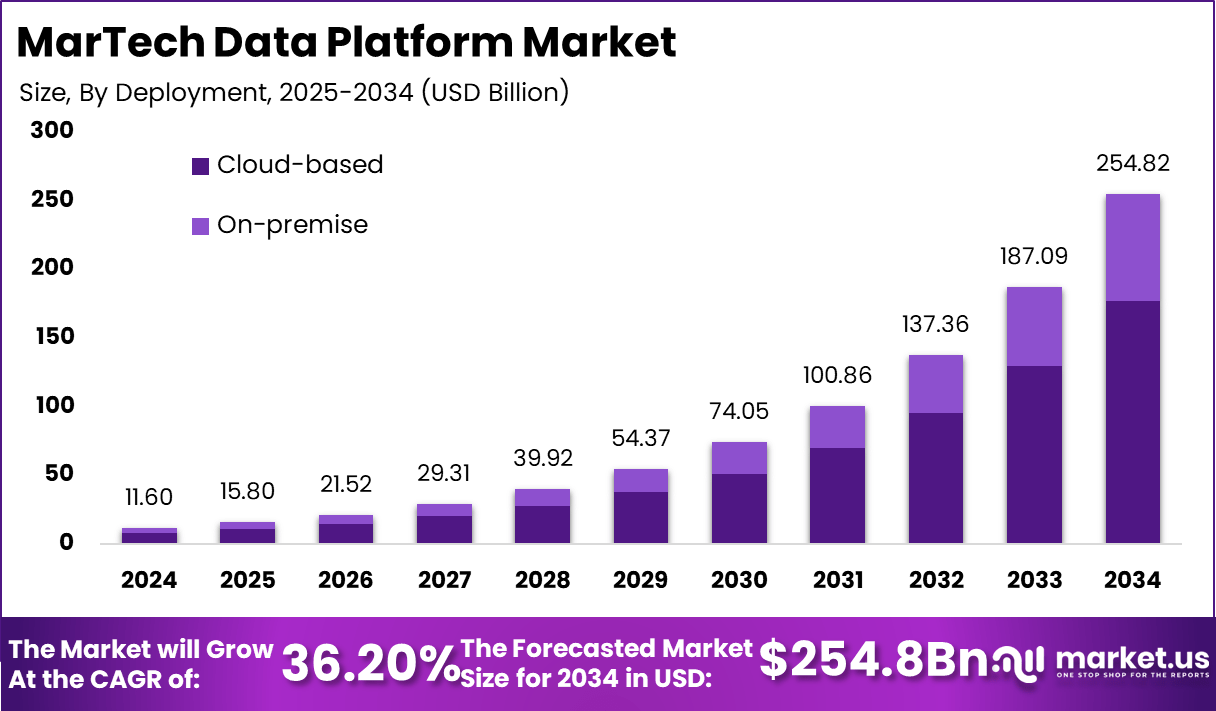
The MarTech Data Platform market reached a valuation of USD 11.6 billion in 2024 and is expected to expand at a strong CAGR of 36.20% through the forecast period. Market revenue is projected to reach approximately USD 254.8 billion by 2034, reflecting rapid adoption across industries. This growth is supported by rising demand for omnichannel customer engagement and increased use of real time marketing analytics. Enterprise wide digital transformation initiatives are also accelerating platform adoption.
The MarTech data platform market refers to software solutions that centralize, unify, and activate marketing data from disparate sources to support customer insights, campaign execution, and performance measurement. These platforms collect data from digital channels, customer interactions, CRM systems, and third party sources to create unified customer profiles. MarTech data platforms support segmentation, personalization, attribution, and analytics that improve marketing effectiveness. Adoption spans enterprises and medium sized businesses aiming to optimize campaigns and deepen customer engagement.
Market Key Takeaways
- The MarTech Data Platform market reached USD 11.6 billion in 2024, reflecting strong enterprise investment in data driven marketing infrastructure and customer intelligence platforms.
- Market expansion remained aggressive, supported by a 36.20% growth pace throughout the forecast period. This growth was driven by rising demand for unified customer data, real time personalization, and AI enabled marketing workflows.
- The global market value was projected to reach USD 254.8 billion by 2034, indicating long term structural adoption across industries.
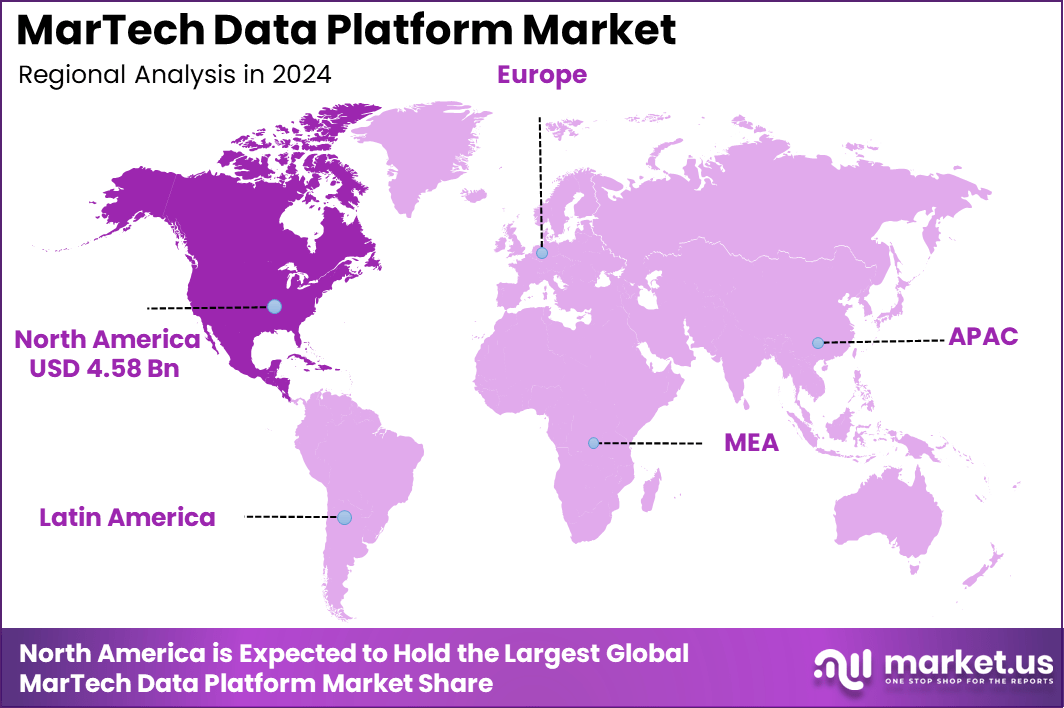
- North America accounted for a 39.5% share in 2024, with a market size of USD 4.58 billion, supported by advanced digital marketing maturity and high enterprise software spending.
- The U.S. market generated USD 4.15 billion in 2024 and was expected to reach USD 76.31 billion by 2034, advancing at a 33.8% growth rate due to rapid adoption of data driven marketing strategies.
- By platform type, Customer Data Platforms dominated with a 56.8% share, highlighting enterprise focus on centralized customer profiles and cross channel data unification.
- By deployment model, cloud based platforms led with 69.4% adoption, reflecting demand for scalability, faster deployment, and seamless integration with existing marketing stacks.
- By organization size, large enterprises held 72.1% share, driven by complex customer journeys, higher data volumes, and larger marketing technology budgets.
- By application, campaign management and measurement accounted for 52.3% adoption, as marketers prioritized performance tracking, attribution, and ROI optimization.
- By end user, the retail sector led with a 31.9% share, supported by strong reliance on personalization, omnichannel engagement, and customer lifetime value optimization.
Regional Analysis
North America held a dominant position in the global market, accounting for 39.5% of total revenue in 2024. The region generated around USD 4.58 billion, supported by mature digital infrastructure and early adoption of cloud based marketing technologies. Strong enterprise investment in customer data unification and personalization tools further strengthened regional leadership. As a result, North America continued to influence platform innovation and market maturity.
Top Driving Factors
One major driving factor of the MarTech data platform market is the rising demand for personalized customer experiences. Customers expect relevant and timely messaging across digital and physical touchpoints. MarTech data platforms enable brands to tailor interactions based on individual behaviour and preferences. Enhanced personalization improves campaign relevance and customer satisfaction.
Another key driver is the need for integrated performance measurement. Marketing leaders require unified metrics to assess channel effectiveness and return on investment. Disparate systems often produce inconsistent or delayed results. MarTech data platforms consolidate performance data and support real time analytics, empowering stakeholders with actionable insights.
Demand Analysis
Demand for MarTech data platforms is influenced by accelerated digital transformation across industries. As organizations adopt more digital channels, complexity in data flows increases. Marketers seek solutions that reduce fragmentation and support cohesive strategies. This demand is strong in sectors such as retail, financial services, travel, and telecommunications.
Demand is also shaped by expectations for data driven decision making. Marketing teams increasingly rely on insights to optimize spend, refine targeting, and anticipate customer needs. MarTech data platforms provide the analytical capabilities necessary to inform these decisions. As competition intensifies, organizations prioritize platforms that strengthen marketing responsiveness.
Increasing Adoption Technologies
Artificial intelligence and machine learning technologies are central to MarTech data platform adoption. These technologies automate customer segmentation, predictive scoring, and anomaly detection. AI enables platforms to identify patterns in large datasets that may elude manual analysis. Operational efficiency and insight quality improve as AI capabilities expand.
Cloud computing infrastructure also accelerates adoption by offering scalable data storage and processing. Cloud based platforms allow organizations to manage large volumes of marketing data without heavy on premises investment. This supports flexible deployment, rapid onboarding, and integration across digital ecosystems. Cloud integration aligns with modern enterprise architecture trends.
Key Reasons
One key reason organizations adopt MarTech data platforms is improved customer understanding. Unified data provides a holistic view of customer behaviour and preferences. This clarity enables targeted engagement and individualized experiences. Enhanced understanding supports stronger relationships and long term loyalty.
Another reason is streamlined marketing operations. MarTech data platforms centralize segmentation, orchestration, and analytics tasks that are otherwise fragmented. This consolidation reduces manual processes and improves collaboration across teams. The result is faster campaign execution and greater operational alignment.
Investment Opportunities
Investment opportunities in the MarTech data platform market exist in platforms that offer real time, AI enabled decision support. Solutions that integrate predictive analytics, cross channel attribution, and automated campaign triggers can deliver strong value. Investors may focus on tools that bridge data and execution seamlessly. Platform extensibility and partner ecosystem integration are key differentiators.
Another opportunity lies in solutions tailored to vertical market needs. Industries such as healthcare, automotive, and retail have unique data structures and regulatory requirements. MarTech data platforms designed for these segments can capture specialized demand. Focused offerings with compliance and domain specific analytics support deeper adoption.
Business Benefits
Adoption of MarTech data platforms improves marketing efficiency and accountability. Unified data supports more precise targeting, reduced waste, and optimized media allocation. Marketers can measure performance more effectively and adjust strategies in real time. These benefits contribute to better resource utilization and campaign results.
MarTech data platforms also foster stronger alignment between marketing and business outcomes. Data driven insights support strategic planning and customer experience design. This alignment improves cross functional collaboration and leadership confidence in marketing investments. Over time, these benefits strengthen organizational performance and competitive advantage.
Regulatory Environment
The regulatory environment for the MarTech data platform market is influenced by data privacy and protection laws. Platforms must ensure compliance with regulations such as GDPR, CCPA, and similar frameworks that govern personal data collection and use. Consent management and secure data handling are essential to maintain legal conformity. Transparent practices help build trust with customers and regulators.
Industry specific compliance requirements also affect platform implementation. Sectors such as healthcare and finance require stringent controls over data access and retention. MarTech data platforms must incorporate governance, audit trails, and access controls to meet these standards. Maintaining regulatory alignment supports sustainable operations and reduces legal risk.
Key Market Segments
By Platform Type
- Customer Data Platforms (CDPs)
- Data Management Platforms (DMPs)
- Analytics & Insights Platforms
- Others
By Deployment
- Cloud-based
- On-premise
By Organization Size
- Large Enterprises
- SMEs
By Application
- Customer Segmentation & Profiling
- Personalization & Targeting
- Campaign Management & Measurement
- Customer Journey Analytics
- Others
By End-User
- Retail
- BFSI
- Technology, Media, & Telecom (TMT)
- Travel
- Healthcare
- Discrete Manufacturing
- Others
Top Key Players in the Market
- Salesforce
- Adobe
- Oracle
- Microsoft
- SAP
- HubSpot
- Tealium
- Segment
- mParticle
- Bloomreach
- ActionIQ
- Lytics
- Zeotap
- Acquia
- Others
Report Scope
| Report Features | Description |
|---|---|
| Market Value (2024) | USD 11.6 Billion |
| Forecast Revenue (2034) | USD 254.8B Billion |
| CAGR(2025-2034) | 36.20% |
| Base Year for Estimation | 2024 |
| Historic Period | 2020-2023 |
| Forecast Period | 2025-2034 |
Discuss your needs with our analyst
Please share your requirements with more details so our analyst can check if they can solve your problem(s)