Table of Contents
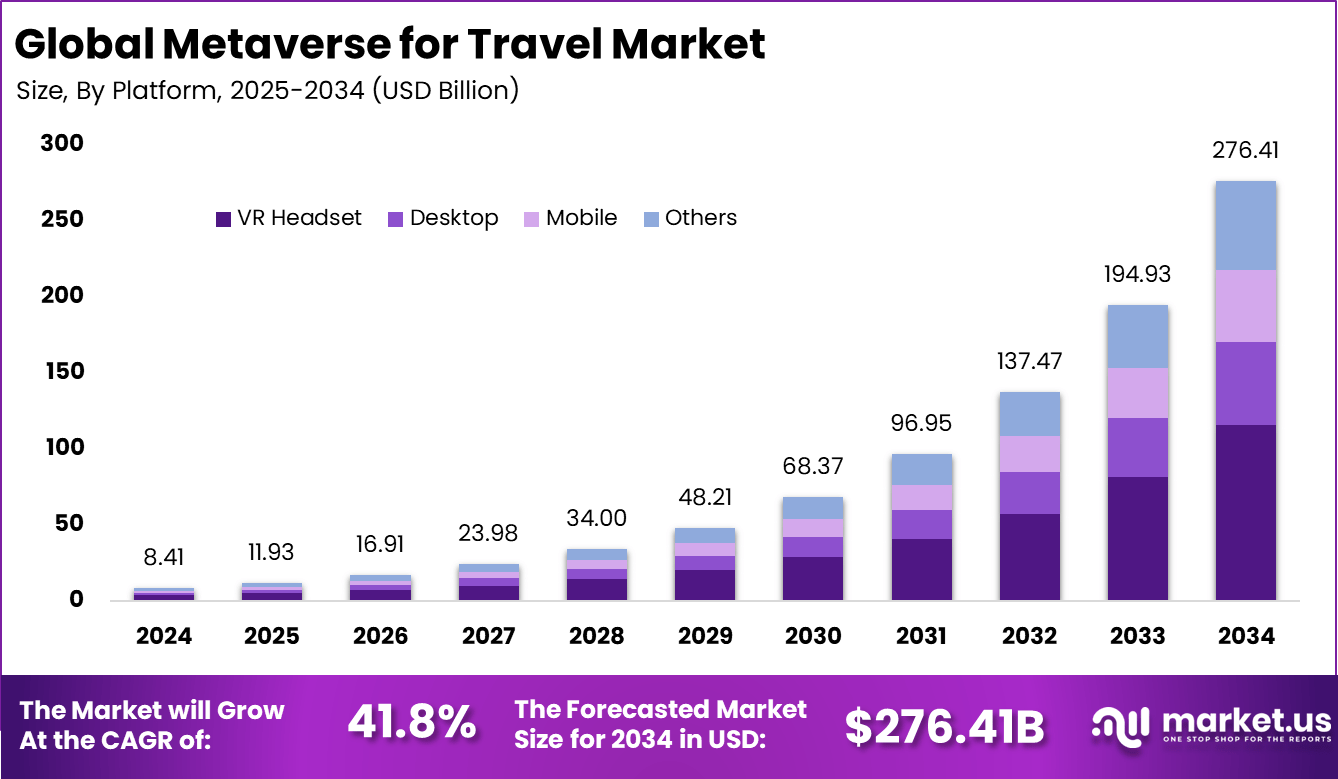
New York, NY – 2025: According to market.us, The global metaverse for travel market was valued at USD 8.41 billion in 2024 and is projected to reach approximately USD 276.41 billion by 2034, expanding at a CAGR of 41.8% during the forecast period from 2025 to 2034. In 2024, North America dominated the market with more than 43.8% share, generating around USD 3.68 billion in revenue, supported by early adoption of immersive travel technologies and strong digital infrastructure.
Buy this research report now and save 60% in the Christmas Sale@ https://market.us/purchase-report/?report_id=167769

Key Takeaways
- VR headsets led with 41.8%, showing strong demand for immersive hardware to preview travel experiences.
- The virtual reality segment dominated at 42.6%, confirming VR as the core technology for interactive travel engagement.
- Virtual tours captured 48.3%, as travelers increasingly explore destinations digitally before booking.
- Travel agencies held a strong 67.8% share, using metaverse tools for destination previews, planning, and customer engagement.
- The U.S. market reached USD 3.32 billion in 2024, growing at a robust 38.5% CAGR due to rapid tech adoption.
- North America led globally with over 43.8% share, supported by advanced digital infrastructure and active investment in immersive travel solutions.
Adoption and Usage Insights
- Global metaverse user penetration is expected to reach 17.4% in 2025, rising to 39.7% by 2030.
- Total global metaverse users are projected to hit 2.6 billion by 2030, indicating mass-market adoption.
- North America remains a key early-adopter region with strong market presence.
- In India, metaverse penetration is projected at 12.4% in 2025, showing growing interest.
- AR and VR adoption in India is expanding, with 44.8% user penetration expected in 2025.
Market Overview
The metaverse for travel market focuses on the use of immersive digital environments to support travel planning, destination marketing, virtual tourism, and customer engagement. Through virtual reality, augmented reality, and interactive 3D spaces, travelers can explore destinations, hotels, cruise ships, and attractions before making booking decisions. This market supports tourism boards, airlines, hotels, and travel platforms by enhancing customer experience and reducing uncertainty during trip planning. As digital engagement becomes central to travel decisions, metaverse tools are being used as a complementary channel to traditional travel services.
This market plays a crucial role in reshaping how travelers discover and evaluate destinations. Virtual environments allow users to experience landmarks, room layouts, and local culture without physical travel. This improves confidence in booking decisions and helps destinations reach global audiences. For tourism authorities, metaverse platforms support digital storytelling and destination branding. Studies show that immersive previews can increase booking intent by over 30% compared to static images or videos.
Top Driving Factors
Growth is driven by increasing demand for immersive digital experiences and the recovery of global travel activity. Travelers are spending more time researching trips online and expect richer content. Advances in virtual reality hardware, faster internet connectivity, and cloud based rendering have improved accessibility. Social media driven travel inspiration has also encouraged destinations to invest in immersive experiences. Industry surveys indicate that more than 65% of travelers prefer interactive content when planning trips.
Demand for metaverse travel solutions is rising among tourism boards, luxury hotels, cruise operators, and travel agencies. These stakeholders use virtual environments to showcase experiences and differentiate offerings. Demand is also growing in education focused and accessible tourism, where virtual travel provides alternatives for users unable to travel physically. Research suggests that virtual destination experiences can reduce booking cancellations by nearly 20% by setting realistic expectations.
Increasing Adoption Technologies
Key technologies supporting adoption include virtual reality headsets, web based 3D platforms, augmented reality applications, and digital twins of real world locations. Artificial intelligence is used to personalize experiences and guide users through virtual journeys. Cloud computing supports large scale access without high local hardware requirements. Industry data indicates that over 70% of immersive travel experiences are now accessible through standard web browsers or mobile devices.
Travel organizations adopt metaverse solutions to improve customer engagement and marketing efficiency. Virtual experiences shorten decision cycles and improve conversion rates. These tools also support sustainable tourism by reducing unnecessary exploratory travel. Cost efficiency is another reason, as digital experiences can reach millions without physical infrastructure. Surveys show that over 55% of travel marketers see immersive platforms as a long term engagement tool.
Investment and Business Benefits
Investment opportunities exist in virtual destination creation, immersive booking platforms, digital experience design, and integration with existing travel systems. Opportunities are also emerging in virtual events, cultural experiences, and destination based commerce. Developing regions are investing in digital tourism to attract global attention. Technology investment trends show immersive experience spending growing by more than 25% annually across travel and hospitality use cases.
Metaverse based travel solutions deliver clear business benefits such as higher engagement, improved brand visibility, and better booking confidence. Interactive experiences increase time spent with content and improve lead quality. Businesses also gain valuable behavioral data to refine offerings. Industry case studies report up to 35% improvement in customer engagement metrics for immersive travel campaigns.
Key Market Segments
By Platform
- Desktop
- Mobile
- VR Headset
- Others
By Technology
- Virtual Reality
- Augmented Reality
- Mixed Reality
- Blockchain
- Others
By Application
- Virtual Tours
- Hotel Bookings
- Destination Marketing
- Travel Planning
- Others
By End-User
- Travel Agencies
- Hotels & Resorts
- Tourism Boards
Top Key Players in the Market
- Meta
- Microsoft
- Airbnb
- Booking Holdings
- Expedia Group
- Accenture
- NVIDIA
- Unity
- Roblox
- Decentraland
- The Sandbox
- Somnium Space
- VIVE
- Tripadvisor
- Others
Driver Analysis
Rising Demand for Pre-Travel Experience Tools
A key driver for this market is the increasing demand from travelers to preview destinations before booking physical trips. Many consumers prefer to explore attractions, accommodations, and local experiences in immersive digital settings to better inform their choices. Virtual reality and 3D tour environments provide users with a clear sense of place, helping reduce uncertainty and strengthen confidence in travel decisions. This trend supports wider adoption of metaverse platforms by travel brands seeking to influence travelers earlier in their decision process.
Another driver is the growing integration of digital engagement within the travel journey. As mobile and internet usage rises, travelers increasingly expect interactive and visually rich content. Metaverse platforms enable enriched digital engagement through simulated environments and interactive interfaces. Travel brands that offer virtual previews and immersive storytelling can capture traveler interest more effectively compared to static imagery or text-based content.
Restraint Analysis
High Development and Adoption Costs
One restraint for the metaverse for travel market is the high cost of developing and implementing immersive virtual platforms. Creating realistic digital environments, maintaining high-quality user interfaces, and integrating these systems with existing booking platforms require substantial investment. Smaller travel operators may find these costs difficult to justify, especially when traditional digital tools still support core customer needs.
Another restraint comes from varying levels of traveler adoption. Not all travelers are familiar with or willing to use virtual environments for planning travel. Some travelers prefer traditional research methods such as brochures, reviews, or direct bookings. This mixed level of adoption can slow overall uptake of metaverse tools across the travel sector.
Opportunity Analysis
Expansion of Virtual Engagement in Travel Planning
An opportunity exists in offering comprehensive virtual engagement tools that enhance traveler planning and inspire experiential exploration. Travel brands can use virtual previews to highlight unique features of destinations, accommodations, and activities in ways that static content cannot match. This can help differentiate offerings and build emotional connection with potential travelers early in the planning phase.
Another opportunity lies in extending virtual experiences to post-booking support and trip augmentation. Travelers could use metaverse platforms during their trip to navigate local areas, interact with guides in virtual formats, or access contextual information based on their physical location. This convergence of virtual and physical travel enhances value for travelers and strengthens brand loyalty.
Challenge Analysis
Technical and User Experience Barriers
A major challenge in this market is ensuring that virtual platforms deliver high-quality user experiences that match traveler expectations. Creating lifelike environments, intuitive navigation, and seamless integration with booking and support systems requires advanced technical capability. Poorly designed experiences can deter users and reduce the perceived value of metaverse tools.
Another challenge lies in standardization and interoperability across travel brands and platforms. Without common technical frameworks, travelers may encounter fragmented virtual environments that differ widely in quality and usability. Ensuring consistency in experience across destinations, hotels, or tours adds complexity to platform development and long-term support.
Future Outlook and Opportunities
The future outlook for the metaverse for travel market remains positive as immersive technologies mature and user adoption increases. Growth opportunities are expected in hybrid travel models that combine physical and digital experiences. Virtual previews, digital concierge services, and immersive loyalty programs will gain traction. As younger travelers seek experience driven planning, immersive travel platforms will become a standard marketing and engagement channel. Industry outlook surveys suggest that over 75% of destination marketers plan to expand immersive digital initiatives.
Report Scope
| Report Features | Description |
|---|---|
| Market Value (2024) | USD 8.41 Bn |
| Forecast Revenue (2034) | USD 276.4 Bn |
| CAGR(2025-2034) | 41.8% |
| Base Year for Estimation | 2024 |
| Historic Period | 2020-2023 |
| Forecast Period | 2025-2034 |
| Report Coverage | Revenue forecast, AI impact on Market trends, Share Insights, Company ranking, competitive landscape, Recent Developments, Market Dynamics and Emerging Trends |
Discuss your needs with our analyst
Please share your requirements with more details so our analyst can check if they can solve your problem(s)