Table of Contents
Report Overview
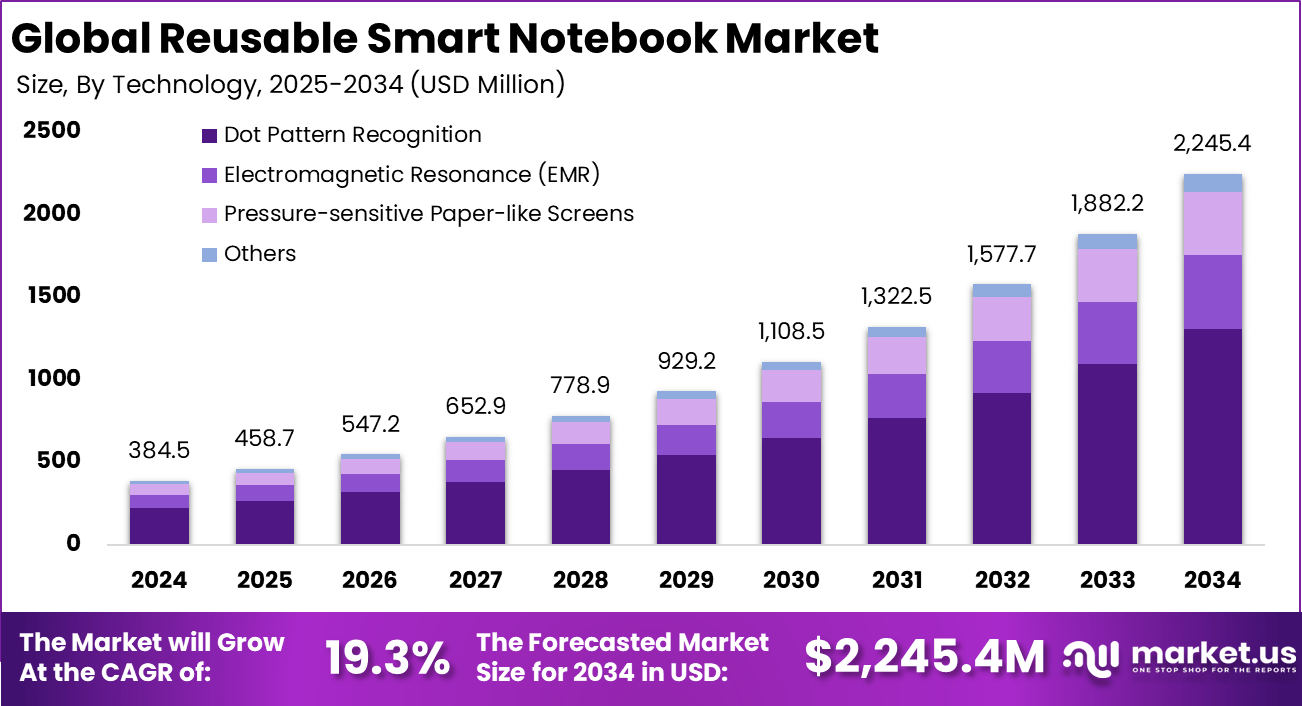
The global Reusable Smart Notebook market was valued at USD 384.5 million in 2024 and is expected to expand rapidly over the forecast period. The market is projected to reach approximately USD 2,245.4 million by 2034, growing at a CAGR of 19.3% from 2025 to 2034. This growth is driven by increasing demand for eco friendly stationery and rising adoption of digital note taking solutions in education and professional settings. Integration of cloud connectivity and handwriting digitization features is further supporting market expansion.
The reusable smart notebook market refers to digital writing notebooks that allow users to write by hand and reuse pages multiple times. These notebooks typically work with erasable surfaces and companion mobile applications that scan and store handwritten notes digitally. Reusable smart notebooks are used by students, professionals, educators, and creative users. They combine traditional handwriting with digital storage and organization. Adoption supports paper reduction and improved note management.
Key Takeaway
- Dot pattern recognition technology led with a 58.3% share, as it enables precise capture of handwritten content and smooth synchronization with digital platforms.
- Online retail dominated distribution at 61.7%, supported by direct-to-consumer sales models, broader product visibility, and rising preference for e-commerce channels.
- Note-taking applications for students and professionals accounted for 52.4%, reflecting demand for reusable solutions that blend handwriting with digital storage.
- Students represented 48.9% of end users, driven by adoption in academic settings focused on sustainability, organization, and digital learning habits.
- North America captured 32.6%, supported by high uptake of smart learning tools and eco-friendly stationery alternatives.
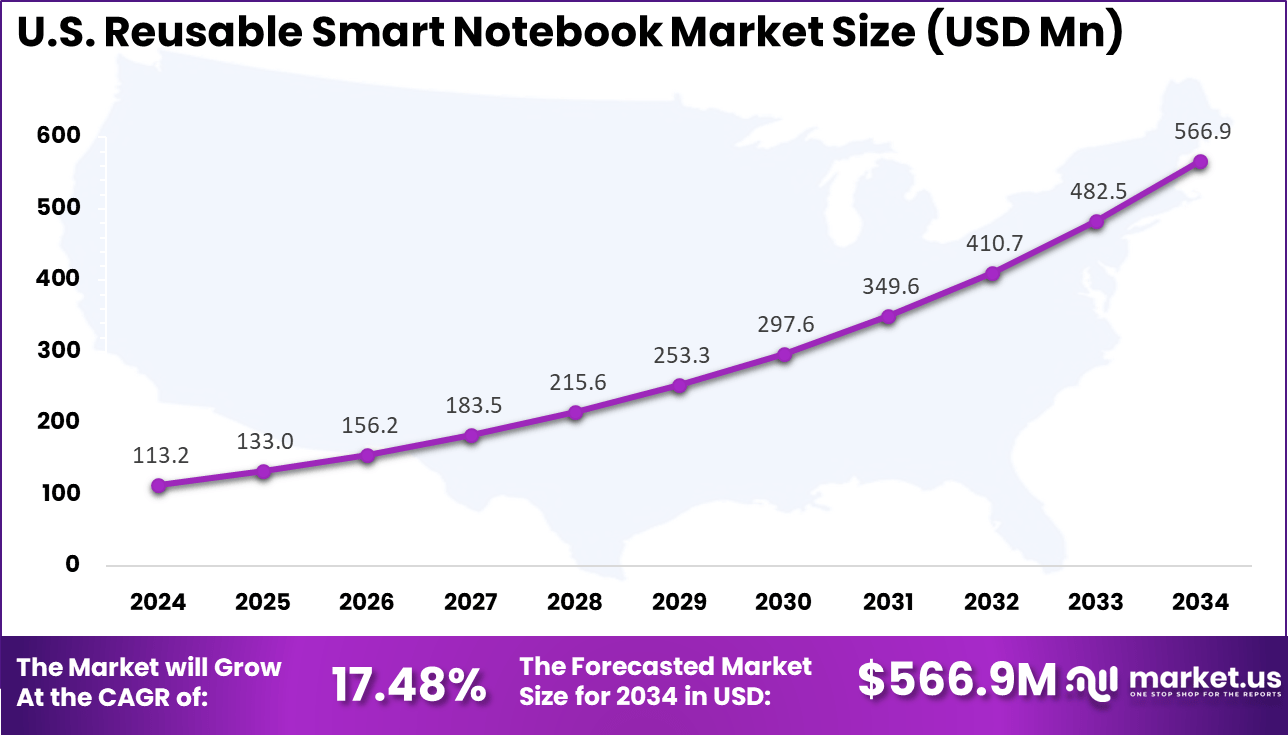
- The U.S. market reached USD 113.2 Million in 2024 and is expanding at a 17.48% CAGR, driven by growing digital note-taking practices and awareness of reusable writing products.
Regional Analysis
North America held a dominant position in the global market, accounting for more than 32.6% of total revenue. The region generated around USD 125.3 million, supported by strong adoption of smart learning tools and high awareness of sustainable products. Early use of reusable writing technologies across schools and enterprises strengthened regional leadership. As a result, North America continues to influence growth and innovation trends in the reusable smart notebook market.

The United States reached USD 113.2 Million with a CAGR of 17.48%, reflecting healthy market expansion. Growth is driven by student adoption and professional use. Sustainability awareness also supports demand. Innovation in smart stationery continues. Market momentum remains positive.
Driver Analysis
The reusable smart notebook market is being driven by the increasing demand for sustainable and efficient note-taking solutions that bridge analog workflows with digital productivity. Users across education, corporate, and creative sectors are seeking tools that reduce paper waste while enabling seamless digitisation of handwritten content.
Smart notebooks integrate with mobile applications and cloud services to capture, organise, and store notes, sketches, and meeting insights in digital formats, improving accessibility and collaboration. This convergence of traditional writing experiences with digital convenience enhances productivity and aligns with organisational and consumer preferences for eco-friendly, technology-augmented stationery solutions.
Restraint Analysis
A significant restraint in the reusable smart notebook market stems from the perception of higher upfront costs relative to traditional notebooks and digital devices. Even though reusable notebooks offer long-term value through repeated use, initial purchase prices can be a deterrent for budget-conscious users, particularly in price-sensitive education and small business segments.
Additionally, some users may encounter usability barriers related to application integration, device compatibility, and learning new digital workflows, which can slow adoption. Concerns about the reliability of digital capture and organisation features, especially in environments with limited connectivity, further constrain market growth.
Opportunity Analysis
Emerging opportunities in the reusable smart notebook market are linked to the expansion of hybrid learning and remote work paradigms that demand versatile, connected tools. Integration with collaboration platforms, note analytics, and AI-enabled summarisation services can enhance the utility of smart notebooks as central components of personal and professional knowledge workflows.
Customisation features that support specialised use cases – such as project planning, creative ideation, or task management – can attract diverse user segments seeking tailored productivity solutions. Partnerships with educational institutions, technology platforms, and enterprise software ecosystems present avenues to embed reusable smart notebooks into broader digital infrastructure, fostering deeper engagement and recurring value.
Challenge Analysis
A central challenge confronting this market relates to balancing hardware simplicity with robust digital functionality and user experience. While smart notebooks must retain the familiar feel of traditional paper for broad appeal, they also need intuitive, reliable software features that justify their premium positioning.
Ensuring seamless capture accuracy across varying handwriting styles, lighting conditions, and device cameras requires ongoing refinement of optical character recognition and syncing technologies. Furthermore, maintaining data security and privacy in cloud-connected services is essential to build trust among users who handle sensitive personal or organisational information.
Emerging Trends
Emerging trends in the reusable smart notebook landscape include deeper integration of artificial intelligence to enhance digitised content with features such as automated summarisation, search-by-concept, and contextual organisation. Users increasingly expect tools that not only capture notes but also help interpret and prioritise them.
Another trend is the adoption of modular notebook systems that allow custom layouts, specialised templates, and domain-specific content structures that support workflows in project management, design thinking, and structured learning. Connectivity with virtual whiteboards, collaboration suites, and task management applications is also gaining traction as users seek unified productivity ecosystems.
Growth Factors
Growth in the reusable smart notebook market is anchored in rising environmental consciousness and the shift toward digital-first work and learning environments. Organisations and individuals prioritise solutions that reduce resource consumption while enhancing knowledge capture and sharing. Technological advancements in cloud services, mobile applications, and machine learning improve the effectiveness of smart notebook platforms and broaden their functional appeal. Increased remote collaboration, hybrid education models, and demand for flexible productivity tools continue to reinforce interest in smart, sustainable alternatives to traditional stationery, supporting long-term market momentum.
Key Market Segments
By Technology
- Dot Pattern Recognition
- Electromagnetic Resonance (EMR)
- Pressure-sensitive Paper-like Screens
- Others
By Distribution Channel
- Online Retail
- Offline Retail
- Direct-to-Consumer (Brand Websites)
By Application
- Note-taking for Students & Professionals
- Sketching & Drawing for Artists
- Meeting & Lecture Transcription
- Project Planning & Brainstorming
- Others
By End-User
- Students
- Professionals & Corporate Users
- Artists & Designers
- Others
Top Key Players in the Market
- Rocketbook
- Moleskine S.p.A.
- reMarkable AS
- boogie board
- Wacom Co., Ltd.
- Livescribe, Inc.
- Elfinbook
- Syncbooks
- Notejoy
- MOYUAN
- Papier
- Genius
- Milanote Pty Ltd
- Appointed
- Whitelines, Ltd.
- Others
Report Scope
| Report Features | Description |
|---|---|
| Market Value (2024) | USD 384.5 Mn |
| Forecast Revenue (2034) | USD 2,245.4 Mn |
| CAGR(2025-2034) | 19.3% |
| Base Year for Estimation | 2024 |
| Historic Period | 2020-2023 |
| Forecast Period | 2025-2034 |
| Report Coverage | Revenue forecast, AI impact on Market trends, Share Insights, Company ranking, competitive landscape, Recent Developments, Market Dynamics and Emerging Trends |
Discuss your needs with our analyst
Please share your requirements with more details so our analyst can check if they can solve your problem(s)