Table of Contents
- Robot Safety Monitoring AI Market Introduction
- How Growth is Impacting the Economy
- Impact on Global Businesses
- Strategies for Businesses
- Key Takeaways
- Analyst Viewpoint
- Use Case and Growth Factors
- Regional Analysis
- Business Opportunities
- Key Segmentation Overview
- Key Player Analysis
- Recent Developments
- Conclusion
Robot Safety Monitoring AI Market Introduction
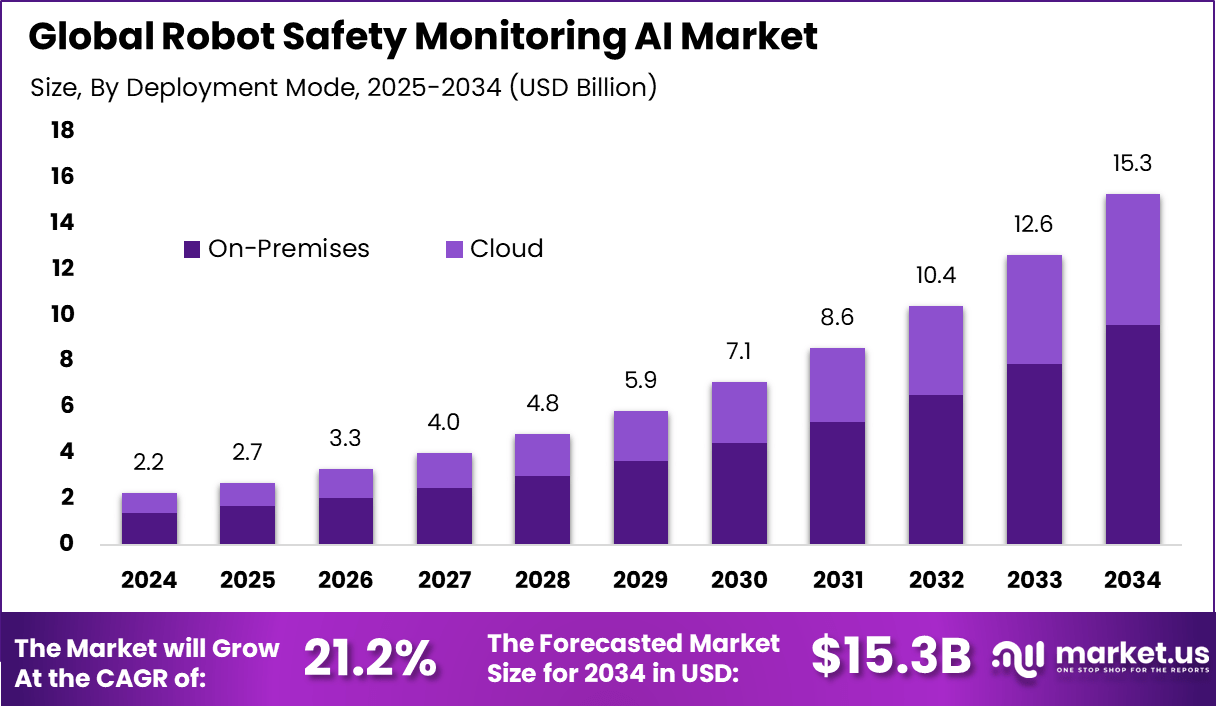
The global robot safety monitoring AI market is witnessing strong momentum as industries increasingly deploy autonomous and collaborative robots. The market generated USD 2.2 billion in 2024 and is projected to grow from USD 2.7 billion in 2025 to approximately USD 15.3 billion by 2034, registering a CAGR of 21.2% during the forecast period. Robot safety monitoring AI uses computer vision, machine learning, and real-time analytics to detect hazards and ensure safe human-robot interaction. North America held a dominant position in 2024 with over 36.3% share, supported by early automation adoption and strict workplace safety regulations.
How Growth is Impacting the Economy
The expansion of robot safety monitoring AI is positively influencing industrial productivity and workforce safety across global economies. As factories and warehouses automate operations, AI driven safety systems reduce workplace accidents, equipment damage, and unplanned downtime. This lowers compensation costs, improves operational continuity, and enhances overall efficiency.
Governments benefit through improved compliance with occupational safety standards and reduced strain on healthcare systems caused by industrial injuries. The market’s growth is also driving demand for AI engineers, safety specialists, and system integrators, creating high value employment opportunities. Over time, safer automation environments are encouraging wider robotics adoption, supporting industrial competitiveness, manufacturing reshoring, and long term economic digitization.
➤ Year-End Sale: Hurry Enjoy Upto 60% off @ https://market.us/purchase-report/?report_id=169792
Impact on Global Businesses
Rising Costs and Supply Chain Shifts
Businesses are facing higher upfront investments in AI powered safety sensors, software platforms, and system integration. However, supply chains are shifting toward standardized and modular safety solutions that reduce long term costs and simplify deployment across multiple facilities.
Sector-Specific Impacts
Manufacturing benefits from reduced accidents and improved compliance. Logistics and warehousing gain safer autonomous material handling operations. Automotive and electronics sectors rely on AI safety systems to support collaborative robots. Healthcare and service robotics adopt monitoring AI to ensure safe human interaction in dynamic environments.
Strategies for Businesses
Organizations are prioritizing the integration of robot safety monitoring AI at early stages of automation planning. Combining AI safety systems with vision sensors and edge computing improves real time response. Businesses are adopting scalable platforms that support multiple robot types and evolving regulations. Continuous workforce training and regular system updates are also critical strategies to maintain safety performance and compliance as robotic complexity increases.
Key Takeaways
- Robot safety monitoring AI supports safe human robot collaboration
- Market growth is driven by rapid automation and strict safety norms
- North America leads adoption due to advanced industrial infrastructure
- AI based monitoring reduces accidents and operational disruptions
- Long term demand is supported by collaborative and autonomous robots
➤ Unlock growth! Get your sample now! @ https://market.us/report/robot-safety-monitoring-ai-market/free-sample/
Analyst Viewpoint
Currently, robot safety monitoring AI is transitioning from reactive safety measures to proactive, predictive systems. Present adoption is strongest in manufacturing and logistics environments with high robot density. Looking ahead, the outlook remains highly positive as collaborative robots and autonomous systems expand into new sectors. Advances in computer vision and AI models are expected to further enhance accuracy and reliability. Over the forecast period, robot safety monitoring AI is anticipated to become a standard requirement across automated workplaces worldwide.
Use Case and Growth Factors
| Use Case | Description | Key Growth Factors |
|---|---|---|
| Human robot collaboration monitoring | Real time detection of unsafe proximity and movements | Rapid growth of collaborative robots in factories |
| Autonomous mobile robot safety | Monitoring navigation paths and obstacle avoidance | Expansion of warehouse and logistics automation |
| Industrial accident prevention | Predictive analysis to prevent collisions and injuries | Stricter workplace safety regulations |
| Vision based safety compliance | AI powered camera systems for hazard detection | Advances in computer vision and edge AI |
| Service robot safety | Ensuring safe interaction in healthcare and public spaces | Rising deployment of service robots |
Regional Analysis
North America dominates the robot safety monitoring AI market with more than 36.3% share, driven by advanced automation, early AI adoption, and strong regulatory frameworks. Europe follows with steady growth supported by stringent worker safety standards and Industry 4.0 initiatives. Asia Pacific is emerging as a high growth region due to expanding manufacturing automation and rising awareness of workplace safety. Other regions are gradually adopting safety AI as robotics penetration increases.
➤ Explore Huge Library Here –
- Robotics Training Services Market
- Travel Rewards Credit Card Market
- Self-Reconfigurable Robots Market
- Bank Statement Aggregation Market
Business Opportunities
Strong business opportunities exist in cloud connected and edge based robot safety monitoring platforms. Demand is rising for AI solutions that can be retrofitted into existing robotic systems. Small and medium enterprises present growth potential through cost optimized safety offerings. Integration of safety monitoring AI with analytics and predictive maintenance platforms creates additional value. Emerging markets offer long term opportunities as automation adoption accelerates.
Key Segmentation Overview
The market is segmented by component into software, hardware, and services, with software playing a central role in AI analytics. By deployment, on premises systems currently dominate, while cloud and hybrid models are gaining traction. Application segments include manufacturing, logistics, automotive, healthcare, and others, with manufacturing leading demand. End users range from large enterprises to small and medium organizations increasingly adopting safety AI solutions.
Key Player Analysis
Market participants focus on improving AI accuracy, real time response, and interoperability with diverse robotic platforms. Competitive differentiation is driven by advanced vision algorithms, low latency processing, and ease of integration. Continuous investment in machine learning models and safety certifications strengthens market positioning. Long term competitiveness depends on scalability, regulatory compliance, and adaptability to evolving automation environments.
- ABB Ltd.
- Siemens AG
- FANUC Corporation
- KUKA AG
- Yaskawa Electric Corporation
- Omron Corporation
- Rockwell Automation
- Universal Robots
- SICK AG
- Keyence Corporation
- Honeywell International Inc.
- Schneider Electric SE.
- Mitsubishi Electric Corporation
- Pilz GmbH & Co. KG
- Cognex Corporation
- Banner Engineering Corp.
- DENSO Corporation
- Epson Robots
- Bosch Rexroth AG
- Teradyne Inc.
- Others
Recent Developments
- Increased integration of AI vision systems with collaborative robots
- Growing adoption of edge AI for real time safety monitoring
- Expansion of predictive safety analytics in industrial facilities
- Rising focus on regulatory compliant robot safety solutions
- Integration of safety monitoring AI with digital factory platforms
Conclusion
Robot safety monitoring AI is becoming a critical enabler of safe and scalable automation. Strong market growth, led by North America, reflects rising demand for intelligent safety systems, positioning this technology as a cornerstone of future automated workplaces.
Discuss your needs with our analyst
Please share your requirements with more details so our analyst can check if they can solve your problem(s)