Table of Contents
- Robotics Training Services Market Introduction
- How Growth is Impacting the Economy
- Impact on Global Businesses
- Strategies for Businesses
- Key Takeaways
- Analyst Viewpoint
- Use Case and Growth Factors
- Regional Analysis
- Business Opportunities
- Key Segmentation Overview
- Key Player Analysis
- Recent Developments
- Conclusion
Robotics Training Services Market Introduction
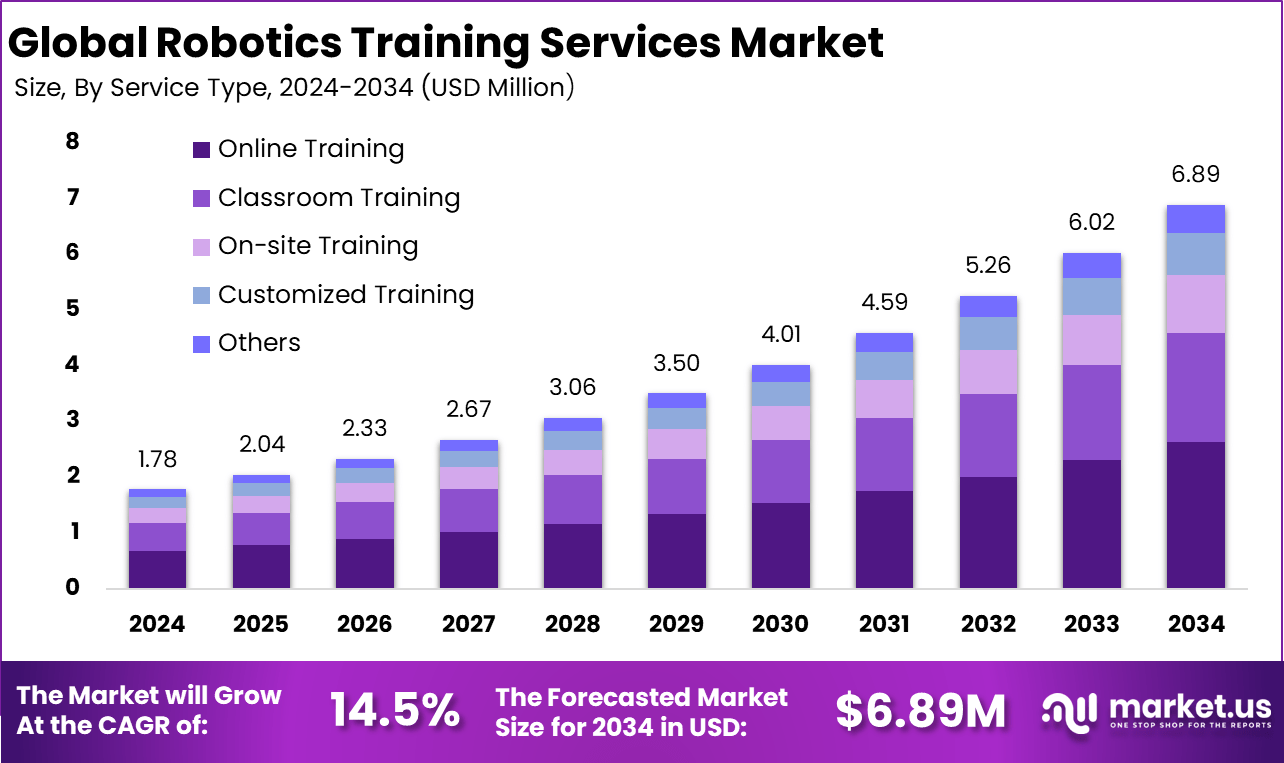
The global robotics training services market is expanding steadily as industries accelerate automation and workforce upskilling. The market was valued at USD 1.78 million in 2024 and is expected to reach around USD 6.89 million by 2034, growing at a CAGR of 14.5% during 2025 to 2034. Robotics training services focus on building technical, programming, safety, and maintenance capabilities required to deploy industrial and service robots efficiently. Asia Pacific leads the market with more than 46.4% share and USD 0.82 million in revenue, supported by rapid industrial automation, manufacturing expansion, and government-backed skill development initiatives.
How Growth is Impacting the Economy
The growth of robotics training services is contributing directly to productivity gains and workforce transformation across global economies. As automation adoption rises, trained personnel reduce downtime, improve robot utilization, and enhance manufacturing output quality. This supports cost efficiency and competitiveness for industries such as automotive, electronics, and logistics.
Governments benefit from reduced skill gaps and improved employability through structured robotics education and certification programs. Training investments are also creating demand for technical instructors, digital learning platforms, and simulation tools, generating high value employment. Over time, a skilled robotics workforce accelerates innovation, supports reshoring of manufacturing, and strengthens national industrial ecosystems, reinforcing long term economic resilience.
➤ Year-End Sale: Hurry Enjoy Upto 60% off @ https://market.us/purchase-report/?report_id=169936
Impact on Global Businesses
Rising Costs and Supply Chain Shifts
Businesses face higher initial spending on training programs, simulation tools, and certification frameworks as robotics adoption scales. However, this investment lowers long term operational risks by reducing errors, accidents, and maintenance costs. Supply chains are shifting toward automation friendly models that require continuous workforce training rather than manual labor dependence.
Sector Specific Impacts
Manufacturing benefits from faster robot deployment and improved production efficiency. Logistics and warehousing gain from skilled operators managing autonomous systems. Healthcare and service sectors rely on training to ensure safe human robot collaboration. Construction and agriculture also see growing demand for robotics skill development.
Strategies for Businesses
Organizations are prioritizing continuous robotics training programs aligned with evolving automation technologies. Blended learning models combining online modules, simulation, and hands on training are gaining adoption. Partnerships with robotics integrators and educational institutions help standardize skill development. Companies are also focusing on cross functional training to enable workers to manage programming, maintenance, and safety simultaneously. Certification-based learning is increasingly used to ensure compliance and operational consistency.
Key Takeaways
- Robotics training services are essential for successful automation adoption
- Market growth is driven by rising industrial and service robot deployments
- Asia Pacific dominates due to strong manufacturing automation
- Training improves productivity, safety, and return on automation investment
- Continuous upskilling is becoming a core business requirement
➤ Unlock growth! Get your sample now! @ https://market.us/report/robotics-training-services-market/free-sample/
Analyst Viewpoint
At present, robotics training services are evolving from optional support to a strategic necessity for automation driven organizations. Demand is strongest in manufacturing and logistics where robotics usage is scaling rapidly. Looking ahead, the outlook remains positive as collaborative robots, AI enabled systems, and service robots enter new industries. Training services are expected to become more standardized, digital, and globally accessible. Over the forecast period, robotics training is anticipated to play a critical role in building a future ready workforce and supporting sustainable automation growth.
Use Case and Growth Factors
| Use Case | Description | Key Growth Factors |
|---|---|---|
| Robotics programming and operation | Training operators to program, configure, and control industrial and collaborative robots | Rapid increase in industrial robot installations and automation adoption |
| Maintenance and troubleshooting | Skill development for preventive maintenance, diagnostics, and repair of robotic systems | Need to minimize downtime and extend robot lifecycle |
| Safety and compliance training | Need to minimize downtime and extend the robot lifecycle | Growing deployment of collaborative robots and stricter workplace safety norms |
| Simulation based robotics training | Virtual environments for hands-on learning without physical robots | Demand for cost effective, scalable, and remote training solutions |
| Service robot operation | Training for robots used in healthcare, retail, and hospitality environments | Expansion of service robotics across non-industrial sectors |
Regional Analysis
Asia Pacific dominates the robotics training services market with over 46.4% share, driven by large-scale automation in manufacturing hubs and strong government support for skill development. North America follows with rising demand from advanced manufacturing and logistics automation. Europe shows steady growth supported by Industry 4.0 initiatives and workforce reskilling programs. Emerging regions such as Latin America and the Middle East are gradually increasing adoption as automation investments expand.
➤ Explore Huge Library Here –
- Travel Rewards Credit Card Market
- Self-Reconfigurable Robots Market
- Bank Statement Aggregation Market
- Partyline Intercom Systems Market
Business Opportunities
Significant opportunities exist in digital and remote robotics training platforms that reduce dependency on physical infrastructure. Customized training programs for small and medium enterprises are gaining relevance as automation spreads beyond large corporations. Simulation and virtual training tools offer scalable growth potential. Emerging economies present long-term opportunities as governments invest in technical education and smart manufacturing initiatives. Service providers offering flexible, industry-specific training models are well-positioned for sustained demand.
Key Segmentation Overview
The market is segmented by training type into programming, operation, maintenance, and safety training. By delivery mode, on-site training currently holds a strong position, while online and virtual training is growing rapidly. By robot type, industrial robotics training dominates, followed by collaborative and service robots. End user segments include manufacturing, logistics, healthcare, construction, and others, with manufacturing leading overall demand.
Key Player Analysis
Market participants focus on curriculum standardization, practical skill development, and alignment with evolving robotics technologies. Competitive differentiation is driven by training depth, certification credibility, and delivery flexibility. Increasing use of simulation tools and digital learning platforms enhances training effectiveness. Long-term competitiveness depends on the ability to update content continuously and support diverse robot platforms and industry requirements.
- ARM Holdings
- ABB Ltd.
- FANUC Corporation
- KUKA AG
- Yaskawa Electric Corporation
- Siemens AG
- Universal Robots
- Mitsubishi Electric Corporation
- Omron Corporation
- Rockwell Automation
- Staubli International AG
- DENSO Robotics
- Kawasaki Robotics
- Honeywell International Inc.
- Epson Robots
- Comau S.p.A.
- Others
Recent Developments
- Expansion of virtual and simulation-based robotics training programs
- Increased focus on collaborative robot safety training
- Integration of AI-driven learning platforms in robotics education
- Growing partnerships between training providers and automation integrators
- Rising adoption of certification-based robotics skill frameworks
Conclusion
Robotics training services are becoming a foundational element of automation-driven industries. Strong growth, led by Asia Pacific, reflects the rising need for skilled robotics professionals, positioning training services as a key enabler of efficient, safe, and scalable automation worldwide.
Discuss your needs with our analyst
Please share your requirements with more details so our analyst can check if they can solve your problem(s)