Table of Contents
Satellite Texting Market Introduction
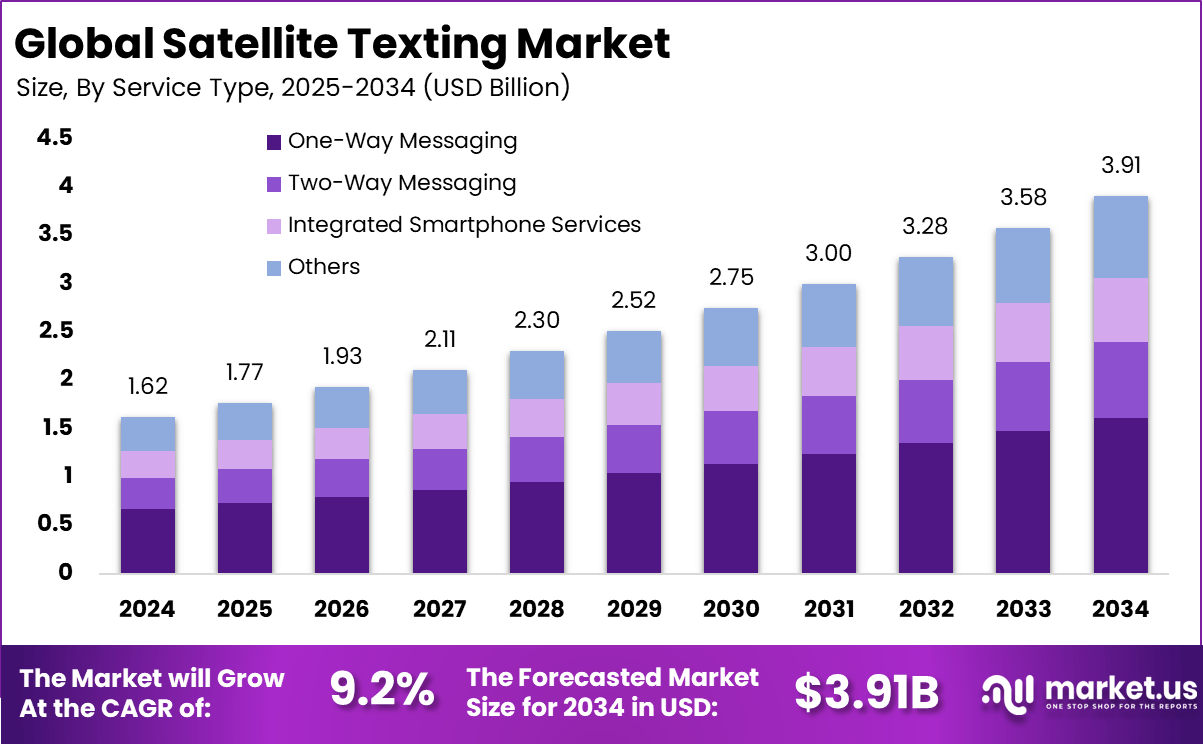
The global satellite texting market is expanding steadily as demand rises for reliable communication beyond terrestrial network coverage. The market was valued at USD 1.62 billion in 2024 and is expected to reach around USD 3.91 billion by 2034, growing at a CAGR of 9.2% during 2025 to 2034. Satellite texting enables short message communication via satellite networks, supporting emergency, remote, and mission-critical use cases. North America dominated the market in 2024 with more than 42.3% share and USD 0.68 billion in revenue, driven by outdoor recreation, disaster preparedness initiatives, and advanced satellite infrastructure.
How Growth is Impacting the Economy
Growth in satellite texting is strengthening communication resilience across national and regional economies. Reliable off-grid messaging supports emergency response, disaster recovery, and public safety operations, reducing economic losses caused by communication failures. Industries operating in remote areas benefit from improved coordination, safety, and productivity, particularly in energy, mining, and logistics.
Governments gain from enhanced emergency alert systems and secure communication channels in underserved regions. Market expansion is also driving investment in satellite manufacturing, ground infrastructure, and software development, generating skilled employment. Over time, satellite texting supports digital inclusion by extending basic communication services to rural and remote populations, contributing to broader economic stability.
➤ Year-End Sale: Hurry Enjoy Upto 60% off @ https://market.us/purchase-report/?report_id=167913
Impact on Global Businesses
Rising Costs and Supply Chain Shifts
Businesses face higher service and device costs compared to terrestrial messaging. However, supply chains are shifting toward hybrid communication models combining satellite and cellular connectivity, improving operational continuity and reducing outage-related losses.
Sector-Specific Impacts
Energy and mining companies rely on satellite texting for worker safety in remote sites. Logistics and maritime sectors use it for route coordination and emergency alerts. Government agencies depend on satellite messaging for disaster response. Consumer markets see growing adoption among outdoor enthusiasts and travelers.
Strategies for Businesses
Organizations are integrating satellite texting into broader communication and safety frameworks. Adoption of multi-network devices that support both cellular and satellite connectivity is increasing. Businesses are focusing on cost optimization through usage-based plans and prioritizing critical messaging workflows. Partnerships with satellite service providers and device manufacturers help ensure reliable coverage and scalability across regions.
Key Takeaways
- Satellite texting enables reliable communication beyond cellular coverage
- Market growth is supported by a 9.2% CAGR through 2034
- North America leads due to strong emergency and outdoor usage
- Hybrid connectivity models are gaining adoption
- Long-term demand is driven by safety and resilience needs
➤ Unlock growth! Get your sample now! @ https://market.us/report/satellite-texting-market/free-sample/
Analyst Viewpoint
Currently, satellite texting is transitioning from niche emergency use to mainstream communication support. Present adoption is strongest in public safety, remote industries, and outdoor consumer segments. Looking ahead, the outlook remains positive as satellite constellations expand and device integration improves. Reduced latency and broader device compatibility are expected to drive wider adoption. Over the forecast period, satellite texting is anticipated to become a standard backup communication layer across consumer and enterprise ecosystems.
Use Case and Growth Factors
| Use Case | Description | Key Growth Factors |
|---|---|---|
| Emergency communication | Messaging during disasters and outages | Rising focus on public safety and preparedness |
| Remote workforce coordination | Communication in off-grid locations | Expansion of remote industrial operations |
| Outdoor recreation | Messaging for hikers and travelers | Growth in adventure tourism activities |
| Maritime and aviation | Safety alerts and coordination | Increasing maritime and air traffic |
| Rural connectivity | Basic messaging in underserved areas | Push for digital inclusion |
Regional Analysis
North America dominates the satellite texting market with more than 42.3% share, supported by strong emergency management systems and consumer adoption. Europe follows with growing use in maritime safety and rural connectivity. Asia Pacific is emerging as a growth region due to expanding disaster preparedness programs and remote industrial activities. Other regions are gradually adopting satellite texting as satellite coverage and affordability improve.
➤ Explore Huge Library Here –
- AI Supercomputer Market
- Metaverse for Travel Market
- Pay‑As‑You‑Go Billing Market
- MarTech Data Platform Market
Business Opportunities
Significant opportunities exist in consumer-friendly satellite-enabled smartphones and wearables. Enterprise solutions for remote workforce safety offer strong growth potential. Integration of satellite texting with IoT and emergency platforms creates additional value. Emerging markets present long-term opportunities as rural connectivity needs rise. Providers offering affordable, interoperable, and scalable services are well positioned for sustained market expansion.
Key Segmentation Overview
The market is segmented by component into devices and services, with services accounting for a major share. By application, emergency and safety communication leads adoption, followed by outdoor recreation and industrial use. By end user, government and enterprise segments dominate, while consumer adoption is growing steadily. Network type segmentation includes low earth orbit and geostationary satellite systems, with low earth orbit gaining traction.
Key Player Analysis
Market participants focus on expanding satellite coverage, improving message delivery reliability, and enhancing device compatibility. Competitive differentiation is driven by network reach, latency performance, and service affordability. Continuous investment in constellation expansion and ground infrastructure strengthens market positioning. Long-term competitiveness depends on interoperability, cost efficiency, and the ability to support mass-market adoption.
- SpaceX (Starlink)
- Globalstar
- Iridium Communications
- Garmin
- ORBCOMM
- Thuraya Telecommunications
- SPOT (Globalstar)
- Lynk Global
- AST SpaceMobile
- Huawei
- Somewear Labs
- Zoleo
- Bullitt Group
- BAE Systems Plc
- Others
Recent Developments
- Expansion of low earth orbit satellite constellations
- Integration of satellite texting into consumer smartphones
- Increased government adoption for emergency alert systems
- Growing partnerships between device makers and satellite operators
- Improved latency and message delivery performance
Conclusion
Satellite texting is becoming a critical communication backup worldwide. Steady growth, led by North America, reflects rising demand for resilient messaging solutions, positioning satellite texting as an essential component of future global communication infrastructure.
Discuss your needs with our analyst
Please share your requirements with more details so our analyst can check if they can solve your problem(s)