Table of Contents
- Self-Reconfigurable Robots Market Introduction
- How Growth is Impacting the Economy
- Impact on Global Businesses
- Strategies for Businesses
- Key Takeaways
- Analyst Viewpoint
- Use Case and Growth Factors
- Regional Analysis
- Business Opportunities
- Key Segmentation Overview
- Key Player Analysis
- Recent Developments
- Conclusion
Self-Reconfigurable Robots Market Introduction
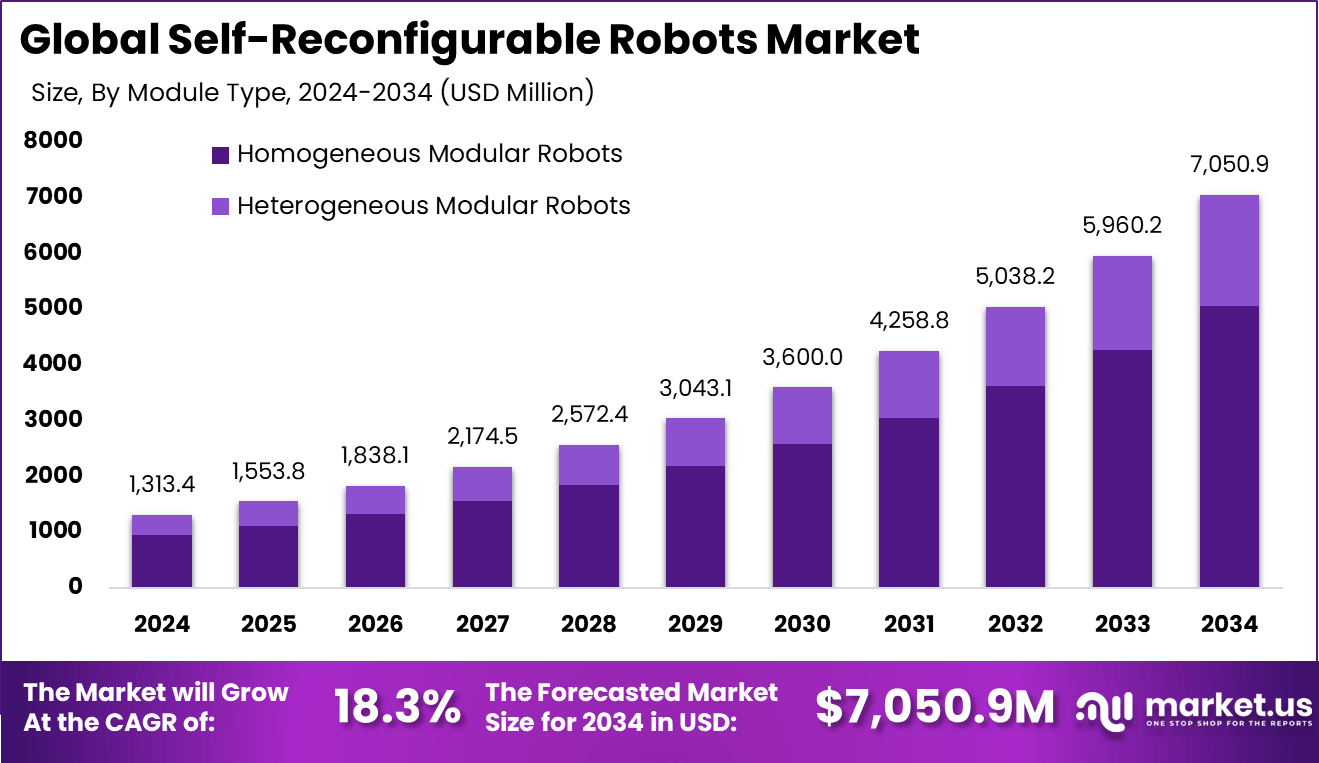
The global self-reconfigurable robots market is gaining momentum as industries seek adaptable, resilient automation systems. The market was valued at USD 1,313.4 million in 2024 and is expected to reach around USD 7,050.9 million by 2034, expanding at a CAGR of 18.3% from 2025 to 2034.
Self-reconfigurable robots can autonomously change structure, function, or behavior to suit different tasks and environments, reducing downtime and improving flexibility. North America leads adoption with more than 48.2% share and USD 633.0 million in revenue, supported by strong R&D investment, defense applications, and advanced manufacturing automation.
How Growth is Impacting the Economy
The growth of self-reconfigurable robots is enhancing economic productivity by enabling more flexible and efficient automation. These systems reduce the need for multiple single-purpose machines, lowering capital expenditure and improving asset utilization for manufacturers. Economies benefit from increased resilience in production lines, particularly in sectors facing labor shortages or volatile demand.
Governments and public agencies gain from adaptable robotic systems used in disaster response, infrastructure inspection, and defense logistics. Market expansion is also driving demand for high-skilled roles in robotics engineering, AI development, and systems integration. Over time, the ability to rapidly reconfigure automation supports faster innovation cycles, localized manufacturing, and long-term industrial competitiveness.
➤ Year-End Sale: Hurry, Enjoy Upto 60% off @ https://market.us/purchase-report/?report_id=169970
Impact on Global Businesses
Rising Costs and Supply Chain Shifts
Businesses face higher upfront costs due to complex hardware, modular components, and advanced control software. However, supply chains are shifting toward modular robotics platforms that reduce long-term replacement and retooling costs, improving lifecycle efficiency.
Sector-Specific Impacts
Manufacturing benefits from flexible production lines that adapt to product changes. Defense and aerospace leverage reconfigurable robots for mission adaptability. Logistics and warehousing improve space utilization and task switching. Healthcare and research institutions adopt these robots for adaptable laboratory and service applications.
Strategies for Businesses
Organizations are investing in modular robot architectures combined with AI-driven control systems to maximize adaptability. Pilot deployments are used to validate return on investment before large-scale rollout. Businesses are also focusing on interoperability with existing automation infrastructure and standard communication protocols. Workforce training in robotics programming and system maintenance is prioritized to fully leverage reconfiguration capabilities and ensure operational continuity.
Key Takeaways
- Self-reconfigurable robots enable adaptable and resilient automation
- Market growth is supported by an 18.3% CAGR through 2034
- North America dominates due to strong R&D and defense adoption
- Modular design reduces long-term automation costs
- Demand is rising across manufacturing, logistics, and defense
➤ Unlock growth! Get your sample now! @ https://market.us/report/self-reconfigurable-robots-market/free-sample/
Analyst Viewpoint
Currently, self-reconfigurable robots are transitioning from research-focused deployments to early commercial adoption. Present demand is driven by advanced manufacturing, defense, and research institutions seeking flexibility and resilience. Looking ahead, the outlook remains positive as AI, sensing, and modular hardware mature. Costs are expected to decline, enabling broader industrial adoption. Over the forecast period, self-reconfigurable robots are anticipated to become a core component of next-generation automation systems, supporting dynamic production and autonomous operations.
Use Case and Growth Factors
| Use Case | Description | Key Growth Factors |
|---|---|---|
| Flexible manufacturing lines | Robots reconfigure for different products | Need for agile and customized production |
| Defense and field operations | Structural adaptation for mission needs | Demand for autonomous and resilient systems |
| Disaster response | Robots adapt to unpredictable environments | Increasing focus on emergency preparedness |
| Warehouse automation | Task switching between picking and transport | Growth of e-commerce and logistics automation |
| Research and education | Modular platforms for experimentation | Expansion of robotics R&D activities |
Regional Analysis
North America dominates the self-reconfigurable robots market with more than 48.2% share, driven by strong defense funding, industrial automation, and academic research. Europe follows with steady growth supported by advanced manufacturing initiatives and robotics research programs. Asia Pacific is emerging as a high-growth region due to rapid industrial automation and increasing investment in smart factories. Other regions are gradually adopting these systems as automation sophistication increases.
➤ Explore Huge Library Here –
- Bank Fee Recovery Services Market
- Banking Data Lake Platform Market
- Bank Connectivity Platform Market
- 4-axis 8-propeller Drones Market
Business Opportunities
Significant opportunities exist in modular hardware platforms and AI-driven control software for self-reconfigurable robots. Customized solutions for defense, logistics, and advanced manufacturing offer strong growth potential. Partnerships with research institutions and system integrators can accelerate commercialization. Emerging markets present long-term opportunities as industries seek flexible automation to manage demand variability. Companies offering scalable, interoperable, and cost-optimized solutions are well positioned for sustained market growth.
Key Segmentation Overview
The market is segmented by component into hardware, software, and services, with hardware accounting for a major share due to modular components. By application, manufacturing and defense represent leading segments, followed by logistics, healthcare, and research. By configuration type, lattice-based and chain-based robots are prominent, while hybrid designs are gaining traction. End users include industrial enterprises, government agencies, and research institutions, with industrial users leading adoption.
Key Player Analysis
Market participants focus on modularity, AI-based control algorithms, and system reliability. Competitive differentiation is driven by reconfiguration speed, durability, and ease of integration. Continuous investment in sensing, actuation, and control software enhances performance. Long-term competitiveness depends on scalability, cost efficiency, and the ability to support diverse use cases across dynamic environments.
- Modular Robotics Inc.
- Roombots (EPFL)
- Q-Bot Ltd.
- HEBI Robotics
- PAL Robotics
- Festo AG & Co. KG
- Yaskawa Electric Corporation
- KUKA AG
- ABB Ltd.
- Robotis Co., Ltd.
- Shenzhen Yuejiang Technology Co., Ltd. (DOBOT)
- Universal Robots A/S
- Boston Dynamics
- Neurala Inc.
- Moley Robotics
- Shadow Robot Company
- Kawada Robotics Corporation
- Mitsubishi Electric Corporation
- FANUC Corporation
- Others
Recent Developments
- Advancements in modular robotic hardware design
- Integration of AI-driven autonomous reconfiguration algorithms
- Increased defense sector adoption for adaptable missions
- Expansion of pilot projects in flexible manufacturing
- Growing collaboration between academia and industry
Conclusion
Self-reconfigurable robots are redefining adaptive automation. Strong growth, led by North America, reflects rising demand for flexible and resilient robotic systems, positioning this market as a key enabler of next-generation industrial and autonomous applications through 2034.
Discuss your needs with our analyst
Please share your requirements with more details so our analyst can check if they can solve your problem(s)