Table of Contents
- SLAM LiDAR Mapping Systems Market Introduction
- How Growth is Impacting the Economy
- Impact on Global Businesses
- Strategies for Businesses
- Key Takeaways
- Analyst Viewpoint
- Use Case and Growth Factors
- Regional Analysis
- Business Opportunities
- Key Segmentation Overview
- Key Player Analysis
- Recent Developments
- Conclusion
SLAM LiDAR Mapping Systems Market Introduction
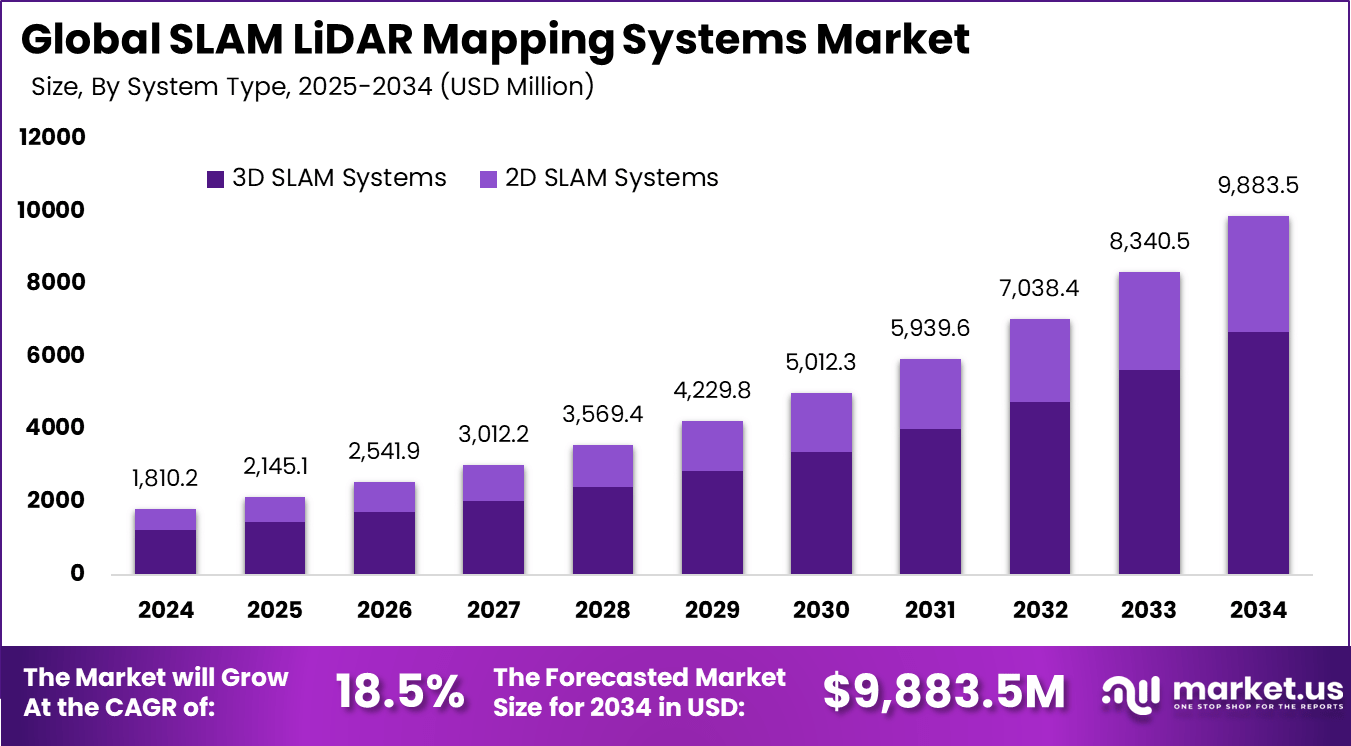
The global SLAM LiDAR mapping systems market is expanding rapidly due to the rising adoption of autonomous navigation, robotics, and real-time 3D mapping solutions. The market was valued at USD 1,810.2 million in 2024 and is expected to reach around USD 9,883.5 million by 2034, growing at a CAGR of 18.5% during 2025 to 2034.
SLAM LiDAR systems enable precise localization and mapping without GPS dependency, making them critical across indoor and outdoor environments. Asia Pacific dominates the market with over 43.4% share and USD 785.6 million revenue, supported by large-scale automation, robotics manufacturing, and smart infrastructure investments.
How Growth is Impacting the Economy
The growth of SLAM LiDAR mapping systems is accelerating productivity across multiple sectors and strengthening technology-driven economies. Increased deployment in robotics, warehouses, and autonomous vehicles improves operational efficiency and reduces manual labor dependency. Governments benefit from improved urban planning, smart transportation, and infrastructure monitoring supported by accurate spatial data.
Manufacturing economies gain from higher automation adoption, enhancing output quality and throughput. Investments in SLAM LiDAR are also stimulating demand for high-value components such as sensors, processors, and AI software, contributing to skilled job creation. As digital twins and smart environments expand, SLAM-based mapping supports long term economic digitization, enabling safer mobility, optimized logistics, and data driven decision making across public and private sectors.
➤ Year-End Sale: Hurry, Enjoy Upto 60% off @ https://market.us/purchase-report/?report_id=170142
Impact on Global Businesses
Rising Costs and Supply Chain Shifts
Businesses face higher upfront costs due to advanced sensors, computing hardware, and software integration. However, supply chains are shifting toward modular and scalable SLAM solutions, reducing long-term operational expenses. Increased localization of sensor manufacturing in the Asia Pacific is also reshaping global supply networks.
Sector Specific Impacts
Logistics companies gain faster warehouse automation and inventory accuracy. Automotive and robotics sectors benefit from improved navigation and safety. Construction and mining adopt SLAM LiDAR for site mapping and monitoring. Healthcare and retail see growing use in service robots and indoor navigation systems.
Strategies for Businesses
Organizations are focusing on integrating SLAM LiDAR with AI and edge computing to improve real-time decision-making. Cloud-based data processing is being adopted to manage large-scale mapping datasets efficiently. Partnerships with robotics and automation providers are helping accelerate deployment. Businesses are also investing in scalable platforms that support both indoor and outdoor environments to future-proof operations. Continuous system calibration and cybersecurity measures are prioritized to ensure accuracy and data integrity.
Key Takeaways
- The market is growing strongly with an 18.5% CAGR through 2034
- Asia Pacific leads due to automation and robotics expansion
- SLAM LiDAR is critical for GPS-denied environments
- Adoption improves efficiency across logistics, mobility, and infrastructure
- Integration with AI and cloud platforms is accelerating market growth
➤ Unlock growth! Get your sample now! @ https://market.us/report/slam-lidar-mapping-systems-market/free-sample/
Analyst Viewpoint
Currently, SLAM LiDAR mapping systems are transitioning from niche robotics applications to mainstream enterprise solutions. Present demand is driven by warehouse automation, autonomous vehicles, and smart infrastructure projects. Looking ahead, the outlook remains highly positive as costs decline and accuracy improves. Future growth is expected from integration with digital twins, AI perception systems, and large-scale smart city deployments. Over the forecast period, SLAM LiDAR is anticipated to become a foundational technology enabling intelligent, autonomous, and data-driven environments worldwide.
Use Case and Growth Factors
| Use Case | Key Growth Factors |
|---|---|
| Indoor robotics navigation | Rapid expansion of warehouse automation and fulfillment centers |
| Autonomous vehicles and mobile robots | Growing demand for precise real-time localization in GPS-denied environments |
| Construction and infrastructure mapping | Increased adoption of digital construction, BIM, and smart infrastructure projects |
| Mining and surveying applications | Need for accurate terrain modeling, safety monitoring, and operational efficiency |
| Service robots in healthcare and retail | Rising deployment of autonomous service robots for navigation and customer interaction |
Regional Analysis
Asia Pacific dominates the market with over 43.4% share, driven by strong robotics manufacturing, smart city programs, and industrial automation in China, Japan, and South Korea. North America follows with high adoption in autonomous vehicles and warehouse robotics. Europe shows steady growth supported by Industry 4.0 initiatives and advanced construction technologies. Emerging adoption in the Middle East and Latin America is linked to infrastructure modernization and logistics automation investments.
➤ Explore Huge Library Here –
- SEPP Interconnect Security Market
- Workload Identity Security Market
- Mobile Phishing Protection Market
- Remote Operation Platform Market
Business Opportunities
Strong opportunities exist in compact and cost-optimized SLAM LiDAR solutions for small and medium enterprises. Cloud-based mapping and analytics services offer recurring revenue potential. Integration with digital twin platforms and AI perception software creates new value chains. Emerging markets present long-term opportunities as automation expands beyond manufacturing into retail, healthcare, and public infrastructure. Companies offering scalable, interoperable systems are well-positioned for sustained growth.
Key Segmentation Overview
The market is segmented by component into hardware, software, and services, with hardware holding a significant share due to sensor demand. By application, robotics and autonomous vehicles represent leading segments, followed by surveying, construction, and logistics. By deployment environment, indoor mapping systems currently dominate, while outdoor and hybrid systems are gaining traction. End user segmentation includes industrial, commercial, and government users, with industrial adoption leading market demand.
Key Player Analysis
Market participants focus on sensor accuracy, real-time processing, and system reliability. Competitive differentiation is driven by SLAM algorithm efficiency, hardware miniaturization, and integration flexibility. Investments in AI-enhanced perception and edge computing capabilities are strengthening product performance. Long term competitiveness depends on scalability, cross-industry applicability, and the ability to support complex dynamic environments.
- Velodyne Lidar
- Leica Geosystems
- Trimble Inc.
- FARO Technologies
- SICK AG
- Quanergy Systems
- RIEGL Laser Measurement Systems
- Topcon Positioning Systems
- Ouster Inc.
- LeddarTech
- GeoSLAM
- Hesai Technology
- Innoviz Technologies
- Cepton Technologies
- Others
Recent Developments
- Increased adoption of solid-state LiDAR in SLAM systems
- Integration of AI-based perception algorithms for higher accuracy
- Expansion of SLAM LiDAR use in warehouse and logistics robots
- Development of lightweight systems for drones and mobile robots
- Growing use of SLAM LiDAR in smart city pilot projects
Conclusion
SLAM LiDAR mapping systems are becoming essential for autonomous navigation and intelligent spatial awareness. Strong growth, led by Asia Pacific and automation-driven industries, is expected to position this technology as a core enabler of future smart and autonomous ecosystems.
Discuss your needs with our analyst
Please share your requirements with more details so our analyst can check if they can solve your problem(s)