Table of Contents
Introduction
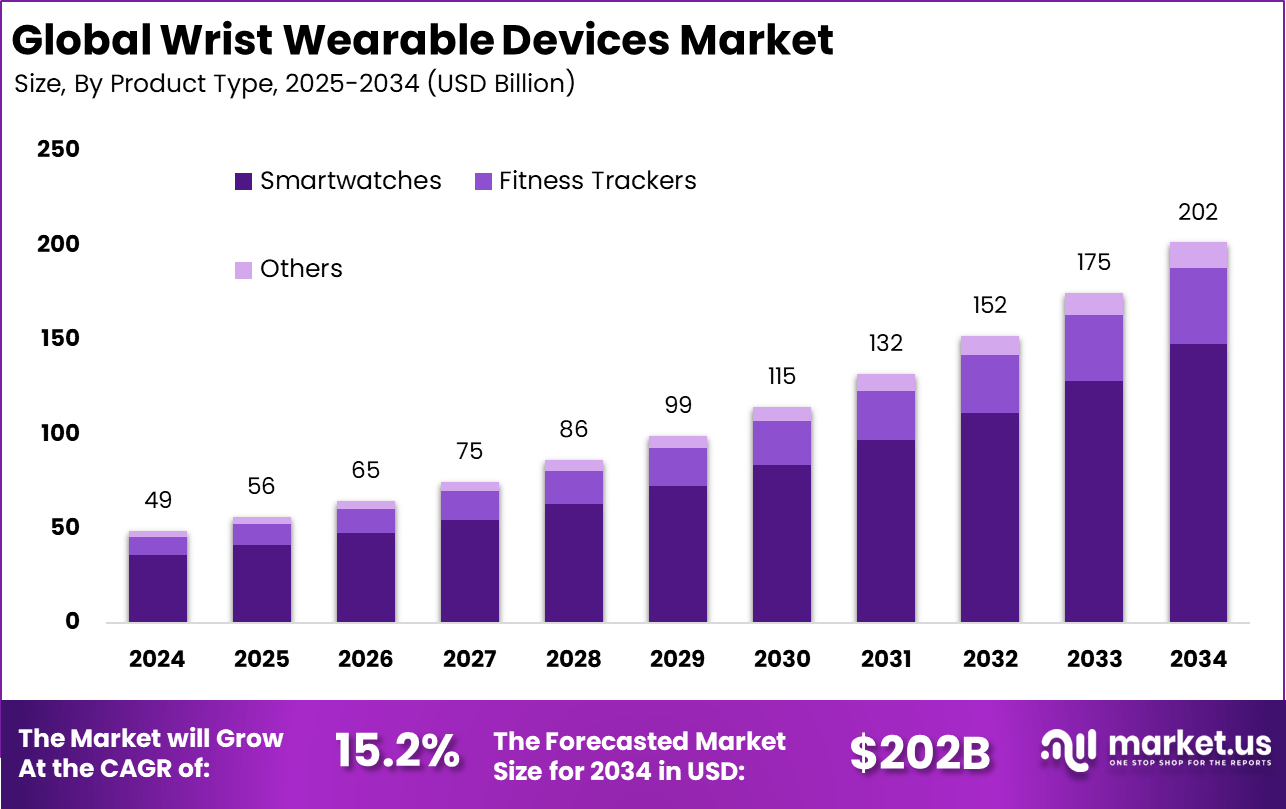
The Global Wrist Wearable Devices Market is expanding rapidly, rising from USD 49 billion in 2024 to an estimated USD 202 billion by 2034, driven by a strong 15.2% CAGR. Growth is fueled by rising health monitoring adoption, fitness tracking demand, and increasing integration of AI-enabled sensors. North America dominated in 2024 with a 33.7% share and USD 16.5 billion revenue, supported by advanced consumer electronics ecosystems and strong digital health uptake.
How Growth Is Impacting the Economy
The accelerating wrist wearable devices market strengthens the global economy by stimulating innovation in digital health, semiconductor manufacturing, and consumer electronics. As demand rises, new employment opportunities emerge across R&D, production, app development, and data analytics. Advancements in biosensors and AI-driven health monitoring tools enhance healthcare efficiency, reducing system costs and encouraging preventive care.
Growing adoption of wearables also boosts consumer spending across fitness, healthcare services, telemedicine, and subscription-based platforms. The market’s expansion drives investments in advanced materials, connectivity technologies, and cloud infrastructure, supporting economic resilience. This broader digital ecosystem encourages entrepreneurship, enhances national competitiveness, and improves productivity through data-driven insights.
➤ Smarter strategy starts here! Get the sample – https://market.us/report/wrist-wearable-devices-market/free-sample/
Impact on Global Businesses
Rising component prices, chip shortages, and logistics delays increase production costs, prompting companies to diversify suppliers and build resilient manufacturing networks. Consumer electronics, healthcare, fitness, and enterprise wellness programs benefit from real-time monitoring and personalized insights. Industries leverage wearables for worker safety, remote diagnostics, and performance tracking. Retailers and e-commerce platforms experience demand growth for connected devices, while insurers explore usage-based wellness models.
Strategies for Businesses
Prioritize sustainable manufacturing, strengthen multi-source supply chains, integrate AI and advanced analytics, invest in ergonomic design, expand subscription-based services, enhance cybersecurity for biometric data, and build cross-industry partnerships in healthcare, sports, and enterprise wellness.
Key Takeaways
- Strong 15.2% CAGR underscores long-term growth.
- Health monitoring and fitness tracking drive adoption.
- North America leads due to digital health maturity.
- Supply chain shifts raise production and procurement costs.
- AI-enabled capabilities enhance product value and user engagement.
➤ Unlock growth secrets! Buy the full report – https://market.us/purchase-report/?report_id=161430
Analyst Viewpoint
The present market momentum reflects strong consumer adoption, healthcare digitalization, and rapid advancements in sensor accuracy and battery efficiency. Future growth remains promising as wearables evolve into comprehensive health platforms integrated with AI diagnostics and personalized insights. Increased focus on chronic disease management, remote monitoring, and workplace wellness is expected to accelerate global demand. Innovation in flexible materials, low-power electronics, and biometric algorithms will shape the next generation of wrist wearables.
Use Case and Growth Factors
| Use Case | Description | Growth Driver |
|---|---|---|
| Fitness Tracking | Monitoring daily activity and workouts | Rising fitness awareness |
| Health Diagnostics | Heart rate, ECG, SpO₂, sleep monitoring | Growing preventive healthcare |
| Enterprise Wellness | Employee health and productivity insights | Corporate wellness programs |
| Sports Performance | Athlete analytics and training optimization | Growth in sports tech adoption |
| Safety Monitoring | Worker monitoring in hazardous environments | Industrial safety compliance |
Regional Analysis
North America leads due to high consumer engagement with digital health and the strong presence of leading electronics brands. Europe shows steady expansion supported by healthcare modernization and growing adoption of wearable-based medical applications. Asia Pacific records the fastest growth, driven by large populations, rising disposable income, and expanding smart device ecosystems. Latin America and the Middle East see rising adoption as connectivity improves, online retail expands, and digital health initiatives gain traction.
➤ Want more market wisdom? Browse reports –
Business Opportunities
Opportunities arise in AI-enabled health diagnostics, subscription-based wellness services, sports analytics platforms, and enterprise wearables for safety and productivity. Medical-grade wearables create pathways into remote patient monitoring markets. Growing demand for personalized insights encourages the development of advanced biosensors, flexible displays, low-energy processors, and secure cloud ecosystems. Startups can tap into niche categories such as kids’ wearables, senior monitoring devices, and chronic disease management solutions.
Key Segmentation
The market includes smartwatches, fitness bands, hybrid wearables, medical-grade wrist devices, and specialized sports trackers. Segments span applications such as health monitoring, fitness tracking, communication, payments, navigation, and enterprise safety. Consumers increasingly use wrist wearables for integrated health insights, seamless connectivity, and personalized digital experiences, driving widespread adoption across multiple demographics.
Key Player Analysis
Leading participants focus on advanced sensor integration, AI-driven analytics, longer battery life, and robust health monitoring algorithms. Innovation emphasizes precision diagnostics, waterproof durability, lightweight materials, and seamless smartphone interoperability. Companies strengthen competitiveness through ecosystem partnerships, cloud services, subscription models, and continuous software updates. Strong investment in R&D, biometric accuracy, and customizable user experiences helps maintain market leadership.
- Apple Inc.
- Casio Computer Co., Ltd.
- Samsung Electronics Co., Ltd.
- Fitbit (Google)
- Garmin Ltd.
- Huawei Device Co., Ltd.
- Xiaomi Corporation
- Mobvoi Information Technology Company
- Zepp Health
- TAG Heuer S.A.
- Timex Group USA, Inc.
- Amazfit (Huami Corporation)
- Suunto
- Polar Electro
- Coros
- Others
Recent Developments
• 2024: Launch of next-gen smartwatches featuring multi-parameter medical diagnostics.
• 2024: Introduction of flexible OLED displays for lightweight fitness bands.
• 2025: Expansion of wearable-based remote patient monitoring programs.
• 2025: New AI-powered sports analytics wearables released for athletes.
• 2025: Collaboration between tech firms and healthcare providers for clinical-grade wearables.
Conclusion
The Wrist Wearable Devices Market continues to surge as digital health, fitness, and smart connectivity rise globally. Advancements in AI, sensors, and ergonomic design ensure strong, sustained growth and expanding opportunities across sectors.
Discuss your needs with our analyst
Please share your requirements with more details so our analyst can check if they can solve your problem(s)