Market Overview and Industry Expansion
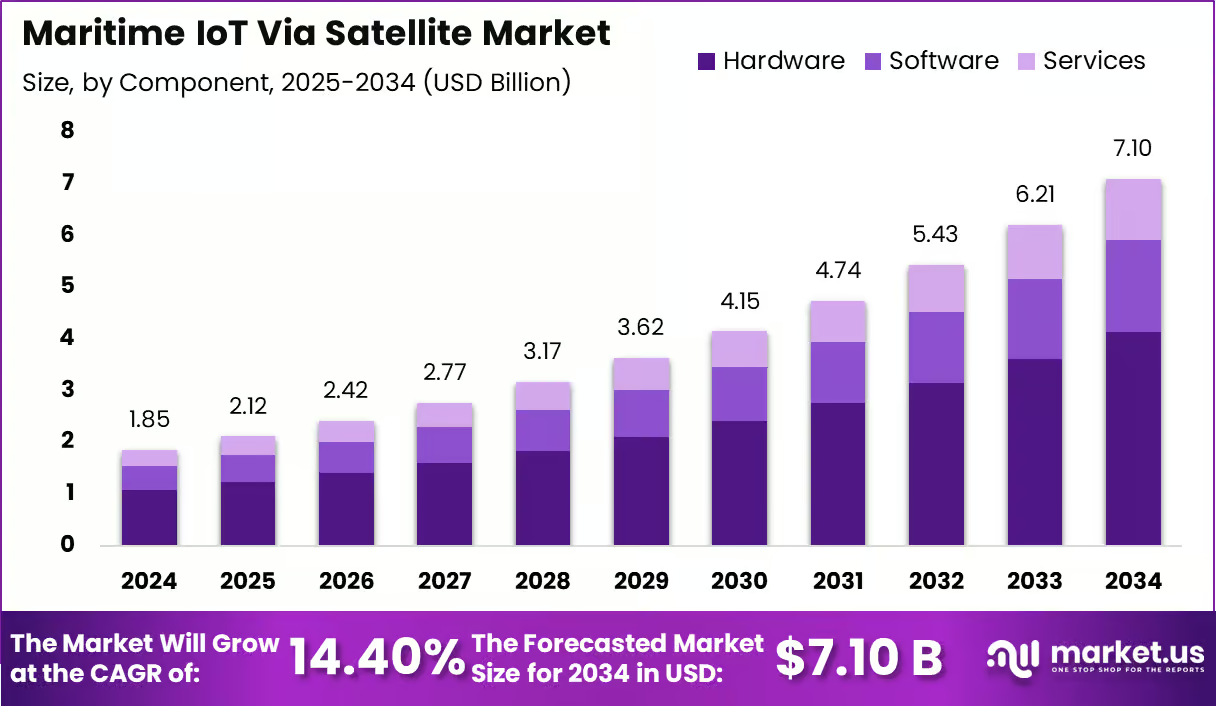
The Maritime IoT via Satellite Market is expanding steadily as global shipping companies adopt connected technologies to improve fleet monitoring and operational efficiency. The market reached USD 1.85 billion in 2024 and is projected to grow to USD 7.10 billion by 2034 at a CAGR of 14.40%. North America dominated the market with a 38.5% share in 2024, representing USD 0.71 billion.
The United States generated USD 0.64 billion in 2024 and is expected to reach USD 2.13 billion by 2034 with a CAGR of 12.78%. By component, hardware accounted for 58.2% share. Fleet management and operations led applications with 36.8%. Commercial shipping represented 47.5% of vessel adoption, while VSAT services captured 52.1%. Shipping companies and operators accounted for 62.7% of end-user demand.
Economic Influence of Satellite-Enabled Maritime IoT
The adoption of satellite-enabled IoT systems across maritime operations is contributing to broader economic productivity within the global shipping and logistics sector. Connected vessel technologies enable shipping companies to monitor fuel consumption, optimize routes, and improve cargo tracking in real time. These capabilities help reduce operational costs while improving shipping efficiency and reliability across international trade routes.
The technology also supports digital transformation within ports, shipping lines, and maritime logistics networks. Increased adoption of connected maritime infrastructure stimulates demand for satellite communication equipment, marine sensors, and digital monitoring platforms. As global maritime trade expands, investments in satellite-based connectivity and IoT infrastructure continue to create new economic opportunities for communication technology providers and maritime service companies.
Impact on Global Businesses and Supply Chain Operations
The growing use of maritime IoT via satellite connectivity is reshaping global shipping operations and supply chain management. Shipping companies are adopting connected vessel technologies to improve route planning, predictive maintenance, and fleet performance monitoring. This transition enables companies to manage large fleets more efficiently while reducing operational risks and downtime.
However, the expansion of satellite connectivity solutions also influences cost structures across maritime technology providers. Businesses must invest in advanced communication equipment, onboard sensors, and satellite bandwidth to maintain reliable connectivity in remote ocean regions. Sector-specific impacts are also visible across logistics and offshore industries. Energy companies use satellite IoT systems to monitor offshore assets, while cargo shipping operators rely on connected data platforms to track vessel performance and cargo conditions.
Strategic Approaches for Businesses
Companies operating in the maritime technology ecosystem are implementing strategies to leverage the growth of satellite-based IoT solutions. Businesses are investing in high-bandwidth communication systems such as VSAT to ensure continuous connectivity for vessels operating in global waters. Technology providers are also developing integrated platforms that combine satellite communication with real-time analytics and fleet monitoring tools.
Shipping operators are focusing on digital fleet management systems that allow centralized monitoring of vessel operations. Another strategy involves integrating IoT sensor networks across ships to collect operational data related to fuel consumption, engine performance, and environmental conditions. Companies are also forming partnerships with satellite service providers to expand global connectivity coverage.
Key Takeaways
- The Maritime IoT via Satellite Market reached USD 1.85 billion in 2024.
- The market is projected to reach USD 7.10 billion by 2034 at a CAGR of 14.40%.
- North America leads the market with a 38.5% share.
- The United States generated USD 0.64 billion in 2024.
- Hardware dominates the component segment with 58.2% share.
- Fleet management and operations lead applications with 36.8%.
- Commercial shipping represents 47.5% of vessel adoption.
- VSAT services account for 52.1% of connectivity demand.
- Shipping companies and operators hold 62.7% share of end users.
Analyst Perspective and Future Industry Outlook
Industry analysts observe strong growth momentum in the maritime IoT via satellite market as shipping companies accelerate digital transformation across fleets and maritime operations. The current market environment is characterized by increasing adoption of connected sensors, real-time vessel monitoring systems, and satellite communication technologies that support data-driven maritime management.
Looking forward, the long term outlook remains positive as global shipping companies continue to invest in digital fleet infrastructure. Advancements in satellite communication networks and marine IoT technologies are expected to enhance connectivity reliability across remote ocean routes. As regulatory requirements related to safety, emissions monitoring, and fuel efficiency increase, satellite-enabled IoT solutions are expected to become essential tools for modern maritime operations.
Use Cases and Growth Drivers
| Use Case | Growth Factor | Market Impact |
|---|---|---|
| Fleet tracking and monitoring | Increasing demand for real time vessel visibility | Improves operational efficiency |
| Predictive maintenance | IoT sensor integration in ship engines | Reduces downtime and maintenance costs |
| Fuel optimization | Rising fuel efficiency requirements | Supports cost reduction strategies |
| Cargo condition monitoring | Growth in global shipping trade | Enhances supply chain transparency |
| Offshore asset monitoring | Expansion of offshore energy operations | Strengthens remote asset management |
Regional Market Landscape
North America remains the dominant region in the maritime IoT via satellite market, accounting for 38.5% share in 2024 and generating USD 0.71 billion in revenue. The region benefits from advanced satellite communication infrastructure, strong maritime technology innovation, and significant investments in digital fleet management systems. Shipping companies operating in North America are actively adopting connected vessel technologies to improve fleet visibility and operational performance.
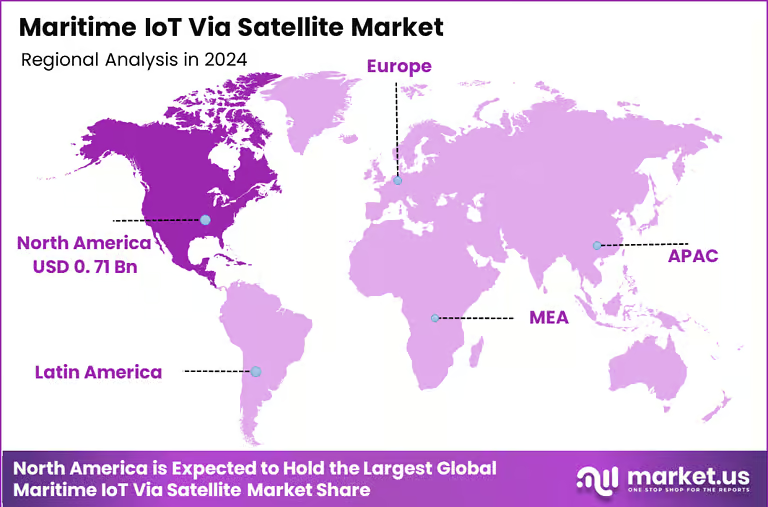
The United States represents the largest market within the region, generating USD 0.64 billion in 2024 and projected to reach USD 2.13 billion by 2034 with a CAGR of 12.78%. Increased adoption of satellite communication systems, rising maritime trade activity, and strong investments in maritime digitalization initiatives are supporting the growth of connected vessel technologies across the country.
Emerging Business Opportunities
The expansion of maritime IoT via satellite connectivity is creating new business opportunities across maritime technology, satellite communication, and logistics service industries. Equipment manufacturers can benefit from the rising demand for onboard communication systems, satellite terminals, and marine sensors used in connected vessel networks. Technology providers also have opportunities to develop advanced data analytics platforms that convert maritime operational data into actionable insights.
Satellite communication providers may expand service coverage and bandwidth capacity to support growing demand from commercial shipping fleets. Consulting firms and maritime technology integrators can also provide fleet digitalization services, helping shipping companies implement IoT-driven monitoring systems. As global maritime trade continues to grow, the need for reliable satellite connectivity and maritime data intelligence is expected to increase.
Key Segmentation Overview
The maritime IoT via satellite market is segmented by component, application, vessel type, service type, and end user. By component, hardware dominates with 58.2% share due to increasing deployment of satellite terminals, sensors, and communication modules onboard ships. By application, fleet management and operations lead with 36.8% share as shipping companies prioritize vessel tracking and operational monitoring.
Vessel type, commercial shipping, represents 47.5% share, reflecting strong digitalization across global cargo fleets. By service type, VSAT connectivity accounts for 52.1% of the market due to demand for high-bandwidth satellite communication. By end user, shipping companies and operators hold 62.7% share as they focus on improving fuel efficiency, safety compliance, and operational performance.
Competitive Market Landscape
The maritime IoT via satellite market is characterized by continuous innovation in satellite communication technologies and marine connectivity solutions. Market participants are focusing on developing high-performance satellite terminals, advanced onboard sensors, and integrated maritime data platforms. Companies are also enhancing connectivity reliability by expanding satellite coverage and improving communication bandwidth for vessels operating in remote ocean regions.
Top Key Players in the Market
- Inmarsat Global, Ltd.
- Iridium Communications, Inc.
- ORBCOMM, Inc.
- Globalstar, Inc.
- Thuraya Telecommunications Company
- KVH Industries, Inc.
- Intelsat S.A.
- Cobham SATCOM
- Airbus SE
- Astrocast SA
- Spire Global, Inc.
- Myriota, Ltd.
- Swarm Technologies, Inc.
- Marlink AS
- Sateliot
- Others
Competition is further driven by the integration of IoT data analytics with fleet management software. Providers are offering solutions that combine satellite connectivity with predictive maintenance analytics and operational monitoring systems. This integrated approach allows shipping operators to manage fleets more efficiently while improving safety and operational transparency.
Recent Industry Developments
• Satellite communication technologies are evolving to support higher bandwidth connectivity for maritime IoT systems.
• Shipping companies are increasingly deploying connected sensor networks to monitor vessel performance in real time.
• Digital fleet management platforms are integrating satellite data with predictive analytics to improve operational efficiency.
Conclusion
The Maritime IoT via Satellite Market is expanding steadily as global shipping companies adopt connected technologies to enhance fleet performance and operational visibility. Continuous improvements in satellite connectivity, marine IoT sensors, and data analytics platforms are expected to support long term growth across the global maritime industry.
Discuss your needs with our analyst
Please share your requirements with more details so our analyst can check if they can solve your problem(s)