Introduction
The global AI in Computer-Aided Synthesis Planning (CASP) market was valued at USD 2.13 billion in 2024 and is projected to reach USD 68.06 billion by 2034, registering a CAGR of 41.4%. North America held 42.6% share with USD 0.90 billion, while the US accounted for USD 0.83 billion and is expected to grow significantly. Software platforms led with 65.8%; ML and DL technologies captured 80.3%; drug discovery dominated at 75.2%; and pharmaceutical and biotechnology companies held 70.5% share.
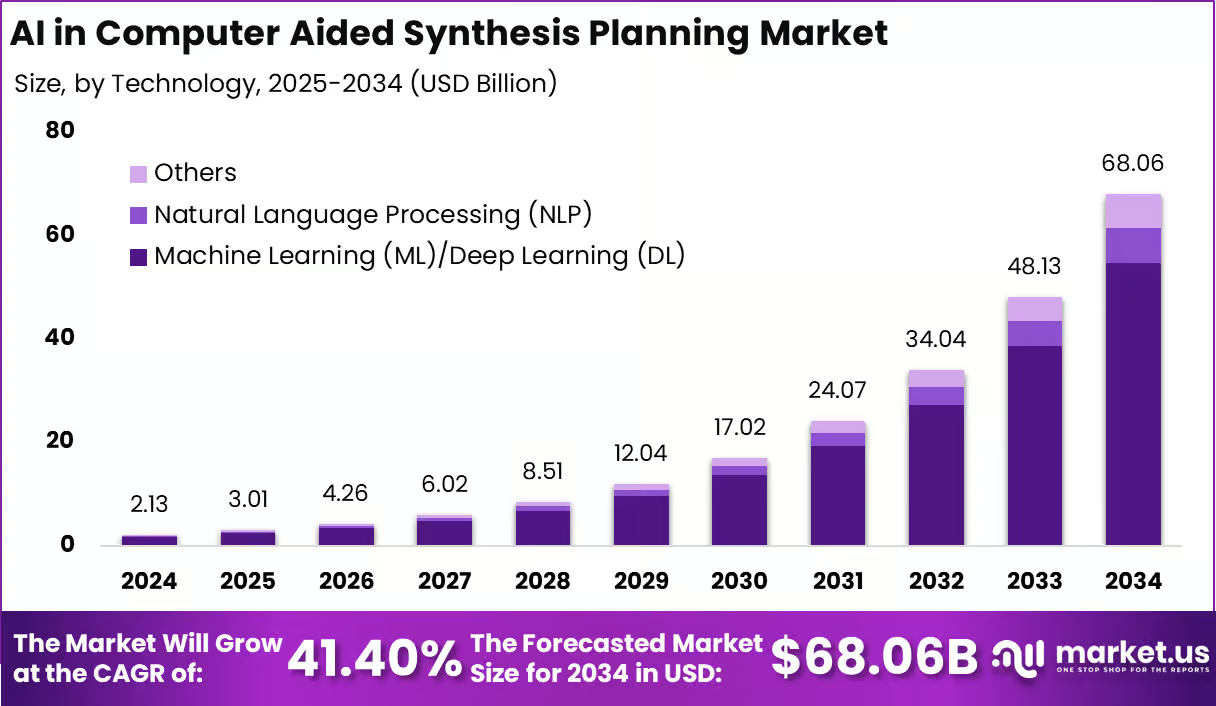
The market is expanding rapidly due to rising complexity in chemical synthesis and increasing demand for faster drug development. AI-driven CASP tools are transforming research workflows by improving prediction accuracy and reducing trial-and-error processes. Continuous advancements in computational chemistry and data availability are further strengthening adoption across scientific domains.
How Growth is Impacting the Economy
The growth of AI in CASP is significantly influencing the global economy by enhancing efficiency in pharmaceutical and chemical manufacturing. Faster synthesis planning reduces development cycles, enabling quicker commercialization of drugs and specialty chemicals. This contributes to improved healthcare outcomes and increased productivity across research-intensive industries. Governments and research institutions are investing in AI-driven innovation, which is strengthening knowledge-based economies and creating high-value employment opportunities.
The expansion of AI-CASP solutions is also encouraging digital transformation across laboratories and production environments. As companies adopt automated synthesis planning, operational costs are optimized, and resource utilization improves. This shift supports sustainable practices by reducing waste and energy consumption in chemical processes. Additionally, the growing integration of AI in scientific research is attracting venture capital and fostering startup ecosystems, further accelerating economic growth and technological advancement globally.
Impact on Global Businesses
Global businesses are experiencing both opportunities and adjustments due to AI in CASP adoption. Initial investments in AI infrastructure, data integration, and skilled talent are increasing operational costs in the short term. However, these investments are expected to improve long-term efficiency and reduce dependency on manual experimentation. Supply chains are also evolving as companies adopt digital tools to optimize raw material selection and streamline synthesis processes.
Sector-specific impacts are particularly visible in pharmaceuticals, chemicals, and materials science. Drug manufacturers are accelerating discovery timelines, while specialty chemical producers are improving formulation precision. Academic institutions and research labs are adopting AI platforms to enhance collaboration and innovation. These shifts are reshaping competitive dynamics and encouraging businesses to adopt advanced technologies to remain relevant.
Strategies for Businesses
Businesses are focusing on integrating AI-CASP platforms with existing R&D systems to improve efficiency and decision-making. Investing in skilled professionals and interdisciplinary expertise is becoming essential to maximize the value of AI-driven tools. Companies are also forming partnerships with technology providers and research institutions to accelerate innovation and reduce implementation risks.
Another key strategy involves leveraging cloud-based platforms for scalability and accessibility. Organizations are prioritizing data quality and governance to ensure accurate model predictions. Continuous investment in automation and digital infrastructure is helping businesses stay competitive and adapt to rapidly evolving market demands.
Key Takeaways
- AI-CASP market is experiencing rapid expansion driven by strong demand in drug discovery
- Software platforms dominate due to the increasing need for predictive synthesis tools
- Machine learning and deep learning are core technologies enabling accuracy and speed
- Pharmaceutical and biotechnology companies are the primary adopters
- North America leads due to a strong research ecosystem and early AI adoption
- Automation and digital transformation are reshaping chemical research workflows
Analyst Viewpoint
The present outlook of the AI-CASP market reflects strong momentum supported by technological advancements and growing adoption across pharmaceutical research. Organizations are increasingly recognizing the value of AI in improving efficiency and reducing development timelines. The integration of advanced algorithms with chemical databases is enhancing predictive capabilities and enabling more accurate synthesis planning.
Looking ahead, the market is expected to maintain high growth as innovation in AI models and computational tools continues. Increased collaboration between academia, technology providers, and industry players is likely to accelerate breakthroughs. The future landscape appears highly promising, with AI-CASP becoming a standard component of modern chemical and drug discovery processes.
Use Case and Growth Factors
| Use Case | Growth Factor |
|---|---|
| Drug discovery optimization | Faster compound identification and validation |
| Retrosynthesis planning | Reduction in trial-and-error experimentation |
| Materials design | Improved accuracy in molecular modeling |
| Chemical process optimization | Enhanced efficiency and cost reduction |
| Academic research | Increased adoption of AI-driven tools |
Regional Analysis
North America dominates the AI-CASP market due to its advanced research infrastructure and strong presence of pharmaceutical and biotechnology industries. The region benefits from early adoption of AI technologies and significant investments in scientific innovation. The US leads the regional market with strong support from research institutions and industry collaborations.
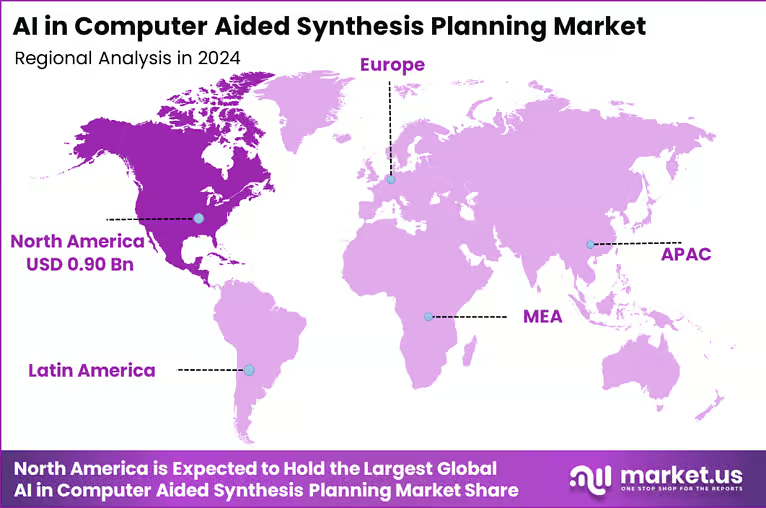
Europe follows with growing adoption driven by government initiatives and academic research. Asia-Pacific is emerging as a high-growth region due to increasing investments in biotechnology and expanding research capabilities. Countries in this region are focusing on digital transformation and innovation, which is expected to drive future market expansion.
Business Opportunities
The AI-CASP market presents significant opportunities for technology providers, research organizations, and pharmaceutical companies. Increasing demand for automated synthesis planning is creating opportunities for software developers to offer advanced platforms and solutions. Companies can explore cloud-based deployment models to enhance accessibility and scalability for users across different regions.
There is also growing potential in expanding AI applications beyond drug discovery into materials science and industrial chemistry. Businesses that invest in innovation and data-driven approaches are expected to gain a competitive advantage. Strategic collaborations and continuous technological advancements are likely to unlock new revenue streams and drive long-term growth.
Key Segmentation
The AI-CASP market is segmented based on offering, technology, application, and end-user, reflecting diverse adoption patterns across industries. By offering, software and platforms dominate due to increasing demand for automated and predictive tools. By technology, machine learning and deep learning lead as they enable accurate modeling and optimization of chemical synthesis pathways.
Application, drug discovery and medicinal chemistry represent the largest segment due to high demand for faster and cost-efficient compound development. By end-user, pharmaceutical and biotechnology companies hold the dominant share as they leverage AI tools to improve research efficiency. These segments collectively highlight strong growth potential and widespread adoption of AI-driven solutions.
Key Player Analysis
Key players in the AI-CASP market are focusing on innovation, product development, and strategic collaborations to strengthen their market position. Companies are investing heavily in research and development to enhance algorithm accuracy and expand application capabilities. Continuous advancements in AI technologies and integration with chemical databases characterize the competitive landscape.
Top Key Players in the Market
- DeepMatter Group Plc
- Merck KGaA
- PostEra
- IKTOS
- Wiley-VCH GmbH
- The Open Science Project
- Medici Technologies, LLC
- IBM Corporation
- Microsoft Corporation
- Hoffmann-La Roche Limited
- Novartis AG
- AbbVie Inc.
- Schrödinger Inc.
- Synple Chem
- Chemify
- Others
Organizations are also emphasizing partnerships with research institutions and technology providers to accelerate innovation. The market is witnessing increasing competition as new entrants introduce specialized solutions. Continuous improvement in software capabilities and scalability is expected to remain a key focus area for market participants.
Recent Developments
- Increased adoption of AI-driven retrosynthesis tools in pharmaceutical research
- Expansion of cloud-based CASP platforms for global accessibility
- Growing collaboration between academic institutions and technology providers
- Advancements in deep learning models for molecular prediction
- Rising investment in AI-based drug discovery solutions
Conclusion
The AI in CASP market is transforming chemical and pharmaceutical research through advanced automation and predictive capabilities. Strong growth potential, driven by innovation and rising adoption, positions this market as a key enabler of future scientific advancements and efficient drug discovery processes.
Discuss your needs with our analyst
Please share your requirements with more details so our analyst can check if they can solve your problem(s)