Overview
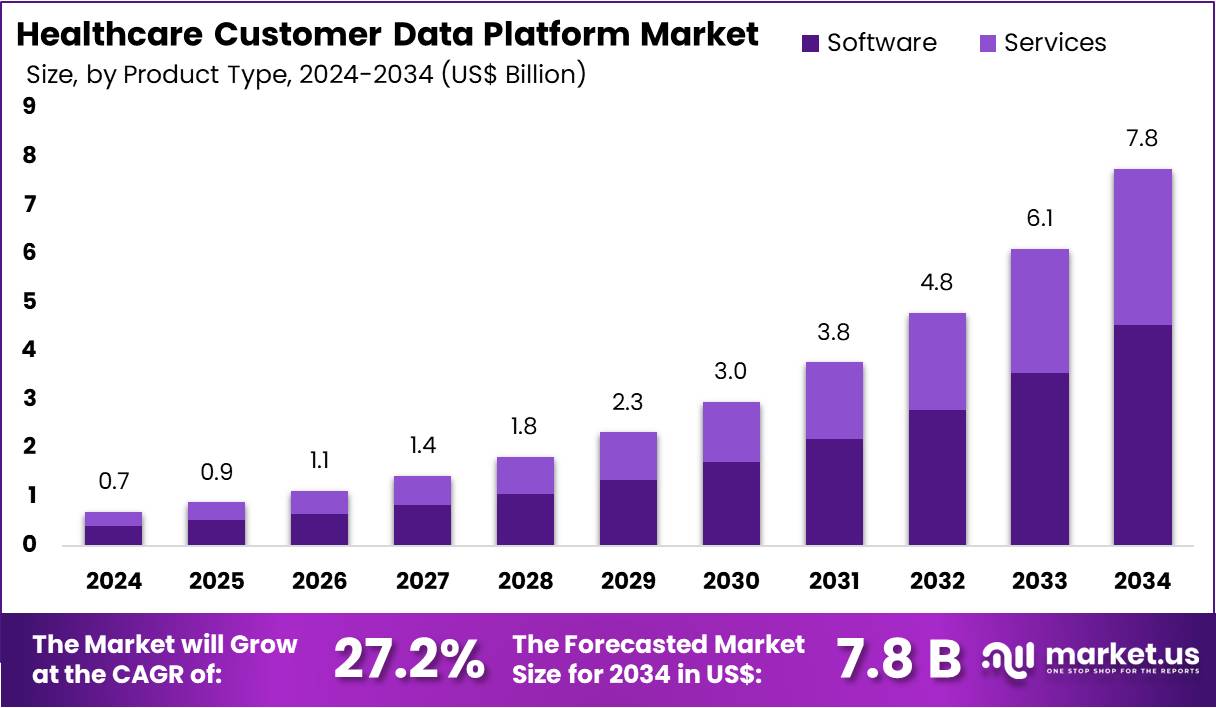
New York, NY – April 23, 2026 – The Global Healthcare Customer Data Platform Market Size is expected to be worth around US$ 7.8 Billion by 2034 from US$ 0.7 Billion in 2024, growing at a CAGR of 27.2% during the forecast period 2025 to 2034.
A Healthcare Customer Data Platform (CDP) is an advanced technology solution designed to unify, manage, and analyze patient and consumer data across multiple touchpoints. It enables healthcare providers, payers, and life sciences organizations to create a single, comprehensive view of each individual by integrating data from electronic health records, mobile applications, wearable devices, and digital engagement platforms.
The adoption of healthcare CDPs has been driven by the increasing need for personalized patient engagement, improved care coordination, and data-driven decision-making. By leveraging real-time data processing and advanced analytics, these platforms support targeted communication strategies, enhance patient experiences, and improve clinical and operational outcomes.
Healthcare CDPs are equipped with capabilities such as data integration, identity resolution, segmentation, and predictive analytics. These features allow organizations to identify patient needs more accurately, deliver tailored health interventions, and optimize marketing and outreach efforts. Additionally, strict compliance with data privacy regulations ensures secure handling of sensitive health information.
Market growth is being supported by the rising demand for digital health solutions, increasing investments in healthcare IT infrastructure, and the growing emphasis on value-based care models. As healthcare systems continue to prioritize patient-centric approaches, the role of Customer Data Platforms is expected to expand significantly, contributing to improved healthcare delivery and long-term patient engagement.
Key Takeaways
- In 2024, the Healthcare Customer Data Platform market generated revenue of US$ 0.7 billion and is projected to reach US$ 7.8 billion by 2034, expanding at a CAGR of 27.2%.
- By product type, the market is segmented into software and services, with the software segment leading in 2024, accounting for a 58.4% share.
- Based on deployment type, the market is categorized into on-premise and cloud-based solutions, with cloud-based deployment dominating at 63.7% share.
- In terms of application, the market includes predictive analytics, security management, personalized recommendations, marketing data segmentation, customer retention and engagement, and others. Predictive analytics emerged as the leading segment, holding a 31.5% revenue share.
- By end-user, the market is divided into large enterprises and SMEs, with large enterprises dominating the segment with a 68.9% share.
- Regionally, North America held the largest market share in 2024, accounting for 46.7% of the total market.
Regional Analysis
North America led the Healthcare Customer Data Platform market in 2024, accounting for a 46.7% revenue share. This dominance is attributed to the rising demand for unified patient data systems to support personalized care delivery. Regulatory and institutional support, including initiatives by the U.S. Department of Health & Human Services (HHS) and the Centers for Medicare & Medicaid Services (CMS), has reinforced the adoption of data-driven healthcare practices.
Additionally, the widespread implementation of electronic health records under the HITECH Act has resulted in significant data generation, creating a strong need for advanced data integration platforms.
Asia Pacific is projected to register the highest CAGR during the forecast period. Growth is driven by increasing digital health adoption, expanding healthcare IT investments, and government-led initiatives such as India’s National Digital Health Mission (NDHM). The region is also witnessing accelerated adoption of cloud-based solutions, supporting scalable and efficient healthcare data management systems.
Emerging Trends
- Rapid digital health adoption is observed, with over 60% of healthcare providers investing in data integration platforms to improve patient engagement and operational efficiency across systems.
- Increasing deployment of AI-driven analytics enables prediction of patient behavior and disease risks, with studies indicating up to 25% improvement in clinical decision support accuracy.
- Strong movement toward interoperability standards such as FHIR is enabling seamless exchange of patient data across systems, improving coordination and reducing duplication of records.
- Cloud adoption is accelerating, with nearly 70% of healthcare organizations shifting toward cloud-based platforms for scalability, cost reduction, and enhanced data accessibility.
Use Cases
- Patient journey tracking allows monitoring across digital and physical touchpoints, improving appointment adherence rates by 20% or more through timely reminders and engagement strategies.
- Personalized communication and care plans are enabled using unified data, resulting in improved patient satisfaction scores and better adherence to treatment protocols.
- Population health management supports segmentation of patients based on risk profiles, helping providers reduce hospital readmissions by approximately 15–20% through proactive interventions.
- Operational efficiency improvement is achieved by integrating clinical and non-clinical data, reducing administrative workload and enabling faster decision-making within healthcare systems.
Frequently Asked Questions on Healthcare Customer Data Platform
- How does a Healthcare CDP differ from traditional healthcare data systems?
Traditional healthcare data systems primarily focus on clinical records and operational data, whereas a Healthcare CDP integrates both clinical and non-clinical data. This integration supports real-time analytics, patient segmentation, and personalized communication strategies, enhancing patient experience and engagement outcomes significantly. - What are the key components of a Healthcare CDP?
Key components of a Healthcare CDP include data ingestion tools, identity resolution mechanisms, data unification engines, analytics modules, and activation tools. These components work collectively to transform fragmented datasets into actionable insights, enabling targeted outreach and improved healthcare delivery efficiency. - What are the primary use cases of a Healthcare Customer Data Platform?
Healthcare CDPs are widely used for patient engagement, population health management, personalized marketing, and care coordination. These platforms enable providers to deliver tailored communication, optimize patient journeys, and enhance preventive care initiatives through data-driven insights and predictive analytics. - What factors are driving the growth of the Healthcare CDP market?
The growth of the Healthcare CDP market is driven by increasing demand for personalized healthcare experiences, rising digital transformation initiatives, and the need for unified patient data. Regulatory pressures and advancements in data analytics technologies are also contributing to market expansion globally. - Who are the key end-users of Healthcare Customer Data Platforms?
Key end-users include hospitals, clinics, healthcare providers, pharmaceutical companies, and health insurance organizations. These entities leverage CDPs to enhance patient engagement, streamline operations, and improve marketing effectiveness, ultimately contributing to better healthcare outcomes and operational efficiency. - What technological trends are shaping the Healthcare CDP market?
Emerging technologies such as artificial intelligence, machine learning, and cloud computing are significantly shaping the Healthcare CDP market. These technologies enable advanced analytics, real-time personalization, and scalable data management, thereby enhancing platform capabilities and driving widespread adoption.
Conclusion
The Healthcare Customer Data Platform market is demonstrating strong growth, supported by increasing digital health adoption, rising demand for personalized patient engagement, and expanding healthcare IT investments.
The integration of advanced technologies such as artificial intelligence, cloud computing, and interoperability standards like FHIR is enhancing data utilization and care delivery efficiency. Market expansion is further reinforced by value-based care models and regulatory support.
With significant adoption across large enterprises and growing momentum in Asia Pacific, Healthcare CDPs are expected to play a critical role in enabling data-driven decision-making, improving patient outcomes, and strengthening long-term healthcare system performance.
Discuss your needs with our analyst
Please share your requirements with more details so our analyst can check if they can solve your problem(s)