
Market Overview
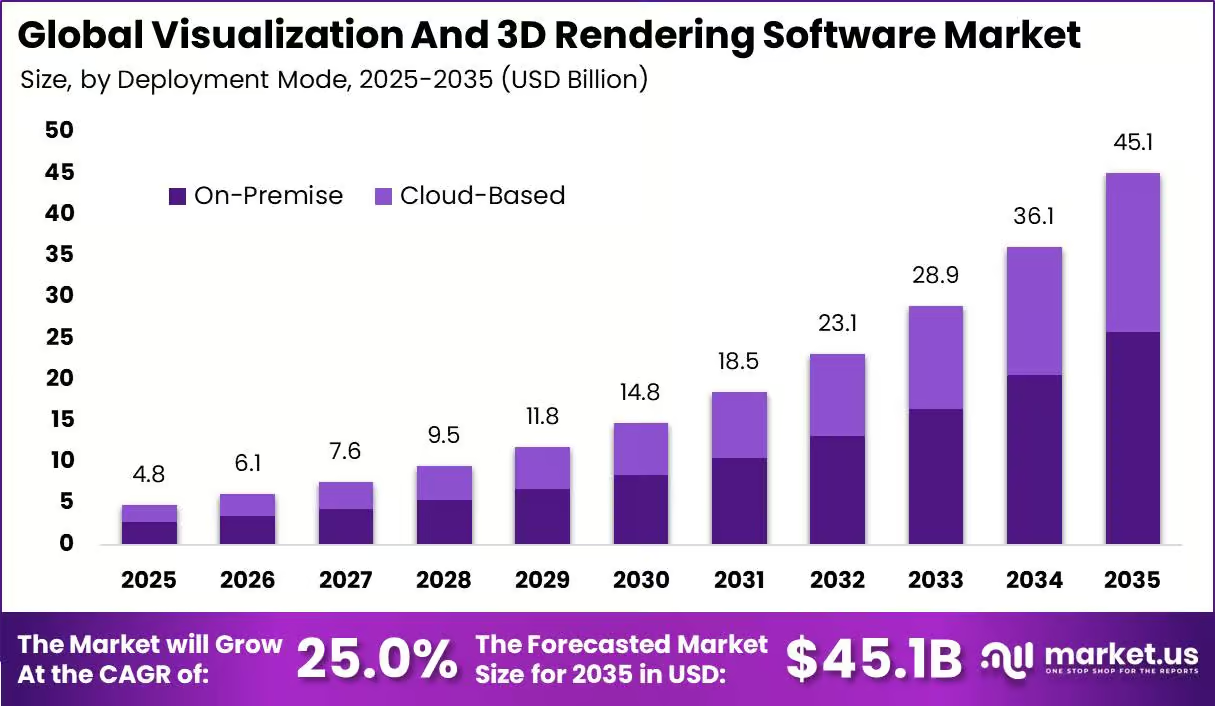
New York, NY – November 06, 2026 – The Global Visualization and 3D Rendering Software Market reached USD 4.8 billion in 2025. The market should grow at a CAGR of 25.0% and reach USD 45.1 billion by 2035. Consequently, this fast rise shows strong demand for digital design tools across major industries.
Moreover, North America held more than 35.4% of the market in 2025 and earned about USD 1.7 billion. Global vehicle production rose from 92.7 million units in 2024 to 96.4 million units in 2025. Therefore, carmakers need more digital prototyping and design testing tools to keep pace with higher output.
Additionally, aircraft makers sharply raised their output. Boeing delivered 600 commercial jets in 2025, about 72% more than the year before and its highest level since 2018. Airbus delivered 793 aircraft in the same year. Consequently, aircraft programs create heavy workloads for simulation, modeling, and rendering platforms.
Gaming companies also fuel demand for real-time 3D content. Industry estimates show that global gaming revenue passed USD 200 billion in 2025, up 9.1%. Moreover, PC gaming grew 12% to USD 43.6 billion. Film studios add more demand, since the visual effects market reached USD 11.4 billion that year.
Furthermore, PwC expects entertainment and media revenue to rise from nearly USD 3 trillion in 2024 to USD 3.5 trillion by 2029. Construction makes up 11–13% of global GDP and nearly 9% of global jobs. Consequently, builders, studios, and manufacturers form a wide and lasting customer base for automotive, architectural, and media visualization tools.
Key Takeaways
- The Visualization and 3D Rendering Software Market was worth USD 4.8 billion in 2025. It should reach USD 45.1 billion by 2035, growing at a CAGR of 25.0%.
- On-Premises led the market with a 57.1% share because defense, aerospace, and heavy industries need secure deployment.
- Product Design and Modeling held a 29.5% share, backed by more product development across manufacturing and consumer sectors.
- AEC captured a 30.1% share as strong construction activity drove wider use of digital design and BIM tools.
- North America led the market in 2025 with a 35.4% share and about USD 1.7 billion in revenue.
➤ Evaluate the Report Quality with an Exclusive Sample Download – https://market.us/report/visualization-and-3d-rendering-software-market/request-sample/
Market Segmentation
By Deployment Mode
The On-Premise segment led the market with a 57.1% share. Defense, aerospace, and heavy-industry users keep sensitive design data on local servers. According to the U.S. Department of Defense, the FY2025 budget approved USD 878.4 billion for national defense. Therefore, large defense programs need secure modeling and simulation systems.
Moreover, rules such as FISMA and FedRAMP set strict limits on how agencies store government data. Hardware spending supports this trend as well. Data center GPU shipments jumped 145.5% quarter over quarter in Q3 2025. Consequently, firms keep building dedicated computing power for graphics-heavy and simulation workloads.
By Application
The Product Design and Modeling segment held a 29.5% share. According to WIPO, global industrial design filings reached about 1.2 million applications in 2024, up 2.6%. These filings covered around 1.56 million designs. Therefore, designers use 3D modeling software to set shape, size, and surface details before building physical prototypes.
By End-User
The AEC segment captured a 30.1% share. According to the U.S. Census Bureau and HUD, U.S. housing starts reached 1.36 million units in 2025. Multifamily starts rose 17.4% year over year. Consequently, architects and engineers use BIM tools to find design conflicts early, which cuts rework, delays, and material waste.
Regional Analysis
North America led the market with a 35.4% share and about USD 1.7 billion in revenue in 2025. Aerospace, defense, gaming, and advanced manufacturing firms drive this lead. Moreover, these companies use high-performance rendering for product design, engineering, and entertainment work. Therefore, the region remains the largest buyer of premium visualization platforms.
However, Asia Pacific is growing fastest. The region produced about 42.7% of global manufacturing output in 2025, with value added of USD 9.4 trillion. Additionally, India’s industrial production rose 7.8% in December 2025, while motor vehicle output grew 33.5%. Consequently, factories across the region need more digital design and simulation tools.
Growth Drivers
According to Autodesk, recurring revenue made up 97% of its total net revenue in fiscal 2026. This figure shows how fully the industry has moved to subscriptions. Moreover, lower upfront costs help mid-sized design firms buy advanced tools. Cloud-hosted tiers can also deliver gross margins of around 85% to 90%.
Additionally, GPU-accelerated real-time rendering adds about 3.9% to the market CAGR worldwide. According to NVIDIA, its Professional Visualization unit earned a record USD 3.2 billion in fiscal 2026, up 70%. Therefore, businesses are investing heavily in faster graphics hardware. This spending creates strong demand for rendering software that uses GPU power.
Key Use Cases
Car makers and aircraft builders use 3D rendering to test designs digitally before they make physical parts. Engineers check shape, fit, and performance on screen. Consequently, teams catch errors early and shorten development cycles. Moreover, digital prototypes cut spending on molds, tooling, and repeated physical testing.
Additionally, architects use BIM and visualization tools to show clients realistic building views before construction starts. Contractors check structural, electrical, and plumbing layouts to avoid clashes on site. Meanwhile, game studios and film teams build real-time scenes, characters, and visual effects. Therefore, both sectors gain faster approvals and better final output.
Business Opportunities
Generative AI rendering opens a new revenue path for software vendors. Neural rendering tools are moving from research labs into commercial use. Moreover, vendors can move from fixed per-seat licenses to usage-based pricing tied to frames or compute time. Consequently, smaller gaming and architecture studios can afford premium rendering features.
Additionally, small firms in Asia Pacific and Latin America offer strong room for cloud-tier growth. Many of these businesses cannot buy costly workstations or long-term licenses. Therefore, low-cost cloud plans let them use professional rendering on demand. Digital twin projects in nearby industries also widen the customer base for vendors.
Major Challenges
Companies struggle to find engineers skilled in real-time rendering, shader programming, and simulation math. This talent gap slows enterprise rollouts of advanced visualization platforms. Consequently, vendors must spend more on training, certification, and technical support. However, these services also add cost and stretch project timelines for many buyers.
Moreover, shortages of high-end GPUs and memory delay upgrades to on-premises rendering farms. Large cloud providers often get hardware first, so mid-sized buyers wait longer. Additionally, tariffs on chips, steel, and copper raise the cost of servers and workstations. Higher electricity prices also push up operating costs for GPU-heavy rendering centers.
Top Key Players in the Market
- Autodesk Inc.
- Dassault Systèmes SE
- Trimble Inc.
- Adobe, Inc.
- Unity Technologies
- Siemens AG
- NVIDIA Corporation
- Enscape
- The Foundry Visionmongers Limited
- Lumion
Conclusion
The Global Visualization and 3D Rendering Software Market shows strong long-term growth potential. Subscription licensing, GPU-powered rendering, and digital prototyping drive steady adoption across automotive, aerospace, construction, and entertainment. Moreover, North America leads today, while Asia Pacific grows fastest. However, talent gaps, hardware shortages, and rising costs remain key hurdles. Consequently, vendors with AI tools and flexible cloud pricing will capture the strongest gains.
Discuss your needs with our analyst
Please share your requirements with more details so our analyst can check if they can solve your problem(s)