
Market Overview
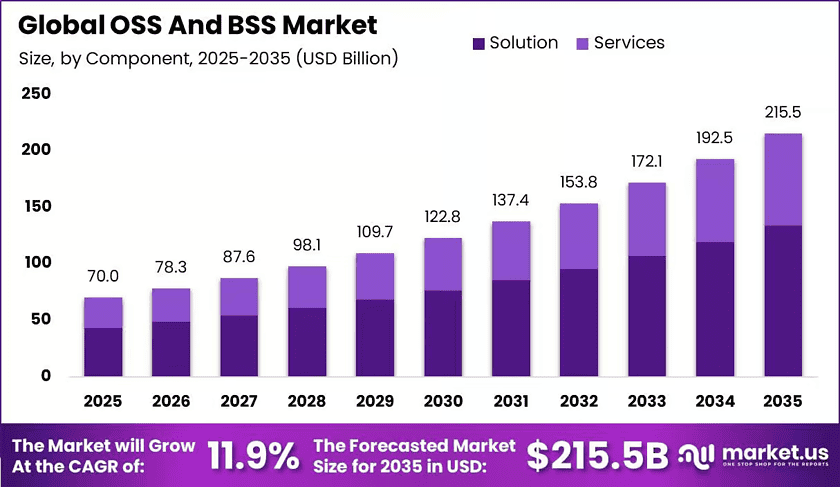
New York, NY – November 06, 2026 – The Global OSS And BSS Market reached USD 70.0 billion in 2025. Industry analysts project it will hit about USD 215.5 billion by 2035, growing at a CAGR of 11.9%. North America led the telecom software space in 2025 with a 32.6% share. The region earned about USD 22.8 billion in revenue. This steady growth shows that telecom operators now treat operations and business support software as core business tools.
Moreover, rising telecom connections drive this expansion. According to the International Telecommunication Union, global mobile-cellular subscriptions reached 9.2 billion in 2025. That equals 112 subscriptions per 100 people. Consequently, operators must manage huge numbers of accounts, bills, and service activations every day.
Additionally, 5G growth adds new complexity to telecom networks. According to the ITU, global 5G subscriptions crossed about 3 billion, close to one-third of mobile broadband connections. Therefore, carriers need smarter orchestration and charging platforms. These tools help them launch new services faster and bill customers correctly.
However, connectivity growth goes beyond mobile phones. According to the ITU, internet users rose to 6 billion, or 74% of the world population. This rise from 5.8 billion in 2024 creates more digital traffic. As a result, operators invest in automated billing, network monitoring, and customer management systems.
Key Takeaways
- The OSS and BSS Market reached USD 70.0 billion in 2025 and will likely reach USD 215.5 billion by 2035, growing at a CAGR of 11.9%.
- Global mobile-cellular subscriptions reached 9.2 billion in 2025, while 5G subscriptions crossed about 3 billion.
- The Solution segment held a leading 62.1% share, driven by rising mobile data traffic and telecom infrastructure investment.
- The On-premises segment led deployment with a 58.2% share, supported by operators’ need for control over critical systems.
- Large Enterprises accounted for 66.7% of the market, driven by large subscriber and network management needs.
- The IT and Telecom vertical held a dominant 55.3% share, reflecting the central role of OSS/BSS in daily telecom operations.
- North America led the market in 2025 with a 32.6% share and about USD 22.8 billion in revenue.
➤ Get Instant Access to the Premium Report Sample Before Purchase – https://market.us/report/oss-and-bss-market/request-sample/
OSS and BSS Market Segmentation
By Component
The Solution segment held a leading 62.1% share in 2025. According to industry data, mobile operators invested over USD 600 billion between 2022 and 2025, with about 85% going to 5G. Consequently, these large network investments raise demand for software that manages billing, orders, and workflows.
Moreover, mobile data traffic reached about 190–210 exabytes per month by early 2026. This traffic surge requires platforms that handle large data volumes. Therefore, operators buy software that improves billing accuracy, detects fraud, and protects service quality. Services also play a role by supporting integration and ongoing system management.
By Solution Type
Network Planning and Design led with a 27.3% share. According to India’s Department of Telecommunications, the country had 3.14 million base stations active by October 2025. Each site needs coverage mapping and capacity analysis before launch. Consequently, planning tools remain vital for fast network expansion.
Additionally, other solution types support the full service lifecycle. Service delivery, fulfillment, and assurance tools help operators activate and protect services. Moreover, billing and revenue management, network performance management, and customer and product management tools turn network usage into revenue. Together, these modules create a complete telecom operations stack.
By Deployment Mode
The On-premises segment held a dominant 58.2% share. According to the OECD, member countries had about 1.9 billion mobile broadband subscriptions by June 2024. This large base pushes operators to keep sensitive subscriber data in-house. Therefore, carriers prefer direct control over billing and provisioning systems.
However, cloud-based deployment is gaining ground quickly. Operators move charging and order management to the cloud to cut costs and scale faster. Moreover, rising hardware and energy costs encourage cloud-native platforms. Consequently, many carriers now run hybrid models that mix on-site control with flexible cloud delivery.
By Enterprise Size
Large Enterprises held a dominant 66.7% share. In India, Reliance Jio serves about 498.47 million broadband subscribers, while Bharti Airtel serves about 307.07 million. Such huge customer bases demand automated billing and network monitoring. Consequently, major telecom groups spend the most on advanced support platforms.
Meanwhile, SMEs form a smaller but growing buyer group. According to GSMA Intelligence, more than 1,250 mobile operators run over 4,600 networks worldwide. Many smaller operators need affordable, cloud-based tools. Therefore, vendors offer flexible subscription models that help smaller firms modernize without high upfront costs.
By Industry Vertical
The IT and Telecom vertical held a dominant 55.3% share. According to the OECD, the ICT sector grew 7.6% in 2023, nearly 3 times faster than the overall economy. This growth shows rising digital demand. Consequently, telecom providers rely on these platforms to plan networks and convert usage into revenue.
Additionally, BFSI, media and entertainment, and retail and e-commerce firms adopt these systems. According to the OECD, about 49% of businesses used cloud computing in 2023. Therefore, demand rises for bundled connectivity, cloud, and security billing. These sectors value accurate billing and reliable digital service delivery.
Regional Analysis
North America led the market in 2025 with a 32.6% share and about USD 22.8 billion in revenue. Mature 5G networks and wide fiber coverage support this lead. Moreover, Tier-1 operators in the US and Canada manage enterprise 5G, IoT, and network slicing. Consequently, they need advanced orchestration and billing platforms.
However, Asia Pacific is the fastest-growing region. India’s telephone subscriber base exceeded 1.35 billion, while broadband subscriptions passed 1.09 billion. China’s mobile base reached 1.8 billion by the end of 2025. Therefore, rapid subscriber growth creates strong demand for scalable telecom support systems across the region.
Market Drivers
Cloud-native platform replacement drives strong market growth. Telecom operators move billing, charging, and assurance from old systems to scalable software. According to the ITU, global internet users reached 6.0 billion in 2025. Consequently, operators must activate and bill more digital services in near real time, adding about 2.6% to growth.
Additionally, autonomous network operations push demand higher. Ericsson introduced more than 20 cloud-native AI and Gen-AI applications across OSS/BSS domains in 2025. These tools reduce manual work and speed up fault fixing. Therefore, operators in North America, Europe, and East Asia invest in self-running networks, adding about 2.1% to growth.
Use Cases
Telecom operators use OSS platforms to plan, build, and monitor their networks. These tools map coverage, track faults, and manage capacity during 5G rollouts. Moreover, service assurance features detect outages early and protect customer experience. Consequently, carriers reduce downtime and keep their networks running smoothly across large regions.
Additionally, operators use BSS platforms to manage customers and revenue. These systems handle billing, product catalogs, orders, and payments for mobile, broadband, and IoT services. Therefore, carriers can launch bundled offers quickly. Enterprises also benefit from accurate usage billing for cloud, security, and connectivity packages.
Business Opportunities
Network API monetization offers a strong new revenue path. Many operators still depend on fixed monthly fees. However, enterprises want paid services such as identity checks, fraud prevention, and device location. Consequently, vendors that offer API catalogs, consent tools, and real-time rating can help carriers unlock fresh income streams.
Moreover, industry-specific private networks create wide growth potential. Factories, ports, and energy sites need dedicated 5G networks with custom billing and monitoring. Therefore, support platform vendors can build tailored packages for these buyers. Manufacturing hubs and Gulf states show especially strong interest in such enterprise network solutions.
Major Challenges
Legacy data integration remains a serious hurdle. Established operators run separate customer, billing, inventory, and network databases built over many years. Consequently, merging this data into one platform takes time and skilled staff. Moreover, poor data quality slows automation and raises project risk during system upgrades.
Additionally, cybersecurity compliance adds cost and complexity. Rules such as the European NIS2 framework increase security testing and reporting duties during migrations. However, many firms lack enough security specialists. Therefore, operators face longer project timelines and higher spending when moving critical support systems to new platforms.
Top Key Players in the Market
- Amdocs
- Cisco Systems Inc.
- Comarch SA
- Hewlett Packard Enterprise Development LP
- Huawei Technologies Co. Ltd.
- Infosys Limited
- Netcracker Technology Corporation (NEC Corporation)
- Nokia Corporation
- Oracle Corporation
- Suntech S.A.
- Telefonaktiebolaget LM Ericsson
Conclusion
The OSS and BSS market keeps growing as telecom operators handle more subscribers, 5G services, and digital traffic. Solution offerings, on-premises deployment, large enterprises, and the telecom vertical lead demand today. Moreover, cloud-native platforms and AI automation open new paths for growth. However, legacy data and security rules still slow progress. Therefore, vendors offering flexible and secure platforms will capture the strongest future opportunities.
Discuss your needs with our analyst
Please share your requirements with more details so our analyst can check if they can solve your problem(s)