Market Overview
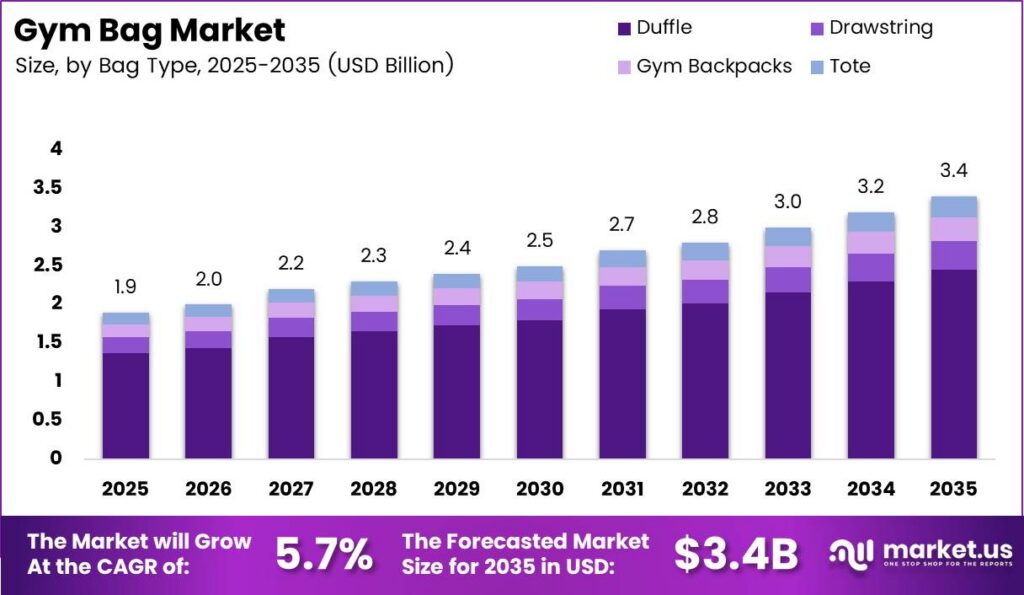
The global gym bag market reached USD 1.9 Billion in 2025 and will hit USD 3.4 Billion by 2035. Industry revenue grows at a 5.7% CAGR from 2026 to 2035. Rising health club memberships and hybrid office schedules boost athletic carry demand. Consequently, accessory brands launch multi-compartment bags to capture frequent replacement sales.
Moreover, athletic carry containers use ventilated shoe tunnels, moisture-resistant linings, and ergonomic straps to organize workout gear. Fitness members, office commuters, and student athletes use these bags to carry sneakers, damp clothes, water bottles, and laptops. Separated compartments trap sweat odors. Therefore, users protect electronics while traveling between offices and fitness centers.
Data-Driven Insights for Smarter Business Decisions:
Explore the Full Report
Key Takeaways
- The global Gym Bag Market was valued at USD 1.9 Billion in 2025.
- The market is projected to reach USD 3.4 Billion by 2035.
- Global market revenue will expand at a CAGR of 5.7% during the forecast period from 2026 to 2035.
- By Bag Type, the Duffle segment led the market with a 71.10% share in 2025 and represents the fastest growing category.
- By Material, the Leather segment held the largest share of 41.23% in 2025, while Canvas is the fastest growing material.
- By Distribution Channel, Hypermarkets & Supermarkets captured a dominant 41.67% share in 2025, whereas the Online channel is the fastest growing segment.
- North America dominated the regional landscape with a 31.78% market share valued at USD 0.60 Billion in 2025, while Asia-Pacific is the fastest growing region.
Additionally, commercial health clubs, university athletic departments, and corporate wellness programs drive institutional and retail purchases. In July 2026, adidas started a 10 year, USD 300 million partnership with Penn State covering 31 varsity sports and 800 athletes. Meanwhile, corporate wellness benefits reimburse fitness gear. Consequently, collegiate and corporate programs sustain bulk orders.
Furthermore, engineers integrate kinetic suspension straps, hard-shell polycarbonate cases, and washable antimicrobial liners into modern bags. In December 2025, a leading manufacturer launched a hard-shell athlete suitcase in 3 sizes starting at USD 260 after 5 years of research. Removable liners simplify cleaning. Therefore, premium hardware lifts average retail selling prices.
Meanwhile, patent protections and chemical safety laws actively shape global bag manufacturing. World Intellectual Property Organization data shows sports design filings rose 8.3% annually through 2025 alongside 65,700 inventions. Additionally, European Union rules restrict fluorochemical coatings at 25 ppb from October 10, 2026. Consequently, compliant brands with patented designs win retail shelf space.
Finally, Health & Fitness Association data shows U.S. gym memberships hit a record 81 million consumers in 2025, rising 5.2% as total facility users topped 100 million. Eurostat figures indicate European extra-EU sporting goods imports reached EUR 10.8 billion in 2024. Expanding gym foot traffic guarantees steady recurring bag demand worldwide.
Market Segmentation Overview
Duffle bags captured a dominant 71.10% type share in 2025 and grow fastest ahead of drawstring packs, backpacks, and totes. Nike Brand Equipment revenue hit USD 2,199 million in fiscal 2026 as wide-mouth zippers easily store weightlifting belts and shoes. Meanwhile, leather led materials with a 41.23% share over nylon and polyester.
Moreover, canvas represents the fastest-growing material as India exported USD 49.5 million of cotton bags in fiscal 2025 to 2026, up 27%. Additionally, hypermarkets and supermarkets led distribution with a 41.67% share in 2025 ahead of specialty stores. Meanwhile, online channels grow fastest as U.S. e-commerce hit USD 340.2 billion in second-quarter 2026.
Drivers
Hybrid work schedules of 3 to 4 days weekly and a 14.2% jump in boutique studio memberships merge office commuting with gym trips. Commuters buy ballistic nylon hybrids priced from USD 95 to USD 165, lifting direct-to-consumer order values by 38.5%. This trend adds +1.9% to the CAGR and expands gross margins by 420 basis points.
Moreover, corporate wellness equipment reimbursements and direct-to-consumer athleisure cross-selling accelerate replacement cycles from 4.2 to 2.6 years. Corporate reimbursements add +1.2% to the CAGR forecast, while athleisure bundling adds +1.1% and antimicrobial liners add +0.8%. Consequently, brands integrating 16 inch laptop sleeves and shoe garages cut payback cycles to 6.5 months.
Use Cases
Urban bicycle and transit commuters use ergonomic gym backpacks with padded lumbar panels to carry laptops alongside damp workout clothes. Samsonite Group reported lifestyle and travel bag sales rose 2.4% in first-half 2026 to form 37.4% of its USD 1,680.6 million revenue. Vertical load alignment prevents back strain during daily city commutes.
Additionally, student athletes and recreational swimmers use lightweight drawstring packs and wide-mouth duffels for school practices. National Retail Federation data shows 67% of back-to-school households shopped by July 2025, spending USD 249.36 on apparel and accessories inside a USD 35 billion market. Consequently, mass retailers use drawstring bags as high-volume traffic drivers.
Major Challenges
State and European bans on fluorinated water-repellent coatings force retailers to quarantine 11.5% of active seasonal SKUs. Switching to silicone coatings raises fabric finishing costs by USD 1.15 to USD 1.60 per meter and cuts abrasion durability by 22%. Consequently, gross margins shrink by 350 basis points, creating a -1.4% CAGR restraint.
However, supply bottlenecks in recycled nylon yarns also create severe price swings and factory delays across Asia. Certified recycled polyamide prices fluctuated by 24% to 31% through 2026 as mill weaving lead times stretched from 35 to 68 days. Holding 21 extra days of fabric stock imposes a -1.1% growth drag.
Business Opportunities
Bag makers can embed rechargeable 265 nanometer UV-C LED sanitization arrays, tracking chips, and smart locker modules into premium bags. Smart electronics add USD 11.40 to USD 14.80 in unit costs but lift retail prices to USD 295. This upgrade expands margins by 1,100 basis points and adds +1.5% CAGR upside.
Furthermore, brands can target emerging urban gym franchises across India, Southeast Asia, and Latin America while launching hard-shell recovery cases. Emerging city gym expansion adds +1.2% to the CAGR forecast, while modular recovery storage adds +0.9% and esports co-branding adds +0.7%. Companion USD 2.99 monthly tracking apps also boost customer value by 44%.
Regional Analysis
North America dominated the global market in 2025 with a 31.78% share valued at USD 0.60 Billion. VF Corporation filings show The North Face generated USD 475.6 million in Americas revenue during second-quarter fiscal 2026. High consumer spending on boutique fitness studios and university sports fuels premium duffle sales across North America.
Meanwhile, Asia-Pacific represents the fastest-growing regional market due to expanding urban gym chains and local textile mills. UNCTAD and WIPO data show Asian ports handled 60% of global container traffic in 2024 while generating 76% of sports design filings through 2025. Proximity to nylon mills shortens delivery lead times for Asian brands.
Recent Developments
- November 2026 — Herschel Supply Company launched a Porsche collaborative carry and car-organizer collection priced from USD 30 to USD 65.
- November 2026 — PUMA SE opened a 41,000 square meter logistics warehouse in Vendenheim, France to process 57,000 daily order lines.
- October 2026 — Samsonite Group acquired an 85% stake in tote and duffel brand BÉIS for USD 178.5 million at a USD 210 million valuation.
- July 2026 — Frasers Group opened a 90,000 square foot Liverpool flagship and expanded Everlast Gyms+ past 60 UK sites as revenue hit GBP 5,325.9 million.
- July 2026 — Under Armour launched 2 new No Weigh bags, including the USD 85 No Weigh Lite, featuring its UA Suspension Strap System.
- May 2026 — Under Armour released 4 compact U.S. gym and running waist and crossbody bags to expand its fitness carry portfolio.
- February 2026 — YETI Holdings unveiled its Skala athletic pack line in 4 capacities from 32L to 60L following its USD 36.2 million Mystery Ranch buyout.
- November 2025 — Under Armour signed a 10 year, USD 104.5 million partnership extension with the University of Wisconsin-Madison covering 23 varsity teams.
- November 2025 — Herschel Supply Company partnered with Kraft Heinz to launch a 2 piece travel carry line using 70% recycled polycarbonate shells.
- August 2025 — adidas AG signed a 10 year apparel and sideline gear partnership with the University of Tennessee covering 20 varsity programs.
- August 2025 — DaKine collaborated with Independent Trucks on a 5 style skate and gym bag capsule led by a 32 liter pack.
- December 2024 — Thule Group acquired 100% of gear mount maker Quad Lock for AUD 500 million to form its Bags & Mounts division.
- October 2024 — VF Corporation sold backpack brand Supreme to EssilorLuxottica for USD 1.506 billion in net cash to focus on core outdoor brands.
Key Players
- Jensen Lee
- EVERLAST WORLDWIDE INC.
- Nike, Inc.
- ToteBagFactory
- Herschel Supply Company Ltd.
- adidas AG
- Under Armour, Inc.
- VF Corporation (The North Face)
- DaKine (MARQUEE BRANDS)
- Other Key Players
Conclusion
The global gym bag industry grows steadily as record health club memberships and hybrid office schedules increase daily gear transit. Consumers replace basic polyester bags with structured ballistic nylon hybrids that protect laptops and shoes. Hybrid commuter adoption adds +1.9% to the CAGR. Consequently, brands achieve higher average order values.
Moreover, duffle bags hold a 71.10% type share while leather captures 41.23% of material revenue ahead of fast-growing canvas. Hypermarkets and supermarkets lead distribution at 41.67%, supported by rapidly expanding online direct stores. North America commands 31.78% of global revenue at USD 0.60 Billion, while Asia-Pacific grows fastest.
Consequently, manufacturers must adopt fluorine-free waterproof coatings, long-term recycled yarn contracts, and UV-C sanitization hardware to protect margins. Shifting sewing orders to Vietnam, Cambodia, and India also reduces bilateral tariff costs. Companies executing these strategies will capture affluent fitness commuters as the market reaches USD 3.4 Billion by 2035.
Looking for data tailored to your specific market, region, or business need?
Request a custom report or consultation — write to us at
sales@market.us
Discuss your needs with our analyst
Please share your requirements with more details so our analyst can check if they can solve your problem(s)