
Market Overview
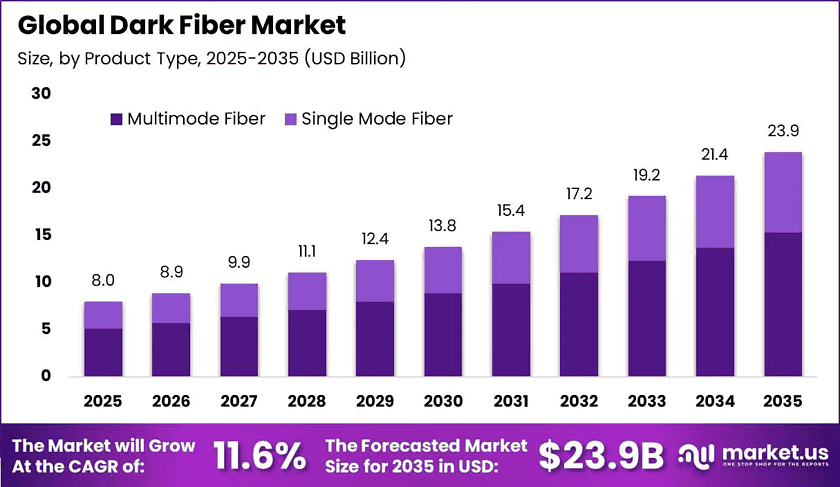
New York, NY – November 10, 2026 – The Global Dark Fiber Market reached a value of USD 8.0 billion in 2025. Analysts expect it to hit USD 23.9 billion by 2035, growing at a CAGR of 11.6%. North America led the unlit fiber space in 2025 with more than a 32.3% share. The region generated about USD 2.58 billion in revenue.
Additionally, rising internet traffic is pushing demand up. According to the ITU, global fixed broadband traffic grew from 5.1 zettabytes in 2023 to 6 zettabytes in 2024. Meanwhile, internet users reached 6 billion in 2025. This growth means operators need more backbone capacity, so they turn to leased fiber instead of slow new builds.
Furthermore, mobile networks add strong pressure. According to GSMA Intelligence, global 5G connections passed 2.7 billion by the end of 2025. Each 5G site needs fast fiber links to the core network. Therefore, mobile carriers lease dark fiber to connect towers and handle growing video and app traffic.
However, data centers drive the biggest shift. According to the IEA, data center electricity use reached 415 terawatt-hours in 2024 and may hit 945 terawatt-hours by 2030. This jump points to fast AI and cloud growth. Consequently, hyperscale firms reserve private fiber routes to link their campuses with low delay.
Key Takeaways
- The Dark Fiber Market was valued at USD 8.0 billion in 2025 and is projected to reach USD 23.9 billion by 2035, growing at a CAGR of 11.6% during 2026–2035.
- Multimode fiber dominated the dark fiber market, holding a 64.2% share.
- Metro networks led the dark fiber market, accounting for a 58.3% share.
- Glass, particularly silica-based optical fiber, dominated the market with an 85.7% share.
- Internet service providers held the leading market position, accounting for a 34.6% share.
- North America led the market in 2025 with a 32.3% share and approximately USD 2.5 billion in revenue.
➤ Evaluate the Report Quality with an Exclusive Sample Download – https://market.us/report/dark-fiber-market/request-sample/
Dark Fiber Market Segmentation
By Product Type
Multimode fiber held a 64.2% share of the dark fiber market. Data centers and enterprise campuses rely on it for short links. Moreover, according to IEEE 802.3 standards, OM3 and OM4 fibers carry 40–100 Gbps over about 100–150 meters. This speed at low cost makes multimode the top choice for in-building networks.
Additionally, single-mode fiber serves longer routes. According to IEEE standards, it supports 50–400 Gbps over at least 40 kilometers. This reach makes it vital for metro rings and intercity links. Therefore, operators often combine both fiber types to balance cost and distance.
By Network Type
Metro networks led this segment with a 58.3% share. According to UN DESA, 58% of people worldwide now live in cities and towns. Dense urban areas host data centers, cell towers, and business parks. Consequently, operators build short fiber rings to connect these sites and carry heavy local traffic.
By Material
Glass, mainly silica-based optical fiber, held an 85.7% share. According to the ITU-T G.657 standard, modern silica fiber can reach attenuation as low as 0.40 dB/km. This low signal loss lets data travel far with little power drop. Therefore, glass outperforms plastic for high-bandwidth and long-distance links.
By End-User
Internet service providers held the top end-user share at 34.6%. According to the World Bank, global fixed broadband subscriptions reached 1.6 billion in 2024. This large customer base pushes ISPs to expand capacity fast. Moreover, BFSI, healthcare, railway, and IT services firms also lease fiber for secure, private connections.
Regional Analysis of Dark Fiber Demand
North America held a 32.3% share in 2025. According to the Fiber Broadband Association, U.S. fiber networks passed 84.6 million homes by the end of 2025. This wide footprint gives carriers and data centers many unlit routes. Consequently, the region remains the largest market for leased fiber capacity.
However, Asia Pacific is the fastest-growing region. According to Indian telecom data, subscribers reached 1,228.9 million in September 2025. Meanwhile, Chinese data centers used 140 billion kilowatt-hours of electricity in 2024. Therefore, operators lease more dark fiber in India and China to meet rising 5G and cloud demand.
Key Growth Drivers
AI network capacity contracts stand out as a key growth driver. According to Lumen, the company secured nearly USD 13 billion in prepaid construction fiber deals by 2025. This shows that hyperscale clients reserve routes before networks are even built. Consequently, this driver could add about +2.4% to the baseline CAGR.
Additionally, enterprise cloud interconnection supports demand in global metro markets. Businesses move workloads to the cloud and need direct, private links to providers. Moreover, according to Cloudflare, global internet traffic grew 19% during 2025. This rising traffic pushes firms to lease dark fiber, which could add about +1.5% to CAGR.
Major Use Cases
Hyperscale data centers use dark fiber to link campuses across a city. These operators light the fiber with their own equipment and control speed and security. Moreover, they can upgrade capacity without asking a carrier for approval. Consequently, AI and cloud providers gain faster and more flexible network growth.
Additionally, banks, hospitals, and railways use dark fiber for private networks. Banks need fast, secure links between trading sites and backup centers. Hospitals share large medical images between branches without delay. Therefore, these sectors gain strong data privacy and reliable performance that public networks cannot always match.
Business Opportunities
Open-access fiber platforms offer strong growth potential. Many networks are still controlled by a single operator. However, leasing unused strands to several tenants improves network use and lowers cost per customer. Moreover, the European Gigabit Infrastructure Act encourages shared ducts and poles, which helps operators cut construction costs.
Additionally, edge data center links create new revenue paths. Companies place small data centers closer to users to cut delay for streaming, gaming, and AI apps. These sites need fast fiber links to core networks. Therefore, fiber owners can sign long-term leases with edge operators in busy metro markets.
Major Challenges
High borrowing costs remain a major barrier for fiber builders. Operators must pay for trenching, conduit, and permits before they earn any lease revenue. Consequently, higher interest rates weaken project returns. Therefore, many firms delay lower-priority routes until financing becomes cheaper and more stable.
However, route diversity creates another technical hurdle. Separate fiber circuits often share the same conduit, bridge, or railway corridor. A single cut can then disrupt several networks at once. Therefore, operators must build separate paths and keep accurate maps, which raises both construction and operating costs.
Top Key Players in the Market
- AT&T Inc.
- Colt Technology Services Group Limited
- Comcast
- Consolidated Communications
- GTT Communications, Inc.
- Lumen Technologies, Inc.
- Verizon Communications, Inc.
- Windstream Intellectual Property Services, LLC
- Zayo Group, LLC
- Microscan
- Sorrento Networks
- NexGen Networks Corporation
- UFINET
- Vikram Group
- DEPL
- UNITE PRIVATE NETWORKS
- Sterlite Power
- Crown Castle
- FirstLight
- Cologix
Conclusion
The dark fiber market shows strong and steady growth as internet traffic, mobile networks, and AI data centers expand worldwide. Multimode fiber, metro networks, glass material, and internet service providers lead their segments, while North America holds the top regional position. However, high financing costs and route diversity limits slow progress. Nevertheless, open-access platforms and edge data center links give operators clear paths to long-term growth.
Discuss your needs with our analyst
Please share your requirements with more details so our analyst can check if they can solve your problem(s)