
Market Overview
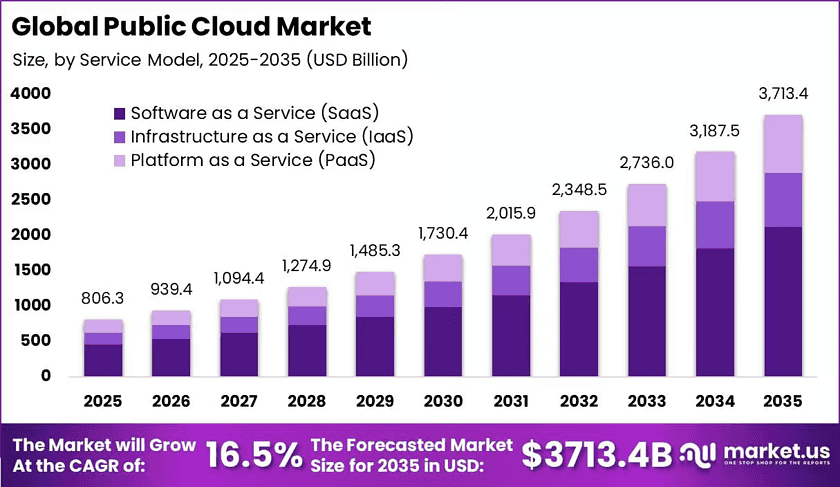
New York, NY – November 10, 2026 – The Global Public Cloud Market reached USD 806.3 billion in 2025. Moreover, the market should grow at a CAGR of 16.5% from 2026 to 2035. Consequently, the sector could reach about USD 3,713.4 billion by 2035. This growth shows strong long-term demand for pay-as-you-use computing services.
Companies move e-mail, office software, file storage, security, finance, and AI workloads to cloud platforms. According to Eurostat, 52.7% of EU enterprises used paid cloud services in 2025. That share rose 7.4 percentage points from 2023. This rise shows that businesses now treat online computing as a core business tool.
Additionally, large firms lead the shift to online computing. According to Eurostat, 84.7% of large enterprises used cloud services in 2025. Among cloud users, 85.2% used e-mail services and 71.5% used file storage. These figures show that firms move daily office tasks first and then shift more complex systems.
However, AI demand is changing what infrastructure providers need. According to the IEA, data-centre electricity demand may rise from 415 TWh in 2024 to 945 TWh by 2030. This jump of more than 2.2 times reflects heavy AI computing. Consequently, cloud providers must secure more power and build larger facilities.
Moreover, investment in digital infrastructure keeps rising. U.S. data-centre construction spending grew from about USD 10 billion in 2021 to nearly USD 40 billion in the first half of 2025. Additionally, UNCTAD reported more than USD 530 billion in greenfield digital projects in developing economies from 2020 to 2024. This spending expands hosting capacity worldwide.
Key Takeaways
- The Public Cloud Market was worth USD 806.3 billion in 2025. It should reach USD 3713.4 billion by 2035 at a 16.5% CAGR.
- SaaS led the market with a 57.1% share in 2025, driven by strong demand for ready-to-use web business applications.
- Large enterprises held a 63.9% share in 2025, supported by complex operations, high data volumes, and large-scale cloud needs.
- BFSI captured a 22.5% share in 2025, driven by demand for secure transactions, data management, fraud detection, and compliance.
- North America led the market in 2025 with a 37.4% share, worth about USD 301.6 billion.
➤ See the Full TOC, Market Tables & Figures in Your Sample Copy – https://market.us/report/public-cloud-market/request-sample/
Public Cloud Market Segmentation
Software as a Service (SaaS) led the market with a 57.1% share in 2025. Enterprises prefer ready-to-use software that they access through web platforms. Moreover, SaaS removes the need to buy, install, and update software on company servers. Meanwhile, Infrastructure as a Service (IaaS) and Platform as a Service (PaaS) serve custom computing and development needs.
According to Eurostat, 46.45% of EU enterprises used ERP software in 2025, and 28.51% used CRM tools. Additionally, 88.71% of large enterprises used ERP. These figures show strong demand for finance, sales, and inventory systems. Therefore, subscription access and automatic updates make SaaS the natural choice for these systems.
Large enterprises held a 63.9% share in 2025 because of complex operations and high data volumes. According to Eurostat, 55.03% of large EU firms used AI, compared with 17% of small firms. This gap shows that larger firms need more computing power. However, small and medium-sized enterprises still offer a large untapped base for migration.
The BFSI segment captured a 22.5% share in 2025, as banks and insurers need secure transactions and fraud checks. According to the World Bank, 79% of adults worldwide had a financial account in 2024. Consequently, growing digital payments push financial firms to adopt cloud security and compliance tools. Moreover, IT, telecom, manufacturing, healthcare, retail, government, and media users are also expanding their cloud use.
Regional Analysis
North America led the global public cloud market in 2025 with a 37.4% share, worth about USD 301.6 billion. The region hosts many hyperscale data centres and software firms. According to UNCTAD, U.S. greenfield data-centre projects reached about USD 38 billion in the first three quarters of 2025. Therefore, the United States remains the region’s main growth engine.
Asia Pacific should grow fastest, supported by rapid digital growth in China, India, Japan, and Southeast Asia. According to UNCTAD, South Korea attracted about USD 21 billion in announced data-centre investment in 2025. Additionally, India received around USD 7 billion. These investments show that Asian nations are building local capacity to meet rising cloud demand.
Key Market Drivers
AI computing demand drives strong cloud growth because model training and inference need huge computing capacity. According to the IEA, data-centre power use could reach about 1,200 TWh by 2035. This rise reflects how heavy AI workloads have become. Consequently, this driver may add about 2.4% to the market CAGR.
Moreover, companies are updating older software and moving it to the cloud. According to Eurostat, 20% of EU enterprises used AI in 2025, up from 13.5% in 2024. This shift turns one-time hardware spending into recurring cloud fees. Therefore, software modernization adds about 1.8% to the CAGR in North America and Europe.
Public Cloud Use Cases
Banks and insurers use public cloud platforms to process payments, detect fraud, and manage customer records. Moreover, these firms run analytics tools to spot risks quickly. Consequently, financial teams serve customers faster while meeting strict reporting rules. Cloud platforms also let them add capacity during busy transaction periods without buying new hardware.
Additionally, retailers and manufacturers run ERP, CRM, and order systems on cloud platforms. These tools connect stores, factories, suppliers, and customers in one view. Therefore, managers can track inventory and sales in real time. Software teams also build, test, and launch new applications faster with cloud development tools.
Business Opportunities in Cloud Computing
Sovereign cloud platforms offer strong growth potential for providers. Governments, defence groups, and hospitals need local data control before they move workloads. Moreover, the EU Data Act lowers the barriers to switching between providers. Consequently, providers that build local infrastructure and earn certifications can win high-value managed-service contracts.
Additionally, industry-specific AI clouds create new sources of revenue. Healthcare, finance, and manufacturing firms want ready AI tools built for their rules and data. Therefore, providers can bundle computing, models, and compliance features into one package. Edge cloud services and green cloud contracts also open new markets for providers in key regions.
Major Challenges
A shortage of cybersecurity skills slows public cloud adoption. Cloud environments need skilled teams for identity control, monitoring, and incident response. However, many firms cannot hire enough trained experts. Consequently, labour costs rise, complex migrations slow down, and companies rely more on managed-security services to protect their systems.
Moreover, limits on the power grid delay new data-centre regions. New facilities need enough electricity generation and grid connections before they can open. However, grid upgrades take years, while cloud demand grows much faster. Therefore, providers spend more on backup power and long-term electricity deals, which raises their operating costs.
Top Key Players in the Market
- Amazon Web Services, Inc.
- Microsoft Corporation
- Google LLC
- IBM Corporation
- Oracle Corporation
- Alibaba Cloud
- Salesforce, Inc.
- SAP SE
- Tencent Cloud
Conclusion
The global public cloud market shows strong long-term growth. SaaS leads the service models, while large enterprises and BFSI firms drive most spending. Moreover, North America leads in revenue, and Asia Pacific grows fastest. AI workloads, software updates, and sovereign cloud needs create new paths for growth. However, power limits and skill shortages remain key hurdles. Consequently, providers that invest in capacity, security, and local compliance will gain a lasting advantage.
Discuss your needs with our analyst
Please share your requirements with more details so our analyst can check if they can solve your problem(s)