
Market Overview
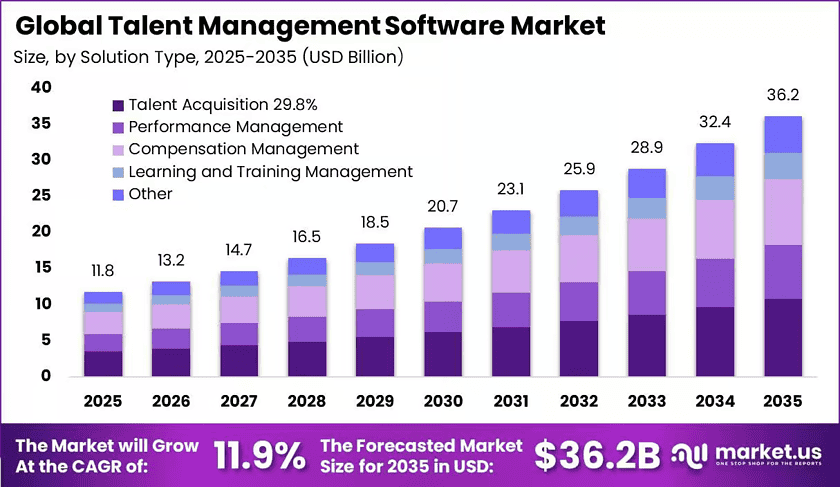
New York, NY – November 10, 2026 – The Global Talent Management Software Market reached USD 11.8 billion in 2025; analysts expect it to hit USD 36.2 billion by 2035 at an 11.9% CAGR. This steady growth shows that employers now treat workforce platforms as core business tools.
Moreover, rising workforce complexity fuels demand for HR technology. According to the World Economic Forum, 22% of jobs could face disruption by 2030. The shift may create 170 million roles and displace 92 million, leaving a net gain of 78 million jobs. Consequently, companies need tools that manage hiring and reskilling at scale.
Additionally, the World Economic Forum expects about 39% of core worker skills to change by 2030. This change pushes employers to track skill gaps and plan training more closely. Therefore, firms adopt employee development platforms that support internal mobility, performance reviews, and structured learning programs across teams.
However, hiring demand stays strong in major economies. According to the U.S. Bureau of Labor Statistics, employers posted 7.3 million job openings in May 2025. This figure shows a busy labor market where recruiters handle large applicant volumes. As a result, HR teams turn to Talent acquisition to speed screening and onboarding.
Furthermore, new business creation adds fresh buyers. According to the U.S. Census Bureau, the country recorded 446,993 business applications in May 2025, including 159,009 high-propensity filings. These growing firms need simple systems for onboarding, workforce planning, and compliance. Consequently, cloud-based talent platforms continue to gain ground among new and expanding employers.
Key Takeaways
- The Talent Management Software Market was valued at USD 11.8 billion in 2025 and should reach USD 36.2 billion by 2035, growing at a CAGR of 11.9%.
- Talent acquisition was the top solution type, holding a 29.8% share.
- On-premises deployment led with a 54.2% share, driven by large enterprises and security-sensitive organizations.
- Large enterprises led the organization size segment with a 64.5% share.
- IT and telecommunications was the leading industry vertical, holding a 23.1% share.
- North America led the market in 2025 with a 36.3% share, worth about USD 4.28 billion.
Market Segmentation
By Solution Type
Talent acquisition led the solution type segment with a 29.8% share in 2025. Employers hire often and compete hard for skilled workers. Moreover, the U.S. EEOC received 88,531 discrimination charges in fiscal 2024. This rise pushes firms toward standard assessments and documented hiring workflows that support fair, consistent decisions.
By Deployment Mode
On-premises deployment held a leading 54.2% share. Large enterprises, public agencies, and security-focused firms want direct control over employee data. According to the U.S. Office of Personnel Management, the federal government had 2.29 million civilian employees in March 2025. Therefore, such large employers need strict access controls and close links with payroll systems.
By Organization Size
Large enterprises dominated organization size with a 64.5% share. According to Eurostat, EU large firms made up only 0.2% of businesses yet employed 59.7 million people in 2023. This scale creates strong needs for standard HR processes. Additionally, these companies have the budgets to fund integrated talent platforms.
By Industry Vertical
IT and Telecommunications led industry verticals with a 23.1% share. According to Eurostat, 76.24% of EU information and communication firms employed ICT specialists in 2024. This high share shows a deep need for technical talent. Consequently, tech and telecom companies use workforce software to manage hiring, skills, and ongoing training.
Regional Analysis
North America led the market in 2025 with a 36.3% share, worth about USD 4.28 billion. The region gains from strong enterprise tech spending and wide HR system use. Moreover, according to report data, U.S. STEM jobs should grow 8.1% between 2024 and 2034. This demand pushes employers to close skill gaps with talent platforms.
Asia Pacific stands as the fastest-growing region. Internet use in the region reached 66% in 2024, which widens access to digital HR tools. Additionally, automation displaced about 1.4 million lower-skilled workers but created 2 million skilled jobs in East Asia and the Pacific between 2018 and 2022. Therefore, employers need strong reskilling and redeployment software.
Market Drivers
AI-led skills intelligence adds about 2.1% to the CAGR in the short term. Employers now use talent software for ongoing workforce decisions, not just record-keeping. Moreover, the U.S. Bureau of Labor Statistics projects about 280,000 yearly openings in computer and IT jobs through 2035. Consequently, firms invest in AI-based skills matching to fill key roles faster.
High-volume hiring automation adds about 1.7% to growth across North America, Europe, and Asia Pacific. Recruiters manage large applicant pools and need faster screening. Additionally, LinkedIn found that 73% of talent acquisition professionals believe AI will change hiring. Therefore, employers adopt automated sourcing, scheduling, and skills-based assessment tools.
Use Cases
Global employers use recruitment platforms to run hiring across many countries. Centralized candidate tracking keeps every application in one place. Moreover, automated workflows cut manual steps for recruiters and hiring managers. Consequently, multinational firms fill roles faster while keeping hiring practices consistent across regions and business units.
Companies also use learning and skills modules to reskill staff in roles exposed to AI. Managers spot skill gaps and assign targeted training paths. Additionally, internal talent marketplaces help employees move into new teams. Therefore, organizations keep valuable people, lower outside hiring costs, and build a ready pipeline of future leaders.
Business Opportunities
Frontline workforce adoption offers a strong growth path for vendors. Many retail, logistics, hospitality, and manufacturing employers still use separate tools for scheduling, payroll, and training. Moreover, wider mobile internet access supports mobile-first hiring and microlearning. Consequently, providers can win new buyers with simple, phone-friendly talent apps for shift workers.
Skills-based internal mobility creates another valuable opening. Employers want to move staff from AI-exposed roles into growing functions instead of hiring outside. Additionally, vendors can bundle skills mapping, career paths, and training into one platform. Therefore, software providers that link skills data with real job openings can capture rising enterprise demand.
Major Challenges
Fragmented HR data slows talent software rollouts. Companies must connect payroll, recruitment, learning, performance, and identity systems that often sit apart. Moreover, data cleanup, API work, and record migration add time and cost. Consequently, large employers with many locations face longer deployments and higher service bills before seeing full value.
Algorithmic bias controls create a second major hurdle. The European Commission classifies recruitment and worker-management AI as high risk. However, vendors must prove their tools treat candidates fairly and transparently. Therefore, providers invest more in audits, testing, and documentation, which raises costs and can delay product launches in regulated markets.
Top Key Players in the Market
- IBM Corporation
- Oracle Corporation
- SAP SE
- Cornerstone
- ADP, Inc.
- Zoho Corporation
- iCIMS
- Workday, Inc.
- Dayforce, Inc.
- Cegid
Conclusion
The talent management software market shows strong long-term growth as employers face skill shifts, steady hiring needs, and AI-driven job changes. Large enterprises, on-premises systems, and talent acquisition tools lead today. Moreover, North America leads while Asia Pacific grows fastest, though data fragmentation and AI rules remain key hurdles. Therefore, vendors offering skills intelligence and frontline tools stand to gain the most.
Discuss your needs with our analyst
Please share your requirements with more details so our analyst can check if they can solve your problem(s)