
Market Overview
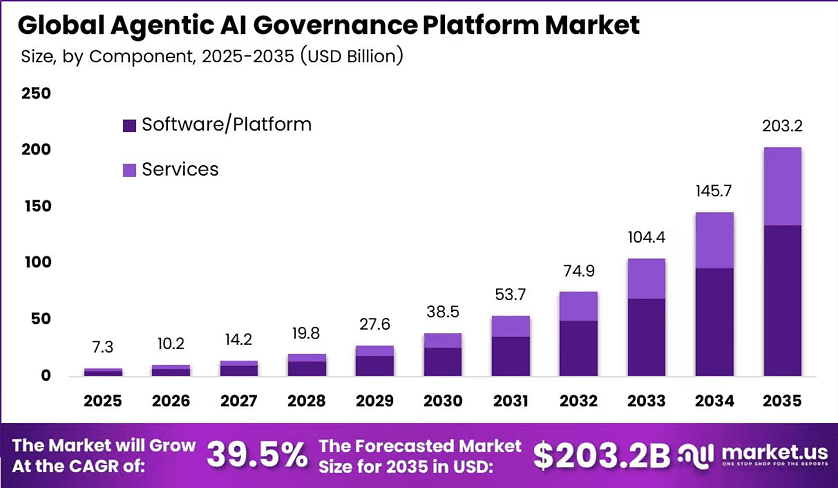
New York, NY – November 23, 2026 – The Global Agentic AI Governance Platform Market reached USD 7.3 billion in 2025. Analysts expect it to reach USD 203.2 billion by 2035, growing at a CAGR of 39.5%. This fast rise shows that firms now treat control of autonomous AI agents as a core business need. North America holds a 36.5% share and earns USD 2.7 billion in revenue. According to its 10-K filing, Palantir earned 74% of its 2025 revenue from US customers.
Moreover, according to the OECD, 20.2% of firms used AI in 2025, up from 8.7% in 2023. Adoption more than doubled in two years. Consequently, every new AI agent creates fresh demand for rules, audit trails, and live monitoring tools across business workflows.
However, large companies lead this shift. The OECD found that 52% of large firms used AI in 2025, compared with 17.4% of small firms. This gap means big enterprises drive most early spending on agent oversight. Additionally, 57.3% of ICT firms used AI, making tech companies key buyers.
Additionally, Microsoft raised research and development spending by USD 3.0 billion, or 10%, in fiscal 2025, according to its annual report. Cloud and AI engineering drove this increase. Consequently, heavy vendor investment keeps product quality high and helps the region stay ahead in agent governance solutions.
Key Takeaways
- The Agentic AI Governance Platform Market reached USD 7.3 billion in 2025 and will reach USD 203.2 billion by 2035, growing at a CAGR of 39.5% from 2026 to 2035.
- By component, Software/Platform leads with an 81.2% share.
- By deployment, Cloud-based leads with a 68.5% share.
- By end-user industry, BFSI leads with a 28.6% share.
- By governance function, Policy Management and Compliance leads with a 27.9% share.
- North America leads with a 36.5% share, worth USD 2.7 billion in revenue.
➤ See the Full TOC, Market Tables & Figures in Your Sample Copy – https://market.us/report/agentic-ai-governance-platform-market/request-sample/
Agentic AI Governance Market Segmentation
By Component
Software/Platform dominates with an 81.2% share. Companies need one control layer to manage many autonomous agents. Moreover, a single platform stores policies, approvals, audit logs, and risk scores together. This setup helps legal, security, and business teams follow the same rules across every workflow.
Additionally, IBM reported USD 29.96 billion in software revenue for 2025. This figure shows a large buyer base for enterprise tools that can carry governance features. Meanwhile, Accenture booked USD 5.9 billion in generative AI work, so services firms help clients adapt platforms to local laws.
By Deployment
Cloud-based deployment leads with a 68.5% share. Agentic systems need quick setup, flexible computing, and frequent updates. Consequently, cloud vendors deliver shared policy libraries and dashboards without long hardware projects. According to Microsoft, Azure passed USD 75 billion in revenue, giving governance vendors a ready customer base.
However, hybrid models also matter. Red Hat found that 73% of 1,200 surveyed IT professionals followed a hybrid strategy in 2025. This result means many firms split critical workloads between data centers and public clouds. Therefore, vendors must support oversight across both settings to win large accounts.
By End User Industry
BFSI leads with a 28.6% share. Banks, insurers, and payment firms face strict rules and direct financial risk. Moreover, they use AI for fraud checks, credit work, and customer support. Consequently, autonomous agents in these areas create urgent demand for clear ownership and strong controls.
Additionally, a Bank of England and FCA survey found that 75% of financial firms already used AI. The same survey showed 84% had an accountable person for AI oversight. These mature structures mean finance firms can spend early on governance platforms. Healthcare, retail, and government sectors follow closely.
By Governance Function
Policy Management and Compliance leads with a 27.9% share. Every agent needs clear rules before it acts, uses data, or calls tools. Therefore, companies want one place to turn laws and internal standards into working controls. This function also creates audit records for leaders.
Moreover, NIST builds its AI Risk Management Framework around 4 core functions, with governance as the base. The EU AI Act can impose fines up to €35 million or 7% of global turnover. Consequently, firms prioritize policy tools first, then add bias, security, and drift monitoring.
Regional Analysis of AI Agent Oversight
North America dominates with a 36.5% share and USD 2.7 billion in revenue. The US hosts major cloud and workflow vendors. Moreover, according to the IEA, US data centre power use may rise by up to 240 TWh by 2030. This growth signals heavy AI demand needing strong oversight.
Asia Pacific grows fastest, led by China. According to the IEA, Chinese data centre power use may grow by 175 TWh by 2030. This expansion shows rapid AI capacity building. Additionally, Europe holds a strong second place because strict data rules push buyers toward explainability and privacy tools.
Key Growth Drivers
AI regulatory enforcement adds about 1.8% to the forecast CAGR. The EU AI Act sets penalties up to €15 million or 3% of global turnover for certain violations. Consequently, governance shifts from optional consulting to a funded operating requirement. Firms now buy recurring software for policy enforcement and evidence capture.
Moreover, enterprise agent deployment adds about 1.5% to growth. According to Stanford HAI, organizational AI adoption rose from 78% to 88% in 2025. Documented incidents also climbed from 233 to 362. Therefore, wider use and rising failures push companies to invest in monitoring and control platforms.
Practical Use Cases
Banks use governance platforms to watch AI agents that handle fraud checks and credit reviews. These tools record each agent’s decision and flag risky actions for human review. Consequently, compliance teams can prove to regulators that automated choices follow approved rules. Moreover, clear audit trails reduce legal exposure during inspections.
Additionally, government agencies use these platforms to manage agents in public services. Officials set access rules, track data use, and stop agents when errors appear. Therefore, agencies protect citizen privacy while still gaining speed from automation. Healthcare providers apply similar controls to protect patient records and support safe clinical workflows.
Business Opportunities
Vendors can build ready-made control packs for specific industries. Healthcare, finance, and industrial firms still lack repeatable setups for agent oversight. Moreover, packaged templates and certified connectors can cut setup time for buyers. Consequently, vendors that turn custom consulting into reusable products can improve margins and win faster deals.
Additionally, embedded governance APIs offer strong upside. Software makers can add oversight features directly into their own products through partner tools. Therefore, governance vendors reach new buyers without building every sales channel alone. Localized editions for emerging markets also open new demand among firms facing high cloud costs.
Major Market Challenges
Autonomous agents create a wide attack surface. The UK government found serious gaps in agent security, tool access, and agent-to-agent messaging. Moreover, OWASP lists risks such as goal hijacking and privilege abuse. Consequently, firms must add policy gateways, sandboxing, and constant testing, which raises setup costs.
However, unclear return on investment also slows buying. Many leaders see governance as overhead rather than a core production control. Therefore, vendors face long proof-of-value cycles and smaller first orders. Additionally, scarce governance talent and old workflow systems make large rollouts slower and harder to support.
Top Key Players in the Market
- International Business Machines Corporation
- Microsoft Corporation
- Alphabet Inc. (Google LLC)
- Amazon.com Inc. (Amazon Web Services)
- SAS Institute Inc.
- SAP SE
- Oracle Corporation
- Hewlett Packard Enterprise Company
- ServiceNow Inc.
- Meta Platforms Inc.
- Palantir Technologies Inc.
- Clarifai Inc.
- DataRobot Inc.
Conclusion
The Agentic AI Governance Platform Market is growing fast as firms deploy more autonomous agents. Software platforms, cloud deployment, BFSI buyers, and policy compliance tools drive demand. Moreover, North America leads while Asia Pacific grows quickly. However, security gaps and unclear returns slow adoption. Consequently, vendors offering industry packs and embedded controls will gain the strongest position in this changing market.
Discuss your needs with our analyst
Please share your requirements with more details so our analyst can check if they can solve your problem(s)