
Market Overview
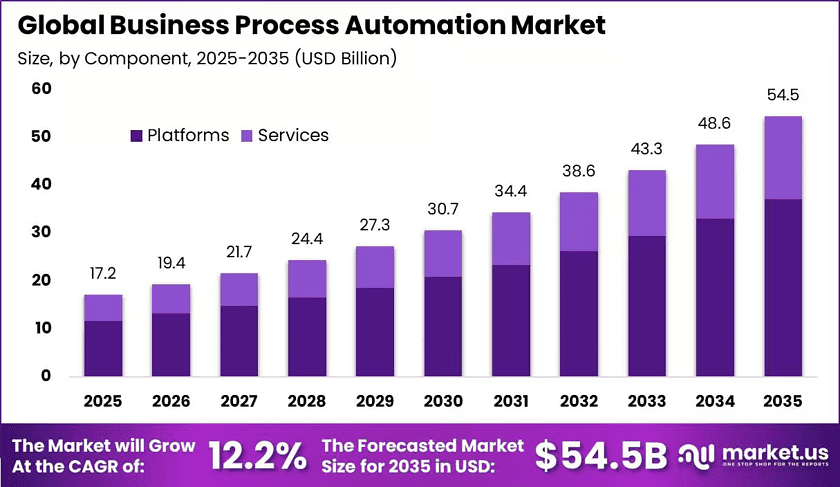
New York, NY – November 04, 2026 – The Global Business Process Automation Market reached USD 17.2 billion in 2025. Moreover, analysts project the market to grow at a CAGR of 12.2% from 2026 to 2035. Revenue should reach about USD 54.5 billion by 2035. North America led the global market in 2025 with a share of more than 35.7%. The region earned about USD 6.1 billion in revenue.
Governments also speed up digital operations. The global E-Government Development Index rose from 0.61 in 2022 to 0.63 in 2024. Additionally, public-sector digital investment reached USD 90.9 billion in 2023. This spending creates steady demand for automated approvals, citizen services, and document processing.
Services make up more than 63% of global GDP, worth over USD 67.5 trillion. Furthermore, global services trade grew 8.0% year-on-year in the third quarter of 2024. This large service economy gives automation tools a huge base. Therefore, firms use process automation to raise productivity and control operating costs.
The U.S. recorded 5.2 million new business applications in 2024, up 47.8% from 2019. New firms need scalable digital workflows and lean teams. Moreover, nearly 14% of jobs face a high risk of full automation, while 32% are partly automatable. These figures show wide room for intelligent workflow solutions.
Key Takeaways
- The Business Process Automation Market reached USD 17.2 billion in 2025 and should hit USD 54.5 billion by 2035 at a 12.2% CAGR.
- Platforms led the component segment with a 68.2% market share.
- Cloud led the deployment segment with 61.7% of the market.
- Accounting and Finance Automation held the largest function share at 27.3%.
- BFSI led the end-use segment with a 29.6% share.
- North America led in 2025 with a 35.7% share and about USD 6.1 billion in revenue.
➤ Download a Complimentary Sample of This Premium Report (Full TOC Included) – https://market.us/report/business-process-automation-market/request-sample/
Market Segmentation
By Component
Platforms held 68.2% of the component segment. Enterprises prefer cloud-based software, and platforms fit this model well. According to Eurostat, 52.7% of EU enterprises used paid cloud services in 2025, up 7.4 percentage points from 2023. Consequently, more firms buy unified platforms to link departments and manage shared workflows.
Large enterprises reached 84.7% cloud adoption, moving key applications online. Additionally, U.S. private investment in information processing equipment and software reached USD 1.19 trillion in 2024. This spending supports platforms that combine low-code tools, analytics, and process management. Therefore, buyers choose single systems over scattered point tools.
By Deployment
Cloud deployment held 61.7% of the market. Global data centre electricity use reached 415 terawatt-hours in 2024, growing about 12% each year. This growth shows how fast hosted infrastructure expands. Consequently, vendors can deliver automation tools faster and at lower upfront cost to customers.
Governments also shift toward hosted services. According to report data, U.S. federal cloud spending reached about USD 17 billion in FY2024. Moreover, total federal IT spending passed USD 130 billion. These budgets show a clear move away from on-premises systems. Therefore, cloud deployment should keep its lead throughout the forecast period.
By Function
Accounting and Finance Automation held 27.3% of the function segment. According to the IRS, the agency processed 271.4 million tax returns and forms in FY2025. It also received 4.5 billion third-party information returns. Such huge volumes push finance teams to automate invoicing, reconciliation, and tax reporting tasks.
About 93.9% of those information returns arrived electronically. Additionally, OECD data shows 70% of 54 Forum on Tax Administration members use AI for compliance and fraud checks. Consequently, finance remains a top area for automation spending. Human resources, supply chain, sales, and customer service functions also add steady demand.
By Vertical
BFSI held 29.6% of the vertical segment. According to the Federal Reserve, its ACH network processed nearly 1.8 billion Treasury payments worth USD 8.5 trillion in 2024. Such high payment volumes need fast and accurate handling. Therefore, banks use automation for reconciliation, fraud checks, and real-time settlement.
The Clearing House RTP network handled 343 million instant payments worth USD 246 billion, up 94% year-on-year. Moreover, cross-border bank claims reached USD 41 trillion in Q3 2024, according to BIS. These volumes increase compliance work. Manufacturing, IT and telecom, retail, and healthcare also adopt workflow automation.
Regional Analysis
North America held a 35.7% share and earned about USD 6.1 billion in 2025. According to the U.S. Bureau of Economic Analysis, private IT investment reached USD 1.19 trillion in 2024. This strong spending base helps finance, healthcare, and government groups deploy automation. Consequently, the region keeps its leading position.
Asia Pacific is the fastest-growing region. Developing Asian economies grew 5.5% in 2025, while fixed broadband coverage rose 17.7% between 2019 and 2023. Additionally, Southeast Asia’s digital economy should pass USD 300 billion in 2025. Better connectivity lets regional firms adopt cloud automation faster.
Market Drivers
Enterprise AI agents add about +2.1% to the baseline CAGR. These agents turn simple task automation into full workflow execution. According to Microsoft, Azure revenue passed USD 75 billion in fiscal 2025, up 34%. Consequently, cheaper AI infrastructure helps companies build and deploy automation agents faster.
Cloud workflow migration adds about +1.7% to growth, mainly in North America and Europe. Moreover, firms move older processes onto cloud platforms to cut hardware costs. According to its SEC filing, Oracle’s cloud-services revenue reached USD 24.5 billion in fiscal 2025, up 24%. This shift lifts platform subscriptions.
Key Use Cases
Finance teams use process automation to handle invoices, receipts, and account matching. These tools read documents, pull key fields, and flag errors for review. Consequently, staff spend less time on manual data entry. Moreover, faster closing cycles help managers get reliable financial reports sooner and make better decisions.
Banks and payment firms use automation to screen transactions and run identity checks. These systems watch payments in real time and spot unusual activity quickly. Additionally, automated settlement reduces delays across payment networks. Therefore, financial institutions lower fraud risk while serving more customers without adding large operations teams.
Business Opportunities
Autonomous finance operations offer a strong future opportunity. Most enterprises still automate single finance tasks rather than full workflows. However, AI agents can now validate records and handle exceptions with little human input. Consequently, vendors that offer agent-led finance tools can win large contracts and build long customer relationships.
Public sector agent platforms create another growth path across Asia Pacific, Europe, and the Middle East. Governments want faster citizen services and simpler approval steps. Moreover, outcome-based pricing lets agencies pay for actual results. Therefore, vendors with secure and compliant platforms can capture rising public digital budgets.
Major Challenges
Legacy system integration remains a major barrier. Automation platforms must connect with older ERP, banking, and mainframe systems without stopping daily operations. Consequently, enterprises spend on APIs, data cleanup, testing, and security first. These extra steps slow projects and push back the time needed to see clear returns.
Skills shortages also slow adoption across global markets. Many firms lack staff who can design, run, and monitor automation workflows. Additionally, scattered process data makes it hard to pick the right tasks to automate. Therefore, companies need training programs and partner support to scale automation programs successfully.
Top Key Players in the Market
- Laserfiche
- TIBCO Software Inc.
- OptimumHQ
- Kissflow Inc.
- Microsoft Corporation
- Zoho Corporation Pvt
- Oracle
- Accenture
- Appian Corporation
- BP Logix, Inc.
- Genpact
- IBM Corporation
Conclusion
The Business Process Automation Market shows strong long-term growth as firms and governments digitize daily work. Platforms, cloud deployment, finance automation, and BFSI lead their segments, while North America leads regional revenue. Moreover, AI agents and cloud migration speed up adoption. However, legacy systems, skills gaps, and data rules still slow progress. Therefore, vendors offering secure, connected, and easy platforms will capture the largest gains.
Discuss your needs with our analyst
Please share your requirements with more details so our analyst can check if they can solve your problem(s)