
Market Overview
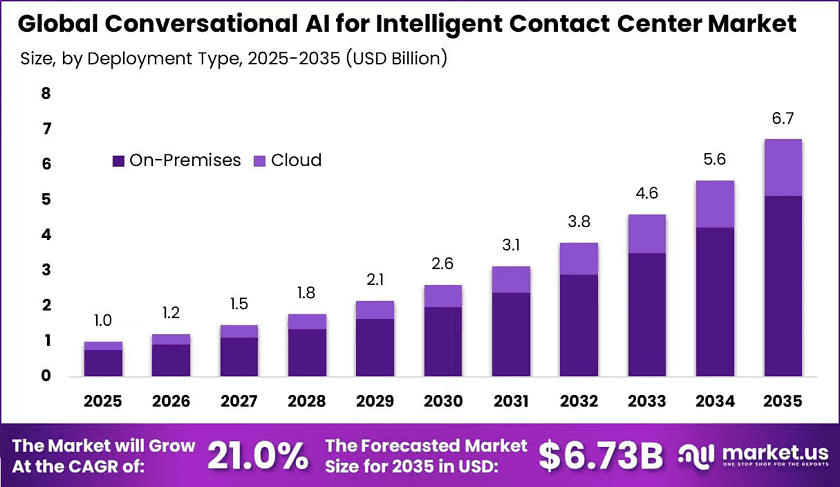
New York, NY – October 22, 2026 – The Global Conversational AI for Intelligent Contact Center Market reached USD 1.00 billion in 2025. Analysts expect the market to reach USD 6.7 billion by 2035, growing at a CAGR of 21.0% from 2026 to 2035. Consequently, businesses now treat AI-powered customer service as a core investment.
Moreover, North America led the global market in 2025 with a more than 41.0% share. The region earned about USD 0.41 billion in revenue. Large enterprise technology budgets and early cloud adoption explain this lead. Therefore, North American firms set the pace for intelligent customer engagement tools worldwide.
Additionally, rising internet use is growing the number of digital customers. According to the ITU, 5.5 billion people used the internet in 2024, up by 227 million from 2023. This figure equals 68% of the global population. Consequently, contact centers now handle more calls, chats, complaints, and service requests.
Furthermore, online shopping growth fuels demand for automated support. According to UNCTAD, business e-commerce sales across 45 major economies reached USD 28 trillion in 2024. Each order creates questions about delivery, refunds, payments, and products. Therefore, retailers use virtual agents to answer these routine questions quickly and at lower cost.
However, labor costs remain a major pressure point for service teams. According to the U.S. BLS, customer-service jobs may decline by 5% between 2025 and 2035, and median pay stands at USD 21.53 per hour. Consequently, companies adopt AI voice and chat systems to deliver faster, round-the-clock service.
Key Takeaways
- The market was valued at USD 1.00 billion in 2025 and is projected to reach USD 6.73 billion by 2035, growing at a CAGR of 21.0% (2026 to 2035).
- The On-Premises deployment segment held a dominant 76.1% share, driven by data security and compliance needs.
- Large Enterprises accounted for a 60.9% share, supported by their scale and investment capacity.
- Phone/Voice was the leading interaction channel, with a 39.9% share.
- BFSI led the industry verticals with a 30.1% share, fueled by rising digital payment volumes.
- Natural Language Processing was the dominant technology, with a 46.3% share.
- North America led the market with a 41.0% share, generating around USD 0.41 billion in revenue in 2025.
➤ See the Full TOC, Market Tables & Figures in Your Sample Copy – https://market.us/report/conversational-ai-for-intelligent-contact-center-market/request-sample/
Market Segmentation Analysis
On-premises deployment held a dominant 76.1% share in 2025, while cloud held 23.9%. Banks, hospitals, and insurers manage sensitive payment and identity data. Moreover, the Identity Theft Resource Center recorded 3,158 U.S. data compromise notices in 2024. Therefore, regulated firms keep AI systems on servers they control locally.
Large enterprises captured a 60.9% share, while small and medium businesses held 39.1%. Large firms handle high transaction volumes and serve millions of customers. Additionally, they have the budgets to connect AI with their existing contact-center systems. Consequently, these companies invest in central platforms that manage calls, chats, and requests at scale.
Phone and voice support led with a 39.9% share, followed by chat at 24.1%. Customers still call for urgent, sensitive, or complex issues such as banking disputes. Moreover, according to the ITU, mobile subscriptions reached 9.1 billion in 2024. Therefore, voice AI can reach customers in almost every region.
BFSI led the industry verticals with a 30.1% share, ahead of retail and e-commerce at 17.9%. According to the Reserve Bank of India, digital payment transactions reached 208.5 billion in 2024. Consequently, banks face frequent questions about failed payments, fraud alerts, and account access. Therefore, they use AI agents for fast, secure support.
Natural Language Processing held a dominant 46.3% share, while generative AI and LLMs reached 18.3%. NLP helps systems understand customer intent, tone, and context. Additionally, UNESCO records 8,324 languages in use worldwide. Therefore, global contact centers need language tools that handle different accents, phrases, and communication styles.
Regional Analysis
North America held a 41.0% share and generated around USD 0.41 billion in 2025. According to the U.S. Bureau of Economic Analysis, the Information sector added USD 1,523.9 billion in value in Q1 2024. Consequently, this large technology base and high labor costs support steady spending on AI service tools.
Meanwhile, Asia Pacific is the fastest-growing region, with a 26.3% share. According to the ITU, internet penetration in the region reached 66% in 2024. Additionally, Southeast Asia’s digital economy reached USD 263 billion in gross merchandise value, up 15%. Therefore, the growing number of online buyers increases demand for automated, multilingual support.
Market Growth Drivers
Cloud-native CCaaS migration adds an estimated 4.2% to the market CAGR. Companies are replacing legacy PBX and IVR systems with subscription cloud platforms. Moreover, industry estimates show cloud models can cut customer acquisition costs by 30% to 35%. Consequently, firms adopt conversational AI faster and with lower upfront spending.
Additionally, the use of agentic voicebots in banking adds about 3.1% to the CAGR. Banks in Asia Pacific and North America use AI agents for payment questions and identity checks. Furthermore, the cost savings from replacing manual work add another 2.3%. Therefore, rising wage pressure pushes service leaders to automate routine calls and chats.
Key Use Cases
Banks use conversational AI to resolve failed payments, block lost cards, and verify customer identity. Voice agents answer callers instantly at any hour. Moreover, the AI passes complex disputes to human staff along with the full case history. Consequently, customers avoid repeating details, and agents spend more time on high-value cases.
Additionally, online retailers use chat and voice bots for order tracking, returns, and refund updates. These bots connect website, email, text, and social media channels into one flow. Therefore, shoppers move between channels without losing progress. Meanwhile, retailers handle seasonal demand spikes without hiring large temporary teams.
Business Opportunities
Agentic AI gives vendors a large chance to grow into wider business process outsourcing work. Many back-office and service roles still lack AI-assisted workflows. Moreover, vendors can move from per-seat licenses to outcome-based pricing, such as charging per resolved interaction. Consequently, providers can raise revenue per seat and improve margins.
Additionally, usage-based pricing for small and medium businesses opens up a new customer base. Smaller firms prefer to pay only for the interactions they use. Furthermore, sovereign AI infrastructure in India and the Middle East creates demand for local hosting. Therefore, vendors with in-country data centers can win regulated contracts.
Major Market Challenges
Gaps in multilingual accuracy remain a key hurdle for conversational AI. Most language models are trained on a small set of major languages. However, many markets speak tonal or low-resource languages. Consequently, AI systems misread customer intent more often, which forces more handoffs to human agents and lowers the savings from automation.
Moreover, data localization rules slow cross-border AI hosting in markets such as India and Southeast Asia. Vendors must build dedicated in-country servers and GPU capacity. Additionally, a shortage of skilled conversation engineers slows deployment. Therefore, providers face higher costs, longer contract cycles, and slower rollouts in regulated regions.
Top Key Players in the Market
- Talkdesk
- NICE
- Genesys
- Five9
- Cisco Systems, Inc.
- Vonage
- RingCentral, Inc.
- ServiceNow, Inc.
- 8×8, Inc.
- Kore.ai
Conclusion
The Conversational AI for Intelligent Contact Center Market shows strong long-term growth. Rising internet use, online shopping, and higher labor costs push companies toward automated service. Moreover, on-premises systems, large enterprises, voice channels, BFSI, and NLP lead current demand. However, language gaps and data rules still slow adoption. Consequently, vendors that offer secure, multilingual, and flexible AI platforms will capture the biggest gains.
Discuss your needs with our analyst
Please share your requirements with more details so our analyst can check if they can solve your problem(s)