
Market Overview
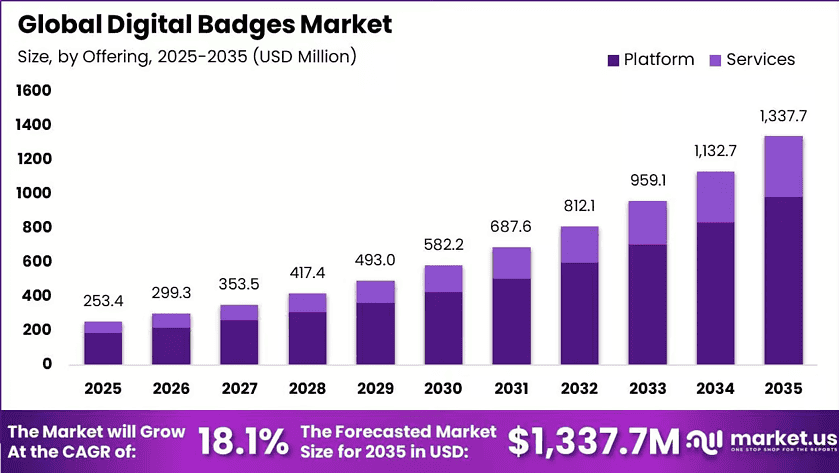
New York, NY – October 27, 2026 – The Global Digital Badges Market reached USD 253.4 million in 2025. Analysts project a CAGR of 18.1% during 2026–2035, which would lift the market to USD 1,337.7 million by 2035. Consequently, digital credentials are moving from a niche tool to a core part of learning and hiring.
Moreover, growth in global education is raising demand for online recognition tools. According to UNESCO, 327 million more children and youth attend school today than in 2000. This rise pushes governments to expand online and blended learning. Therefore, schools need digital assessment and badge systems to track progress at scale.
Additionally, the job market rewards verified digital skills. According to the U.S. Bureau of Labor Statistics, computer and IT jobs will create about 317,700 openings per year from 2024 to 2034. Consequently, employers use micro-credentials and badges to confirm skills quickly. This trend reduces their reliance on traditional degrees alone.
However, quality checks for online education have long lagged behind enrolment growth. According to UNESCO, less than 35% of higher education quality assurance bodies reviewed distance education before the pandemic. Therefore, regulators and institutions now favor clear, standard recognition formats. Digital credentials help them track learner outcomes as online programs grow.
Moreover, AI and data are reshaping skill needs across many jobs. According to the World Economic Forum, only about 20% of business leaders view their workforce as skilled in these areas. Consequently, firms launch modular reskilling programs. These programs issue stackable badges that close the skills gap step by step.
Key Takeaways
- The Digital Badges Market was valued at USD 253.4 million in 2025. It is projected to grow at a CAGR of 18.1% and reach an estimated USD 1,337.7 million by 2035.
- By offering, the platform segment dominated the market with 73.5% of the total market share.
- By end-use, the academic segment dominated the digital badges market with 65.2% of the total market share.
- North America led the digital badges market with 39.5% of the total market share, equal to about USD 100.09 million.
➤ Download a Complimentary Sample of This Premium Report (Full TOC Included) – https://market.us/report/global-digital-badges-market/request-sample/
Digital Badges Market Segmentation
By Offering
Platforms lead the offering segment with a 73.5% share in 2025. Institutions and employers prefer unified systems that issue, store, and verify credentials in one place. Moreover, rising badge volumes support this lead. According to the 1EdTech/Credential Engine 2025 Badge Count, issued badges grew from 74.7 million in 2022 to 320.4 million in 2025.
Consequently, this more than fourfold jump shows that platforms can handle large volumes at scale. Services, meanwhile, support setup, integration, and badge design. Additionally, many institutions lack in-house skills for credential design and system links. Therefore, service providers help clients align badges with learning goals and existing software tools.
By End-use
Academic users dominate end-use with a 65.2% share in 2025. Universities and colleges issue badges to record short courses and skill gains. Moreover, according to the 2026 UPCEA/Modern Campus report, 85% of institutions design microcredentials for workforce development. This focus links classroom learning directly to job readiness.
Corporate users form a growing part of demand. According to the Coursera Microcredentials Impact Report 2025, 96% of employers say microcredentials strengthen a job application. Consequently, companies use badges for training, skill checks, and promotion paths. This adoption turns employee learning into proof that managers can trust and verify.
Regional Analysis
North America leads the global market with a 39.5% share, worth about USD 100.09 million in 2025. The United States drives most of the region’s revenue. Moreover, more than 4,000 U.S. universities and colleges use digital credentialing systems. This wide base gives vendors steady demand and strong renewal potential.
Additionally, Europe and Asia-Pacific are building strong public credential systems. More than 76,000 European Digital Credentials for Learning have been issued into Europass wallets. Meanwhile, Skill India Digital Hub reports over 1.5 crore candidates and 68,000+ employer partners. Therefore, these regions offer large room for growth for badge providers.
Key Market Drivers
Micro-credential growth is the top market driver and adds about 6.0% to the CAGR forecast. The Council of the European Union backed a common approach to micro-credentials in 2022. Consequently, universities and trainers now use badges to show short learning results. This shift lets institutions earn revenue from many small learning events.
Moreover, skills-based hiring boosts badge demand. According to TestGorilla, 53% of employers have dropped degree requirements entirely, up from 30% the year before. Therefore, job seekers need clear proof of their skills. Digital badges fill this gap by giving employers fast, verified records of what candidates can do.
Use Cases
Universities use digital badges to record skills that transcripts often miss. Students earn badges for short courses, projects, and extra activities. Moreover, graduates share these badges on job sites and resumes. Consequently, employers see clear, verified proof of skills before interviews begin.
Companies use badges to track employee training and skill growth. HR teams link badges to learning systems and career paths. Additionally, staff gain visible rewards for finishing programs. Therefore, managers can spot skilled workers faster and plan promotions with better data. This approach also helps more staff finish their training.
Business Opportunities
National credential suites offer a strong growth path. Governments design micro-credential frameworks and need systems that issue and verify badges across borders. However, many countries still rely on scattered pilots or old record systems. Consequently, vendors with complete issuing, wallet, and analytics tools can win large public contracts.
Additionally, regulated sectors such as healthcare, finance, and defense need trusted skill records. These industries must prove staff training to regulators and clients. Therefore, sector-specific badges with strong checks can meet these needs. Providers that build tailored programs for these fields can charge premium prices and build lasting client ties.
Major Challenges
Uneven quality standards remain a key challenge. No common rules govern how institutions assess or issue badges. Consequently, employers struggle to judge what a badge is worth during hiring. Many hiring teams either ignore badges or build their own review rules, which adds time and cost to screening.
Moreover, system compatibility puts ongoing pressure on vendors. Badge platforms must work with many learning, HR, and portfolio tools. However, small data errors in revocation or evidence links can trigger support requests. Therefore, providers spend more on service and testing, which reduces margins in high-volume segments.
Top Key Players in the Market
- Pearson
- SkillSoft Corporation
- PeopleCert
- Accredible
- Parchment
- Accreditrust Technologies
- Badge List
- BadgeCraft
- Convergence Tech
- Open Badge Factory
- Certopus
- Credly
Conclusion
The global digital badges market shows strong momentum as education and hiring shift toward verified skills. Platforms and academic users lead demand, while corporate adoption keeps rising. North America holds the top position, while Europe and Asia-Pacific build strong public systems. However, quality gaps and system compatibility remain hurdles. Therefore, vendors that offer trusted, connected, and scalable credential tools will capture the next wave of growth.
Discuss your needs with our analyst
Please share your requirements with more details so our analyst can check if they can solve your problem(s)