
Market Overview
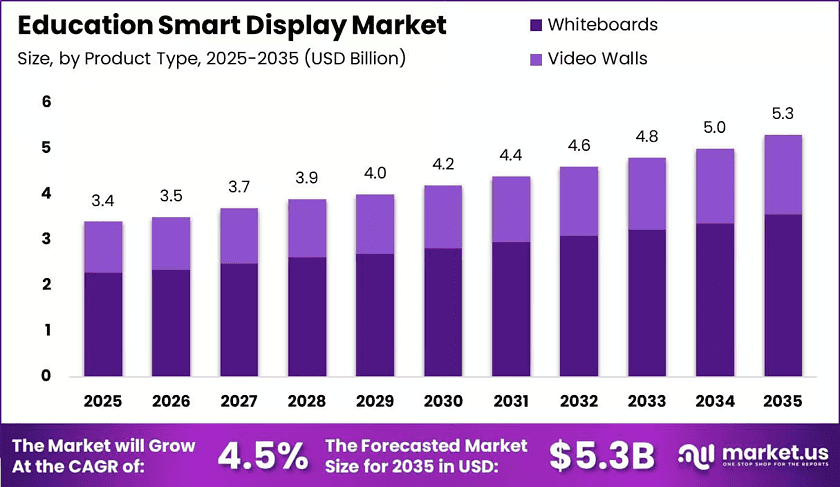
New York, NY – October 29, 2026 – The Global Education Smart Display Market reached USD 3.4 billion in 2025. Analysts project it will grow at a CAGR of 4.5% from 2026 to 2035 and reach about USD 5.3 billion. Consequently, schools keep investing in interactive classroom screens as part of long-term digital learning plans.
Moreover, school connectivity still has large gaps worldwide. According to UNESCO, only 40% of primary schools, 50% of lower-secondary schools, and 65% of upper-secondary schools have internet access. These gaps leave a lot of room for growth. As networks improve, more schools can use smart displays for video lessons and wireless sharing.
Additionally, government budgets support this shift toward digital classrooms. According to the German government, Digital Pact 2.0 will provide EUR 5 billion over 5 years, split equally between federal and state budgets. This shared funding lowers the financial risk for schools. Therefore, institutions can plan display upgrades across many classrooms at once.
Similarly, the United Kingdom committed GBP 45 million to school connectivity in 2025. According to the Department for Education, this included GBP 25 million for wireless networks and GBP 20 million for fibre upgrades. Stronger school networks make cloud content and screen casting work reliably. Consequently, interactive classroom technology becomes more useful for teachers.
Furthermore, North America has a large base of learners. According to national data, the United States had 49.6 million public-school students, while Canada recorded 5.5 million in 2023/24. This large group of students supports steady demand. Meanwhile, the U.S. E-Rate programme set a USD 5.05 billion funding cap for 2025, which helps districts buy equipment.
Key Takeaways
- The Education Smart Display Market is valued at USD 3.4 billion in 2025 and should reach USD 5.3 billion by 2035 at a 4.5% CAGR.
- Whiteboards led the product-type segment with a 67.2% share because of their multifunctional, shared-use classroom format.
- LCDs led the display-technology segment with a 54.3% share, backed by cost-effective image quality and long operating life.
- Displays up to 55-inch led the display-size segment with a 58.6% share, owing to lower installation cost and flexibility.
- North America led the market in 2025 with a 35.9% revenue share, worth about USD 1.2 billion.
➤ Evaluate the Report Quality with an Exclusive Sample Download – https://market.us/report/education-smart-display-market/request-sample/
Education Smart Display Market Segmentation
By Product Type
Whiteboards lead the product segment with a 67.2% share. These boards fit the traditional classroom setup and add digital tools. Moreover, one interactive whiteboard can replace a regular board, a projector, and a separate screen. Therefore, schools save space and money while updating teaching methods across every grade level.
Additionally, large public programmes keep demand for whiteboards strong. According to the World Bank, the Türkiye Safe Schooling project received USD 160 million and deployed 45,000 smartboards. This scale shows how governments buy in bulk. Meanwhile, video walls serve larger halls and shared spaces, but they remain a smaller, niche category.
By Display Technology
LCDs lead the technology segment with a 54.3% share. LCD panels balance screen size, clear images, touch features, and fair pricing. Moreover, they last a long time, which suits tight school budgets. Consequently, buyers often choose LCD screens over direct-view LEDs, OLEDs, and other newer panel types.
Furthermore, energy rules favour efficient panels in schools. According to the U.S. Environmental Protection Agency, ENERGY STAR limits sleep and off-mode power to 0.5 watts for signage displays. This cap cuts running costs for schools. Therefore, energy-efficient LCD classroom screens fit well with public sustainability goals and long-term budget plans.
By Display Size
Displays up to 55 inches lead the size segment with a 58.6% share. These screens are large enough for lessons and shared viewing. Moreover, they stay easy to install, move, and replace. Consequently, standard classrooms and small learning rooms prefer this format, while larger panels above 55 inches suit lecture halls.
Additionally, procurement data shows a clear cost benefit. According to Victoria’s Department of Education, a 55-inch dual-touch LCD eBoard costs AUD 4,180, plus AUD 700 for installation. This lower total cost helps schools stretch fixed budgets. Therefore, districts can equip more classrooms room by room with mid-size displays.
Regional Analysis
North America held the top position in 2025 with a 35.9% share and about USD 1.2 billion in revenue. Strong classroom tech spending supports this lead. Moreover, according to the U.S. Department of Education, the region allocated USD 1.3 billion for academic enrichment grants. This funding helps districts buy devices, software, and teacher training.
However, Asia Pacific should record the fastest growth. According to China’s education ministry, China had 286.4 million enrolled students and 470,034 institutions in 2024. This huge student base creates large demand for new and replacement displays. Additionally, the region’s strong electronics manufacturing base lowers sourcing costs and improves product availability.
Market Drivers
Public classroom funding stands out as the strongest driver. Governments turn digital policy into large hardware tenders that cover many classrooms. According to the report, this driver adds about 1.0% to the forecast CAGR. Consequently, schools buy displays, installation, and software together, which reduces adoption risk and supports steady supplier revenue.
Moreover, interactive teaching continues to spread worldwide. According to OECD TALIS 2024, 66% of teachers who frequently use digital resources use them for direct instruction. This habit shows that teachers rely on screens to present lessons. Therefore, schools see smart displays as daily teaching tools rather than optional extras.
Use Cases
Teachers use smart displays for daily lessons in standard classrooms. They write notes digitally, play videos, and share content wirelessly from laptops or tablets. Moreover, students can work on the screen together during group tasks. Consequently, classrooms become more interactive, and teachers can save and share lesson materials easily after class.
Additionally, universities use large interactive screens in lecture halls and group study rooms. Lecturers present complex STEM topics with visuals and live annotation. Furthermore, remote students can join sessions through connected display platforms. Therefore, higher education institutions support hybrid learning and teamwork without needing separate projectors, boards, and video conference equipment.
Business Opportunities
AI software subscriptions offer a strong new revenue path for display makers. Most school tenders still focus only on hardware. However, vendors can add lesson-planning tools, content creation, and device management as paid services. Consequently, suppliers can build recurring income and stronger long-term relationships with schools and education districts.
Moreover, managed lifecycle services create another clear opportunity. Schools often lack staff to install, update, and repair classroom technology. Therefore, providers can offer complete packages that cover setup, software updates, training, and replacement. Additionally, corporate training rooms open a related market where the same interactive display platforms can serve business learning needs.
Major Challenges
Electronics supply chains remain a major challenge for display suppliers. Manufacturers source panels, touch layers, chips, and circuit boards from many countries. Moreover, tariffs and shipping route changes delay deliveries and raise costs. Consequently, schools may face longer installation schedules, and suppliers must hold extra stock to protect delivery timelines.
Additionally, many teachers still lack strong technology skills. Schools may install advanced displays, but staff often use only basic features. Furthermore, weak school Wi-Fi limits cloud tools and wireless casting. Therefore, vendors and schools must invest in teacher training and network upgrades to unlock the full value of classroom displays.
Top Key Players in the Market
- Promethean World Ltd
- SMART Technologies
- BenQ Corporation
- ViewSonic Corporation
- Hitachi Ltd.
- Panasonic Corporation
- LG Electronics Inc.
- Samsung Electronics Co., Ltd.
- Sharp NEC Display Solutions, Ltd.
- Epson America, Inc.
- Intel Corporation
Conclusion
The Education Smart Display Market keeps growing steadily as schools invest in digital classrooms. Government funding, better connectivity, and interactive teaching drive this demand. Moreover, whiteboards, LCD panels, and mid-size screens lead the main segments. However, supply chain risks, high upfront costs, and teacher skill gaps remain. Therefore, vendors offering software, services, and training will gain the strongest long-term position.
Discuss your needs with our analyst
Please share your requirements with more details so our analyst can check if they can solve your problem(s)