
Market Overview
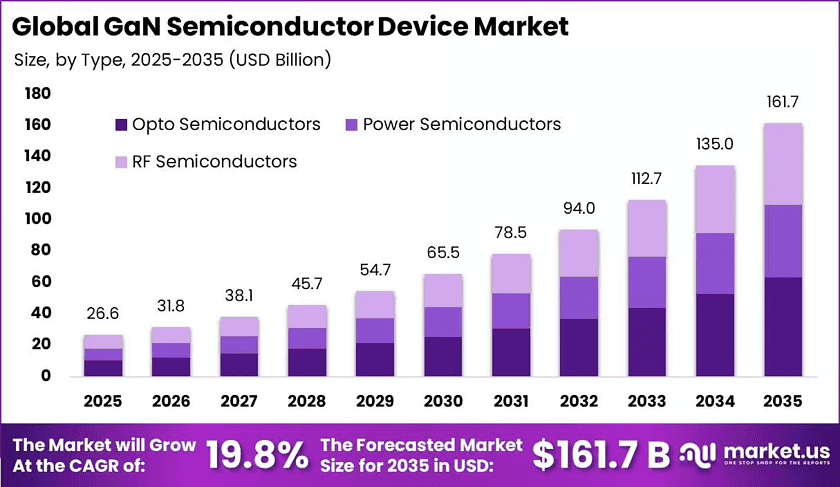
New York, NY – November 03, 2026 – The Global GaN Semiconductor Device Market was valued at USD 26.6 billion in 2025. Analysts expect it to reach USD 161.7 billion by 2035, growing at a CAGR of 19.8% from 2026 to 2035. Consequently, this fast growth shows strong demand for efficient, high-speed power and radio chips.
Moreover, Asia-Pacific led the global market in 2025 with a more than 39.4% share. The region earned about USD 10.5 billion in revenue during the year. This lead comes from its deep chip supply chain and large electronics base. Therefore, buyers in the region get quick access to GaN parts for phones, chargers, and telecom gear.
Additionally, GaN chips switch faster and lose less power than many silicon devices. 5G networks covered about 55% of the world’s population in 2025 and served nearly 3 billion mobile broadband users. Consequently, telecom equipment makers need more high-frequency GaN components to support this large and growing user base.
However, electric vehicles create an equally strong growth path. According to the International Energy Agency, global electric car sales passed 20 million units in 2025. That equals one in four new cars sold. Therefore, automakers need more GaN-based onboard chargers and charging systems to support faster, lighter, and more efficient vehicle designs.
Furthermore, clean energy adds long-term demand for efficient power devices. The world is expected to add around 4,600 GW of renewable capacity between 2025 and 2030. This build-out needs efficient inverters and grid equipment. As a result, solar, wind, and grid projects will rely more on GaN power semiconductors to cut energy losses.
Key Takeaways
- The GaN semiconductor device market was valued at USD 26.6 billion in 2025 and is projected to reach USD 161.7 billion by 2035 at a CAGR of 19.8%.
- Opto semiconductors lead with a 39.1% share, supported by strong demand for LEDs, lasers, displays, and photodetectors.
- Transistors hold a leading 38.2% share, driven by their growing use in power conversion, RF systems, and high-efficiency electronics.
- The 4-inch wafer segment leads with a 35.5% share, supported by proven production processes, stable yields, and controlled costs.
- Consumer electronics accounts for a leading 28.6% share, fueled by high-volume demand for smartphones, laptops, displays, chargers, and adapters.
- Asia-Pacific led the market in 2025 with a 39.4% share and about USD 10.5 billion in revenue.
➤ Grab the Exclusive Preview of This Premium Research Report Now – https://market.us/report/gan-semiconductor-device-market/request-sample/
Market Segmentation
By Type
Opto semiconductors held a leading 39.1% share of the market by type. LEDs, laser diodes, photodetectors, displays, and automotive lighting drive this lead. Moreover, according to the U.S. Department of Energy, LED lighting could make up about 84% of installations by 2035. This shift gives GaN light-emitting parts a long and stable base of demand.
Additionally, power semiconductors and RF semiconductors make up the other key type groups. Power devices serve chargers, EV systems, and data centres. RF devices support base stations, radar, and satellite links. Therefore, all three groups benefit from the same push for better efficiency, higher speed, and smaller system size.
By Component
Transistors hold a leading 38.2% share of the market by component. According to the International Energy Agency, data centres used about 415 TWh of power in 2024, which may reach 945 TWh by 2030. Consequently, GaN transistors gain ground through faster switching and lower energy losses. Meanwhile, power ICs, rectifiers, and diodes support chargers and converters.
By Wafer Size
The 4-inch wafer segment leads with a 35.5% share by wafer size. According to the Japan Science and Technology Agency, the substrate can make up nearly 60% of GaN MOSFET cost. Therefore, manufacturers stick with proven 4-inch lines that deliver stable yields. Meanwhile, 2-inch, 6-inch, and 8-inch formats serve niche and future volume needs.
By End-Use Industry
Consumer electronics accounts for a leading 28.6% share by end-use industry. Smartphones, laptops, displays, chargers, and adapters drive steady high-volume demand. Additionally, automotive, telecom, aerospace and defense, healthcare, and industrial users widen the customer base. Consequently, GaN suppliers can spread risk across many sectors while consumer brands keep production lines busy.
Regional Analysis
Asia-Pacific holds a 39.4% share and earned about USD 10.5 billion in 2025. China, Taiwan, South Korea, and Japan host strong wafer, packaging, and assembly networks. Moreover, according to SEMI, global fab capacity was projected at 33.6 million wafers per month in 2025. Asia-Pacific remains a central hub for this production base.
However, North America is expected to grow the fastest. According to the U.S. Department of Commerce, the country had awarded around USD 33.7 billion in direct CHIPS incentives by January 2025. This funding expands local chip production. Consequently, demand is rising for GaN devices in server power, radar, aerospace, and industrial converters.
Key Growth Drivers
Data-centre power upgrades add about 2.3% to the market CAGR. According to the International Energy Agency, data centres used around 1.5% of global electricity in 2024. Therefore, operators are moving to higher-voltage racks and more efficient power conversion. GaN devices cut heat and power losses, which helps lower running costs in dense computing sites.
Additionally, fast-charging consumer devices add about 1.8% to the market CAGR. Asia-Pacific, North America, and Europe lead this trend. Consumers want small chargers that power phones and laptops quickly. Consequently, brands are adopting GaN chargers because these devices run cooler, weigh less, and deliver more power in a compact size.
Use Cases
Electric vehicle makers use GaN devices in onboard chargers and charging systems. These parts convert power with less waste and need less cooling. Moreover, lighter chargers free up space and reduce vehicle weight. Therefore, automakers can improve driving range and charging speed while keeping power electronics compact and reliable over long periods.
Additionally, telecom operators use GaN amplifiers in next-generation mobile base stations and broadband networks. These chips handle high frequencies with strong output and good efficiency. Defence and satellite firms also use GaN in radar systems and space payloads. Consequently, these buyers get better signal reach without large increases in system power.
Business Opportunities
Bidirectional vehicle power offers a promising path for GaN suppliers. Vehicle-to-home and vehicle-to-grid systems let electric cars send stored energy back to homes and power grids. However, wider adoption still depends on supportive grid rules. Therefore, suppliers can build higher-value power modules, gate drivers, and reference designs for this emerging segment.
Moreover, space-qualified GaN platforms open new revenue for RF and power suppliers. Satellite builders need light, efficient, and radiation-tolerant parts for long missions. Additionally, direct-current building systems and grid-edge microinverters create fresh demand. Consequently, firms that invest early in testing and qualification can win long contracts in these high-value fields.
Major Industry Challenges
Gallium supply concentration remains a serious challenge for GaN makers. China controls most primary gallium output and requires export licences for gallium and related materials. Consequently, manufacturers outside China face cost and delivery risks. Therefore, companies are seeking new gallium sources, building safety stocks, and diversifying their wafer and packaging partners.
Additionally, epitaxy yield scaling slows wider production. Each move to a larger wafer requires yield gains, new qualification, and customer approval. Moreover, crystal defects can reduce breakdown voltage, switching speed, and gain stability. As a result, producers must invest in defect control and testing before they expand volume on bigger wafers.
Top Key Players in the Market
- Infineon Technologies AG
- Qorvo, Inc.
- Texas Instruments Incorporated
- NXP Semiconductors N.V.
- onsemi
- Toshiba Corporation
- Transphorm Inc.
- Mitsubishi Electric Corporation
- ROHM Co., Ltd.
Conclusion
The GaN semiconductor device market shows strong growth potential across power, radio, and lighting uses. Moreover, fast mobile networks, electric vehicles, data centres, fast chargers, and renewable energy drive steady demand. Asia-Pacific leads the industry, while North America grows fastest through new chip investment. However, gallium supply risks, trade tariffs, and yield issues remain key hurdles. Consequently, firms that secure materials and scale efficient production will gain a lasting advantage.
Discuss your needs with our analyst
Please share your requirements with more details so our analyst can check if they can solve your problem(s)