
Market Overview
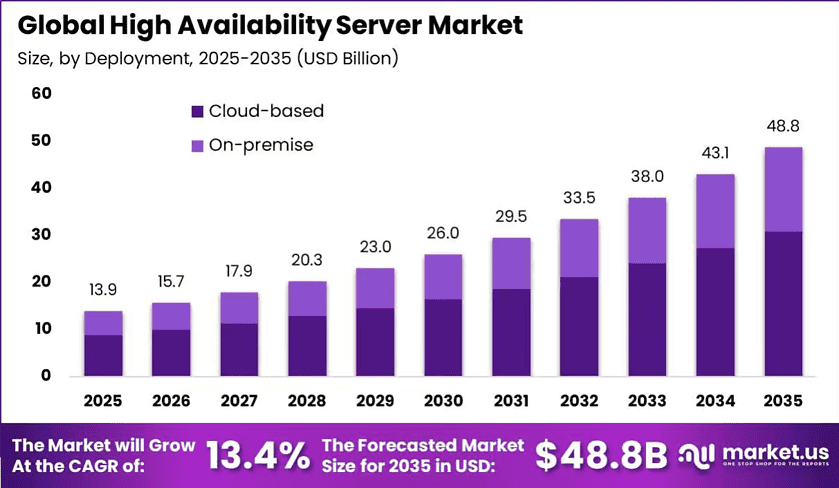
New York, NY – November 03, 2026 – The Global High Availability Server Market reached USD 13.9 billion in 2025. It should reach about USD 48.8 billion by 2035, which means a CAGR of 13.4%. This steady growth shows that businesses need more servers that keep running without interruption.
Data centres create much of the demand for fault-tolerant servers. According to the IEA, data centres used about 415 TWh of electricity in 2024, which was nearly 1.5% of global power use. Consequently, server buyers face growing pressure to keep this large and expanding infrastructure available at all times.
Moreover, the IEA expects data-centre electricity demand to reach about 945 TWh by 2030. This forecast shows that computing capacity will keep growing quickly around the world. Therefore, operators will need more redundant servers to protect workloads as their facilities grow.
Additionally, cloud computing, AI, online payments, and real-time apps all need servers with failover support and fast recovery. Businesses use these systems to reduce downtime in payments, logistics, and healthcare. As a result, always-on server platforms now act as core business tools rather than optional upgrades.
Furthermore, according to the U.S. Census Bureau, U.S. retail e-commerce sales reached USD 316.1 billion in Q4 2025, up 5.3% from the year before. Online sales now make up 16.6% of retail. Consequently, retailers need resilient servers to protect revenue during traffic peaks.
Key Takeaways
- The High Availability Server Market reached USD 13.9 billion in 2025 and should hit USD 48.8 billion by 2035, growing at a CAGR of 13.4%.
- Cloud-based deployment held the largest share at 63.2% in 2025, driven by rising enterprise cloud adoption.
- Linux led the operating system segment with a 43.4% share, supported by strong container and Kubernetes adoption.
- IT and Telecommunications led end-user industries with a 28.6% share, driven by growing internet and 5G usage.
- North America led the market in 2025 with a 38.2% share, generating about USD 5.3 billion in revenue.
➤ Get Instant Access to the Premium Report Sample Before Purchase – https://market.us/report/global-high-availability-server-market/request-sample/
High Availability Server Market Segmentation
By Deployment
Cloud-based deployment led the market in 2025 with more than 63.2% share. Businesses choose cloud hosting because it gives them flexible and reliable computing. Consequently, companies spend less on buying and maintaining large on-site server rooms, which speeds up cloud adoption across many industries.
Moreover, according to Eurostat, about 52.7% of EU enterprises bought cloud services in 2025, up 7.4 percentage points from 2023. Large enterprises reached 84.7% cloud usage. Therefore, major firms now depend heavily on remote servers, and those servers must stay online at all times.
By Operating System
Linux led the operating system segment in 2025 with more than 43.4% share. Enterprises value its open-source design, scalability, and reliability. Additionally, Linux carries no extra per-server licence costs. As a result, it is the preferred platform for cloud-native and containerised workloads.
Furthermore, according to the Cloud Native Computing Foundation, 91% of surveyed organizations ran containers in production in 2024. Kubernetes production use rose to 80% from 66% in 2023. This jump shows that firms are moving fast toward automated computing, and Linux supports that move well.
By End-user Industry
IT and Telecommunications led end users in 2025 with a share of more than 28.6%. Telecom operators and IT service providers must keep networks and platforms running without breaks. Consequently, these companies invest heavily in redundant processing, data replication, and automatic failover systems.
However, other industries also add steady demand. BFSI, retail, healthcare, and industrial users depend on continuous uptime for payments, patient records, and factory control. Therefore, resilient server infrastructure is spreading well beyond telecom, which broadens the market base across many sectors.
Regional Analysis
North America led the market in 2025 with more than 38.2% share and about USD 5.3 billion in revenue. Cloud providers, banks, and healthcare networks in the region need constant uptime. Moreover, according to the U.S. BEA, the U.S. digital economy added about USD 2.6 trillion in value, which drives strong server demand.
Meanwhile, Asia Pacific is the fastest-growing region, thanks to rapid digitalisation and rising AI investment. According to the ITU, 66% of people in Asia Pacific used the internet in 2024, up from 30% in 2010. Consequently, providers in the region need far more reliable computing capacity.
Market Drivers
AI workloads now make high availability a core infrastructure need. According to the IEA, power use from AI-optimised facilities could grow more than 4x by 2030. Therefore, downtime costs rise across AI training and inference. This driver adds an estimated +2.4% to the market CAGR.
Additionally, cloud workload concentration strengthens demand in North America, Europe, and Asia Pacific. According to UNCTAD, announced data-centre investment exceeded USD 270 billion in 2025. Consequently, operators build more redundant facilities to host critical workloads. This driver adds about +1.9% to growth.
Use Cases
Banks and payment firms use fault-tolerant servers to process transactions without interruption. These systems copy data across nodes and switch over instantly when hardware fails. Consequently, customers can keep paying, transferring, and trading at any time. Moreover, financial institutions avoid revenue losses and regulatory penalties linked to service outages.
Hospitals also depend on resilient servers to keep patient records and diagnostic systems available. Doctors need instant access to data during emergencies. Therefore, healthcare networks deploy clustered servers with automatic recovery. Additionally, telecom operators use similar platforms to manage billing, routing, and messaging services around the clock.
Business Opportunities
Sovereign edge availability platforms offer strong growth potential. Many developing markets are still building local digital infrastructure for payments, public services, and business apps. Consequently, vendors that offer locally hosted resilient servers can win new customers. Moreover, governments increasingly prefer keeping critical data within national borders.
Additionally, availability-as-a-service contracts create recurring revenue streams. Providers can combine hardware, remote monitoring, failover testing, and service-level support in one package. Therefore, suppliers move beyond one-time equipment sales. Customers also gain predictable costs and lower downtime risk, which makes these bundled offers attractive.
Major Challenges
Power density and cooling create serious design problems for redundant servers. AI hardware generates more heat inside each rack. Consequently, operators face higher cooling costs and longer liquid-cooling testing cycles. Moreover, limited rack-level power makes it harder to add backup capacity without major facility upgrades.
However, trade duties and supply disruptions add another layer of risk. Servers rely on imported processors, memory, storage, and power components. Therefore, tariffs and shipping delays raise procurement costs and slow deployments. Additionally, buyers must retest new component sources for compatibility, which further delays project timelines.
Top Key Players in the Market
- HP Development Company L.P.
- Fujitsu
- Oracle Corporation
- Cisco Systems
- CenterServ
- Dell Inc.
- Unisys Global Technologies
- NEC Corporation
- IBM Corporation
- Stratus Technologies
Conclusion
The High Availability Server Market is growing steadily as businesses depend more on cloud, AI, and real-time digital services. Cloud deployment, Linux platforms, and telecom users lead demand, and North America holds the top position. Moreover, Asia Pacific is expanding fast. However, cooling limits and trade risks remain hurdles. Consequently, vendors that offer resilient, service-based solutions will gain a strong edge.
Discuss your needs with our analyst
Please share your requirements with more details so our analyst can check if they can solve your problem(s)