
Market Overview
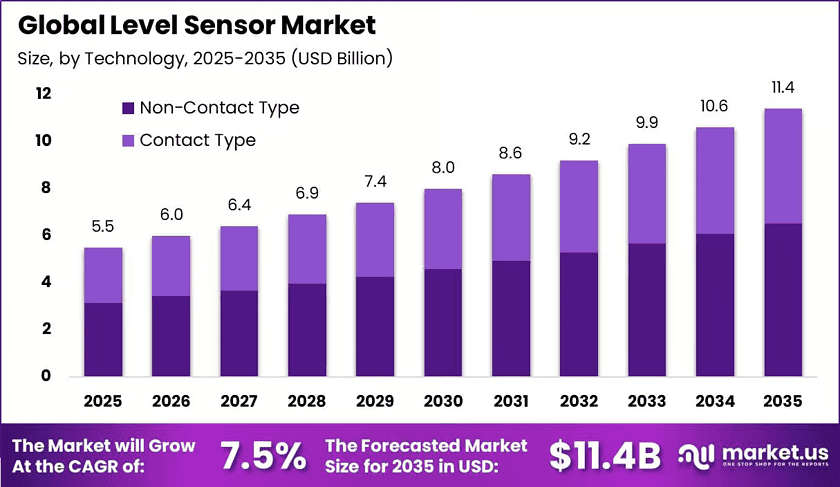
New York, NY – November 12, 2026 – The Global Level Sensor Market reached USD 5.5 billion in 2025. Analysts expect it to reach USD 11.4 billion by 2035, growing at a CAGR of 7.5%. This steady growth shows that industries want more reliable tools to measure liquids, gases, and solids. Asia-Pacific led the market in 2025 with more than 38.5% of the total share. The region earned about USD 2.12 billion in revenue.
Automotive production also supports the market. According to OICA, global vehicle output rose from 92.7 million units in 2024 to 96.4 million units in 2025. Consequently, carmakers need more level sensors to track fluids, coolants, and fuel across busy assembly lines and paint shops.
Additionally, Asia-Pacific built more than 61% of global vehicles in 2025. China alone produced 34.53 million units, up 10.4% from the year before. According to OICA, global vehicle sales also rose 4.7% to 99.8 million units. This growth keeps sensor demand strong across regional supply chains.
Energy markets add further support. According to the IEA, global oil demand grew by about 830,000 barrels per day in 2025. Furthermore, UNIDO reported that global factory output rose 1.3% in early 2025. Therefore, tanks, pipelines, and reactors need accurate tank level monitoring to run safely and efficiently.
Key Takeaways
- The Level Sensor Market was worth USD 5.5 billion in 2025 and should reach USD 11.4 billion by 2035 at a CAGR of 7.5%.
- Ultrasonic level sensors led the sensor type segment with a 23.5% share.
- Non-contact technology led with a 57.3% share.
- Continuous level monitoring led with a 64.1% share.
- Oil and gas led end-use industries with a 28.9% share.
- Asia-Pacific led the market in 2025 with a 38.5% share, earning about USD 2.12 billion in revenue.
➤ Preview Key Insights with an Exclusive Sample Report Download – https://market.us/report/global-level-sensor-market/request-sample/
Market Segmentation
By Sensor Type
Ultrasonic level sensors held a leading 23.5% share in 2025. These devices measure levels without touching harsh fluids, chemicals, or sludge. Consequently, plant operators choose them for clean, corrosive, and hazardous sites where contact devices often wear out or break down too quickly.
Wastewater needs also push this segment forward. According to UN-Water, households produced 268 billion cubic meters of wastewater in 2022, but only 58% was safely treated. Therefore, cities need more treatment plants and storage tanks, and each site needs reliable ultrasonic measurement.
By Technology
Non-contact level sensors held a dominant 57.3% share in 2025. Operators want accurate readings without placing devices inside foam, vapours, or corrosive liquids. Moreover, chemical plants, water utilities, and food producers prefer these tools because contact sensors often corrode, get coated, or need frequent cleaning.
According to UNEP, chemical production capacity grew from 1.2 billion tonnes in 2000 to 2.3 billion tonnes in 2017. This growth means more tanks and reactors need safe monitoring. Additionally, UNEP estimates that about 1 million workers die yearly from chemical exposure, so plants favour radar and ultrasonic options.
By Monitoring Type
Continuous level monitoring held a dominant 64.1% share in 2025. Unlike point switches, these sensors send live data on stock, flow, and storage conditions. According to the IEA, refinery crude throughput was projected at 83.3 million barrels per day in 2025. Consequently, even small errors at this scale can cause overflow or delays.
By End-Use Industry
The Oil and Gas Industry led end-use demand with a 28.9% share. According to the Energy Institute, global oil output hit a record 96 million barrels per day in 2023. Therefore, producers rely on level sensors to stop overflow, avoid dry running, and improve oil-water separation.
Regional Analysis of Level Measurement Demand
Asia-Pacific led the market in 2025 with a 38.5% share and about USD 2.1 billion in revenue. According to the International Federation of Robotics, Asia made up 74% of global robot installations in 2024. Consequently, high factory automation raises demand for radar, ultrasonic, and pressure sensors across tanks and silos.
North America should grow the fastest during the forecast period. Factory upgrades, reshoring, and water network renewal drive this growth. Moreover, chemical, pharmaceutical, food, and energy firms invest in safety tools. Therefore, regional buyers increasingly choose smart level transmitters to meet strict rules and improve plant uptime.
Key Growth Drivers
Factory automation stands out as a major growth driver. According to the International Federation of Robotics, factories installed 542,000 robots in 2024, and China added 295,000 units. Consequently, automated lines need more sensors to track liquids, powders, and bulk materials, which raises sensor content per production line.
Smart electronics also support connected level measurement. According to WSTS, global semiconductor sales reached USD 795.6 billion in 2025, up 26.2%. Additionally, wider chip supply gives sensor makers better processors and wireless modules. Therefore, factories can move from simple alarms toward networked, continuous level tracking systems.
Use Cases Across Industries
Water utilities use level sensors to manage raw water reservoirs, treatment tanks, and clean water storage. Operators track chemical dosing vessels in real time to keep water safe. Moreover, live data helps teams prevent overflow, plan pumping, and reduce energy waste across large municipal networks and remote pumping stations.
Chemical and oil producers use radar and ultrasonic sensors inside reactors, storage tanks, and pipelines. These tools measure corrosive or hazardous materials without direct contact. Consequently, plant teams reduce worker exposure, avoid spills, and keep production steady. Additionally, accurate readings support better inventory control and smoother product transfers between sites.
Business Opportunities
Predictive maintenance services offer strong growth potential for sensor suppliers. Many installed sensors still work as isolated switches rather than connected devices. However, industrial customers now want better uptime and lower repair costs. Therefore, suppliers can sell subscription-based diagnostics that turn simple hardware into long-term, high-margin service relationships.
Hydrogen production and battery materials processing create fresh demand for advanced level instruments. These new facilities handle sensitive fluids under strict safety rules. Moreover, remote water monitoring in developing regions opens further room for wireless sensors. Consequently, suppliers that offer rugged, connected, and easy-to-install products can win early contracts in these markets.
Major Challenges
Semiconductor supply exposure remains a key challenge for sensor makers. Radar, ultrasonic, and wireless sensors depend on chips, communication modules, and power devices from Asian suppliers. However, trade tariffs and Red Sea shipping delays raise costs and delivery risks. Consequently, firms build larger inventories, which ties up cash and raises certification expenses.
Delayed capital spending also slows market growth. Buyers often purchase level sensors within larger plant expansion or control system projects. Moreover, weaker global growth and falling commodity prices lead oil, mining, and metals firms to postpone investment. Therefore, longer approval cycles stretch procurement timelines and increase price pressure on suppliers.
Top Key Players in the Market
- Honeywell International Inc.
- Siemens AG
- ABB Group
- Schneider Electric SE
- Emerson Electric Co.
- AMETEK, Inc.
- Yokogawa Electric Corporation
- Balluff GmbH
- SICK AG
- Omega Engineering, Inc.
Conclusion
The level sensor market shows steady long-term growth, driven by factory automation, energy demand, and water infrastructure upgrades. Asia-Pacific leads today, while North America grows fastest. Moreover, non-contact and continuous monitoring solutions gain strong preference across process industries. However, chip supply risks and delayed capital projects remain hurdles. Consequently, suppliers that offer connected, rugged, and service-ready products will capture the best future opportunities.
Discuss your needs with our analyst
Please share your requirements with more details so our analyst can check if they can solve your problem(s)