
Market Overview
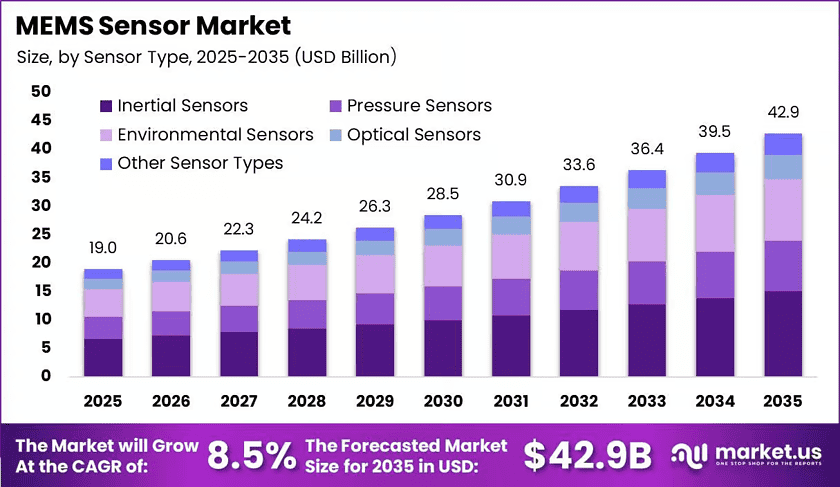
New York, NY – October 28, 2026 – The Global MEMS Sensor Market was valued at USD 19.0 billion in 2025. Micro-electromechanical systems (MEMS) are tiny devices that detect motion, pressure, and sound. Moreover, the market is projected to grow at a compound annual growth rate of 8.5% during 2026–2035, reaching about USD 42.9 billion by 2035. Asia-Pacific led the market in 2025, holding more than 36.4% of total market share and generating about USD 6.9 billion in revenue.
Demand is rising as smartphones, wearable devices, vehicles, and factory systems rely on multiple MEMS sensors. According to IDC, global smartphone shipments reached nearly 1.2 billion units in 2025. Because each device uses several sensors, this single product category alone drives demand for billions of components every year.
Industrial automation adds another layer of growth. According to the International Federation of Robotics, about 542,000 industrial robots were installed worldwide in 2024. This installation pace signals strong long-term demand for motion, vibration, and position sensing in factories.
Geopolitical pressures, however, are reshaping costs and supply routes. Tariffs, shipping delays, and raw material price swings affect how manufacturers source components. Additionally, many companies are diversifying production sites to reduce risk while keeping their products competitively priced.
Key Takeaways
- The MEMS Sensor Market was valued at USD 19.0 billion in 2025 and is projected to reach USD 42.9 billion by 2035, growing at a CAGR of 8.5%.
- Inertial sensors held the largest sensor-type share at 35.1%, driven by motion detection and navigation applications.
- Consumer electronics led end-use segments with a 28.9% share, supported by high-volume smartphone and wearable production.
- Asia-Pacific led the market with a 36.4% share and approximately USD 6.9 billion in revenue in 2025.
➤ Access the Exclusive Sample Report Featuring Full TOC, Data Tables & Figures – https://market.us/report/mems-sensor-market/request-sample/
Market Segmentation
By Sensor Type
Inertial sensors held a leading 35.1% share, supported by their use in motion detection, stability control, and navigation. This share shows how central these components are to vehicles, aircraft, smartphones, and robots. As a result, inertial products remain the foundation of many motion-related applications.
Pressure, environmental, and optical sensors serve a broader range of functions. Meanwhile, manufacturers continue to combine these sensor types into integrated modules. Consequently, buyers can meet several sensing needs with fewer separate components.
By End-Use Industry
Consumer electronics held a leading 28.9% share, driven by smartphones, tablets, audio products, and connected home devices. These products are manufactured in much higher volumes than most automotive or industrial systems. Therefore, each device using several MEMS sensors creates steady demand across the supply chain.
Automotive and industrial applications add significant volume as well. According to OICA, global motor vehicle production exceeded 85 million units in 2023. Each vehicle uses several accelerometers and gyroscopes for safety, navigation, and driver-assistance functions.
Regional Analysis
North America is emerging as the fastest-growing regional market, with revenue expanding at high single-digit CAGRs. Advanced driver-assistance systems, industrial IoT technologies, and medical devices drive this growth across the United States and Canada. Therefore, sensor suppliers are strengthening their local presence to serve these customers more closely.
Asia-Pacific remains the scale leader in the global market. China, Japan, South Korea, Taiwan, and ASEAN economies together account for more than half of global electronics exports by value, according to UN Comtrade and WTO data. This scale keeps the region central to global MEMS supply chains.
Drivers
Smartphone and wearable sensor densification could add about 2.2% to market CAGR. Each smartphone typically integrates 5–8 MEMS sensors, and each new device generation adds more sensing functions. As a result, this channel may require billions of MEMS devices every year.
Automotive safety and ADAS sensorization could add about 1.8% to market CAGR. According to NHTSA, automatic emergency braking was already installed in approximately 90% of new U.S. light vehicles. Since regulators continue to require advanced safety features, automakers must keep increasing sensor content in each vehicle.
Use Cases
Wearable health devices use MEMS sensors to track movement and daily body activity. These components allow fitness trackers and medical monitors to collect motion data accurately in compact designs. Consequently, healthcare providers gain new ways to observe patients outside clinical settings.
Robotics and factory equipment rely on MEMS sensors to measure vibration, position, and operating feedback. Such sensors help machines detect problems early and maintain consistent performance. Therefore, manufacturers can plan maintenance more effectively and reduce unexpected equipment downtime.
Business Opportunities
Next-generation automotive autonomy sensing offers a strong growth path as higher automation levels increase sensor content per vehicle. Suppliers that deliver automotive-qualified inertial, pressure, and environmental sensors can capture greater revenue from each vehicle. Moreover, long development cycles reward companies that begin early.
Localized packaging and test hubs give companies a practical way to lower logistics risk. Building regional capacity near major customers can shorten delivery times and improve supply reliability. Additionally, nearby facilities help suppliers respond faster when demand shifts.
Major Challenges
Specialty gas and material volatility raises the cost of semiconductor fabrication. Helium, high-purity hydrogen, and critical metals have experienced sharp price swings in recent periods. As a result, producers must hold larger inventories and renegotiate supply contracts more often.
Skilled talent shortages and testing limits also slow market growth. Engineers with specialized MEMS process knowledge remain scarce in Asia-Pacific and North America. Moreover, calibration and testing throughput can restrict output when customer demand rises quickly.
Top Key Players in the Market
- STMicroelectronics N.V.
- Robert Bosch GmbH
- Infineon Technologies AG
- TDK Corporation
- Murata Manufacturing Co., Ltd.
- Panasonic Corporation
- NXP Semiconductors N.V.
- Analog Devices, Inc.
- Sensata Technologies, Inc.
- Amphenol Corporation
Conclusion
The MEMS sensor market is moving toward broader adoption across smartphones, vehicles, factories, and healthcare devices. Companies that manage cost pressures, diversify supply chains, and invest in advanced sensing technologies will be best positioned. Moreover, leading players are reshaping competition through acquisitions and research. Overall, the market offers strong long-term potential for businesses that stay adaptable.
Discuss your needs with our analyst
Please share your requirements with more details so our analyst can check if they can solve your problem(s)