
Market Overview
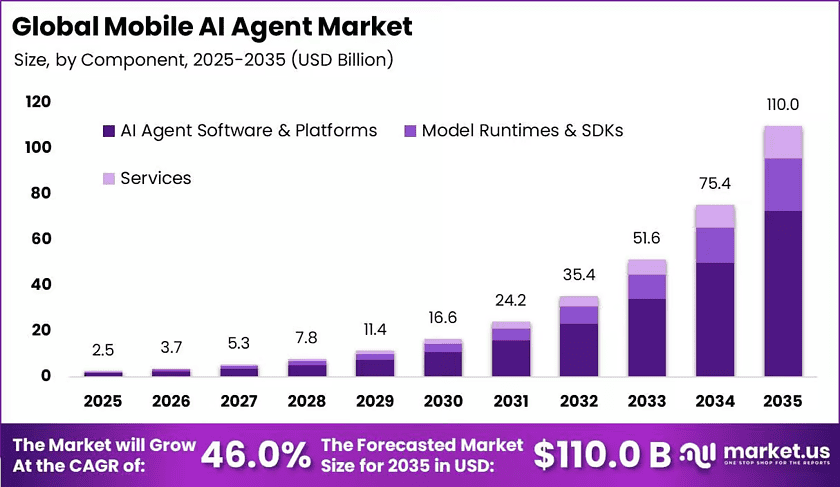
New York, NY – October 26, 2026 – The Global Mobile AI Agent Market reached USD 2.5 billion in 2025. Analysts expect it to hit USD 110.0 billion by 2035, growing at a CAGR of 46.0%. North America led the market in 2025 with over 40.3% share and nearly USD 1.01 billion in revenue. Consequently, mobile AI assistants are becoming a core part of everyday smartphone use for millions of people.
Smartphone growth fuels this expansion. According to ITU, global mobile-cellular subscriptions reached 9.1 billion in 2024, exceeding the world population by 12.1%. This figure shows that many people carry more than one connected device. Consequently, AI agent providers gain a very large and ready audience worldwide.
Additionally, ITU estimates that around 6.0 billion people used the internet in 2025, up from 5.8 billion in 2024. This rise brings millions of new users who can try AI agents for shopping and scheduling. However, around 2.2 billion people still remain offline today.
The wider digital economy also supports demand. According to the World Bank, the digital economy contributes more than 15% of global GDP, nearly USD 16 trillion in 2024. Therefore, businesses and consumers increasingly depend on mobile tools that save time, cut effort, and simplify routine daily tasks.
Key Takeaways
- The Mobile AI Agent Market was valued at USD 2.5 billion in 2025 and should reach USD 110.0 billion by 2035, at a CAGR of 46.0%.
- AI Agent Software and Platforms led the Component segment with a 66.1% share in 2025.
- Smartphones led the Device Type segment with more than 81% share, backed by processing power, sensors, and connectivity.
- The Hybrid Device-Cloud model held more than 60.5% share of the Deployment Model segment.
- Personal and Productivity Agents led the Agent Type segment with more than 36.0% share.
- Small and Compact Language Models led the Model Type segment with more than 41.0% share, due to device power and battery limits.
- Multimodal AI Agents captured more than 46.1% share of the Modality segment.
- Android led the Operating System segment with more than 62.1% share, backed by over 3.9 billion active users.
- Personal Productivity led the Application segment with more than 31.25% share.
- Consumers led the End User segment with more than 68.1% share.
- North America led the market in 2025 with more than 40.3% share and about USD 1.01 billion in revenue.
➤ Get Instant Access to the Premium Report Sample Before Purchase – https://market.us/report/mobile-ai-agent-market/request-sample/
Mobile AI Agent Market Segmentation
AI Agent Software and Platforms held 66.1% of the Component segment in 2025. Software platforms form the main working layer of mobile agents because they understand requests and complete tasks. Consequently, hardware and services mostly play a support role, while software captures most of the value.
Smartphones captured more than 81.1% of the Device Type segment. According to the report, global smartphone shipments reached 1,223.1 million units in 2024, up 7.1% from 2023. This growth gives agent developers a fast-growing base of capable devices. Moreover, sensors and constant connectivity make phones the ideal agent platform.
The Hybrid Device-Cloud model held more than 60.5% of the Deployment Model segment. According to the IEA, data centre investment reached around USD 500 billion in 2024. Rising cloud costs push providers to split work between devices and servers. Therefore, hybrid systems balance speed, cost, and computing power.
Personal and Productivity Agents led the Agent Type segment with more than 36.0% share. According to the ILO, average global working time reached about 42 hours per week in 2024. Long work weeks create steady demand for help with tasks. Consequently, users rely on agents for calendars, drafts, and reminders.
Small and Compact Language Models held more than 41.0% of the Model Type segment. Most smartphone batteries hold about 4,000–5,000 mAh, which limits heavy processing. This constraint favors lighter models that run smoothly on phones. Therefore, compact models fit continuous mobile use better than large language models.
Multimodal AI Agents captured more than 46.1% of the Modality segment. Smartphones take about 92.5% of all photos worldwide, according to the report. This huge volume of images means users need agents that understand visuals. Moreover, people mix text, voice, and camera inputs on one device every day.
Android led the Operating System segment with more than 62.1% share. According to StatCounter, Android accounted for around 67.61% of global mobile OS usage in August 2026. This reach shows how open licensing spreads devices across all price ranges. Consequently, Android gives agent developers the widest possible audience.
Personal Productivity led the Application segment with more than 31.25% share. Around 361.6 billion emails moved worldwide every day in 2024, according to the report. This heavy message load creates demand for tools that sort, reply, and schedule. Therefore, productivity apps remain the top use for mobile agents.
Consumers dominated the End User segment with more than 68.1% share. According to the UN, the global population reached about 8.16 billion, with around 5.5 billion people online. This connected crowd forms a far larger base than enterprise users. Consequently, consumer-focused agents lead overall adoption.
Regional Analysis
North America held more than 40.3% market share in 2025. The U.S. digital economy reached around USD 4.9 trillion in 2024, nearly 18% of national GDP. This scale gives AI firms strong funding and skilled workers. Moreover, demand for data scientists should rise 33.5% by 2034.
Asia Pacific emerged as the fastest-growing region, with around a 26.0% share. Internet adoption across Asia-Pacific reached about 66%, compared with 87–92% in Europe and the Americas. This gap shows major room for new users. Consequently, providers see strong future growth across large Asian populations.
Market Drivers
Smartphone makers now build AI agents directly into operating systems. More than 80% of flagship phones shipped in 2025 included a pre-installed AI assistant, up from under 35% in 2023. This shift cuts customer acquisition costs sharply. Therefore, device makers can sell paid AI features with each upgrade.
Telecom operators keep expanding 5G and edge computing networks. Around 3 billion 5G subscriptions were active worldwide in 2025, covering 55% of the global population. Faster networks let agents respond quickly and handle richer tasks. Additionally, chipmakers like Qualcomm now deliver up to 46.0% higher on-device AI performance.
Use Cases
Professionals use mobile AI agents to manage busy workdays. These agents organize calendars, prepare email drafts, and send timely reminders. Moreover, hybrid workers depend on them to coordinate meetings across locations. Consequently, agents reduce routine admin work and free employees to focus on higher-value tasks.
Shoppers use multimodal agents to search for products with their phone cameras. Users can snap a photo, ask questions by voice, and compare options instantly. Additionally, agents can track orders and handle customer support chats. Therefore, retailers gain faster service and smoother buying journeys for mobile customers.
Business Opportunities
AI agents can move beyond scheduling into completing purchases and payments for users. Today, agent-led transactions still make up only a small share of digital payments. However, this gap opens room for new commission-based revenue models. Consequently, platforms can earn stronger margins from low-cost transaction services.
Rural areas and smaller cities across Asia Pacific remain underserved by mobile AI services. India, Southeast Asia, and Sub-Saharan Africa offer large groups of new smartphone users. Moreover, local-language agents can win trust quickly. Therefore, early providers can capture loyal users before competition grows.
Major Challenges
Data centres face growing pressure on power grid capacity. New large grid connections can take years, which delays cloud capacity for AI processing. Consequently, cloud providers spend heavily on energy deals and power infrastructure. These rising costs push companies to shift more AI workloads onto devices.
Companies struggle to hire skilled AI engineers, especially in North America and Europe. This talent gap slows product development and raises hiring costs. Additionally, battery and heat limits restrict how much AI processing phones can handle. Therefore, developers must balance agent features against device efficiency.
Top Key Players in the Market
- Samsung Electronics Co., Ltd.
- Google LLC
- OpenAI
- Microsoft Corporation
- Meta Platforms, Inc.
- Huawei Technologies Co., Ltd.
- Xiaomi Corporation
- Alibaba Group Holding Limited
- Apple Inc.
Conclusion
The Mobile AI Agent Market is on track for very fast growth, driven by AI built into smartphones, wider 5G coverage, and rising demand for productivity tools. Software platforms, hybrid deployment, and multimodal agents lead adoption. Moreover, North America holds the top position, while Asia Pacific grows fastest. However, power limits, talent gaps, and regulation remain hurdles. Consequently, companies that build efficient, trusted agents will gain the strongest position.
Discuss your needs with our analyst
Please share your requirements with more details so our analyst can check if they can solve your problem(s)