
Market Overview
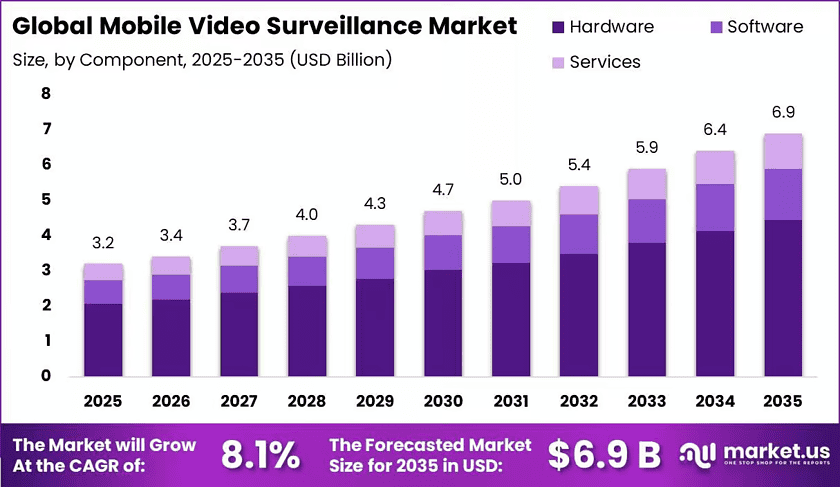
New York, NY – October 30, 2026 – The Global Mobile Video Surveillance Market reached a value of USD 3.2 billion in 2025. Analysts expect it to reach about USD 6.9 billion by 2035, growing at a CAGR of 8.1%. This steady growth shows that fleets increasingly treat onboard video as a core part of daily operations. Asia-Pacific led the market in 2025 with more than 37.0% share. The region earned about USD 1.18 billion in revenue.
Commercial vehicles and other moving assets drive demand for live monitoring and video recording. Moreover, fleet owners want better driver safety and remote surveillance. According to OICA, global vehicle production rose from 92.7 million units in 2024 to 96.4 million units in 2025. As a result, more vehicles now need in-vehicle camera systems.
This growing vehicle base creates demand for cameras, digital video recorders, storage, connectivity, and video software. Additionally, OICA data shows China produced 34.5 million vehicles, and India produced 6.4 million. These two countries alone build a large pool of new vehicles. Therefore, Asian manufacturers and fleet operators offer strong buyer potential for vehicle surveillance suppliers.
The United Nations reported that 19 of the world’s 33 megacities sat in Asia in 2025. However, large cities also bring heavy traffic and higher safety risks. Therefore, city operators need real-time monitoring across buses, delivery fleets, and emergency vehicles. This urban pressure keeps demand for mobile camera solutions strong.
Key Takeaways
- The Mobile Video Surveillance Market reached USD 3.2 billion in 2025 and will likely reach USD 6.9 billion by 2035, growing at an 8.1% CAGR.
- Hardware held a leading 64.5% share by component, driven by demand for onboard cameras, recorders, and storage equipment.
- IP video surveillance held a leading 62.1% share by system type, supported by wider mobile broadband and 5G coverage.
- Transportation held a leading 42.5% share by end-user, driven by passenger, cargo, and fleet monitoring needs.
- Asia-Pacific led the market in 2025 with more than 37.0% share, generating about USD 1.18 billion in revenue.
➤ Evaluate the Report Quality with an Exclusive Sample Download – https://market.us/report/mobile-video-surveillance-market/request-sample/
Market Segmentation
By Component
Hardware held a leading 64.5% share because every system needs physical equipment to work. Cameras capture video, while recorders, drives, and power units store footage. Moreover, each bus, truck, or rail car needs its own devices. Therefore, equipment sales grow directly with the size of each fleet.
According to the U.S. Federal Transit Administration, 119,834 transit vehicles ran in maximum service in 2023. This figure shows a large installed base for onboard cameras. Additionally, software and services gain ground as fleets need remote control and upkeep. Consequently, suppliers can pair device sales with long-term service contracts.
By System Type
IP video surveillance held a leading 62.1% share of the market. IP cameras turn video into digital data at the device itself. As a result, operators can view live footage, store files centrally, and add cameras easily. Moreover, large fleets save on maintenance when they expand across many routes.
According to the International Telecommunication Union, 96% of people had mobile broadband coverage in 2025. Additionally, 5G networks covered about 55% of the population. This wide coverage makes live video upload practical for fleets. However, analog systems still serve older vehicles and cost-sensitive buyers that delay upgrades.
By End-User
Transportation held a leading 42.5% share by end-user. Buses, trains, aircraft, and freight fleets need constant monitoring of passengers and cargo. According to IATA, airline passenger traffic grew 10.4% in 2024. Therefore, rising travel volumes create more need for quick video checks after incidents and complaints.
Military and defense, industrial, and government users also deploy mobile cameras widely. Moreover, police vehicles and emergency fleets rely on video for evidence and field safety. Industrial sites use vehicle cameras to track equipment and worker safety. Consequently, these smaller segments add steady demand beyond the main transport sector.
Regional Analysis
Asia-Pacific remained the top region with 37.0% of global revenue in 2025. China, India, Japan, and South Korea keep expanding connected fleet and city security systems. Moreover, dense populations increase the need to monitor passenger safety and traffic incidents. Therefore, Asian buyers will likely remain the largest regional customer base.
North America will likely grow fastest during the forecast period. Fleet operators replace old analog systems with IP-based solutions. Additionally, the U.S. Bipartisan Infrastructure Law authorized up to USD 108 billion for public transport programs. This funding gives transit agencies money to buy connected safety equipment and upgrade their vehicles.
Market Drivers
Mobile broadband reach turns onboard cameras into connected tools rather than standalone recorders. This driver adds about 1.2 percentage points to CAGR. Moreover, live upload and remote health checks replace costly manual footage retrieval. Consequently, suppliers earn recurring revenue from storage, device management, and analytics services.
Fleet safety digitization adds about 1.0 percentage point to growth. According to Verizon Connect, 74% of video telematics users said the technology improved driver safety. Additionally, 48% said it reduced accident costs. Therefore, fleets now use video for active coaching, not just for evidence after a crash.
Key Use Cases
Commercial fleet operators use dual-facing dash cameras to watch both the driver and the road. These systems send in-cab alerts when drivers show risky behavior. Moreover, managers review clips during coaching sessions. Consequently, trucking and delivery companies lower crash risk and defend drivers against unfair claims.
Public transit agencies install cameras on buses, trains, and metro cars to protect passengers. Control centers watch live feeds during incidents and send help faster. Additionally, recorded footage supports insurance claims and complaint reviews. Therefore, transit operators improve rider trust while reducing vandalism and on-board security problems.
Business Opportunities
Legacy fleet retrofits offer a large untapped opportunity. Many older vehicles still use analog recorders or have no cameras at all. Moreover, suppliers can offer financed subscription plans that lower upfront costs for buyers. Consequently, vendors can earn steady income from installation, storage, maintenance, and evidence management services.
School bus safety bundles and video evidence subscriptions create further room for growth. Schools and districts want reliable systems that protect children and record traffic violations. Additionally, cold-chain sensor fusion lets food and medicine carriers combine video with temperature data. Therefore, suppliers can build specialized packages for high-value niche markets.
Major Challenges
Restricted equipment rules in the United States block certain covered video products from new authorization. Federal regulators have limited the import and sale of these devices. Moreover, higher tariffs on certain chips raise component costs. Consequently, system integrators face thinner margins and must quickly find other trusted suppliers.
Shipping delays and unstable freight costs create ongoing supply pressure. Camera modules, processors, and recorders still move, but timing remains uncertain. Additionally, cybersecurity updates and mixed-vendor setups add work for fleet teams. Therefore, manufacturers hold more buffer stock, shift assembly closer to buyers, and invest in secure software support.
Top Key Players in the Market
- Hangzhou Hikvision Digital Technology Co., Ltd.
- Axis Communications AB
- Zhejiang Dahua Technology Co., Ltd.
- Luminator Technology Group
- Hanwha Vision
- Pro-Vision
- March Networks
- Apollo Video Technology
- Safe Fleet
- CP PLUS
Conclusion
The mobile video surveillance market keeps growing as fleets put connected safety ahead of other upgrades. Hardware, IP systems, and transportation users lead demand, while Asia-Pacific holds the top regional spot. Moreover, wider broadband coverage and digital fleet safety tools speed up adoption. However, equipment restrictions and shipping instability remain real risks. Consequently, suppliers that focus on retrofits, subscriptions, and secure systems will gain the strongest long-term positions.
Discuss your needs with our analyst
Please share your requirements with more details so our analyst can check if they can solve your problem(s)