
Market Overview
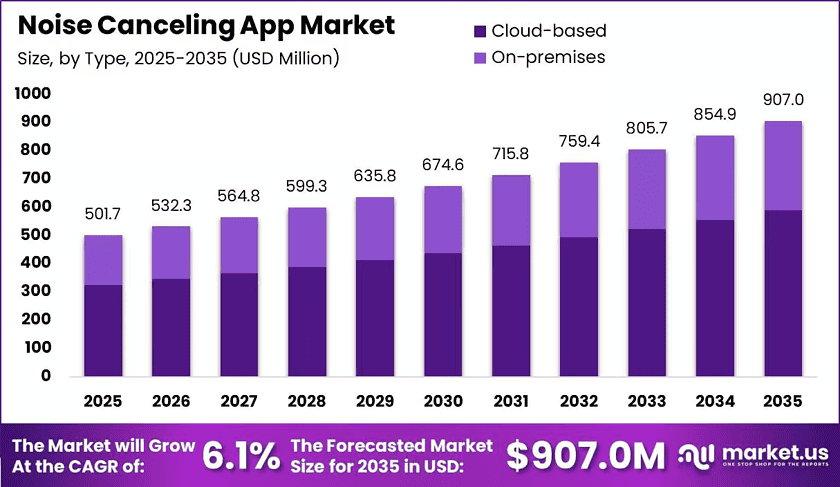
New York, NY – October 27, 2026 – The Global Noise Canceling App Market reached USD 501.7 million in 2025. Analysts expect it to reach about USD 907.0 million by 2035, growing at a CAGR of 6.1%. Consequently, software that removes background noise is turning into a steady business tool for workers and companies. North America led the market in 2025 with a 34.7% share, worth about USD 174.09 million.
Remote and hybrid work drive much of this demand. According to the U.S. Bureau of Labor Statistics, 35.5 million Americans teleworked in Q1 2024, up from a rate of 19.6% to 22.9%. Therefore, more home workers now need clear calls, and they often choose apps over costly headphones.
Moreover, the large number of connected devices helps app makers reach more people. According to the International Telecommunication Union, the world had about 9.1 billion mobile subscriptions in 2024. This huge user base gives voice-clarity apps a wide sales channel in both rich and developing markets.
Additionally, health concerns support growth in audio filtering tools. According to the World Health Organization, more than 1.5 billion people live with some hearing loss. Noise reduction apps let users hear sound clearly at lower volume. As a result, they protect hearing and add health value for buyers.
Key Takeaways
- The Noise Cancelling App Market is valued at USD 501.7 million in 2025 and should reach USD 907.0 million by 2035 at a 6.1% CAGR.
- Cloud-based solutions held a 65% share of the Type segment, driven by rising enterprise cloud adoption.
- Large enterprises held a 56.2% share of the Application segment, thanks to high call volumes and central IT budgets.
- North America led the market with a 34.7% share, worth about USD 174.09 million in 2025.
➤ Unlock the Sample Version of This Premium Report with Detailed Tables & Figures – https://market.us/report/noise-canceling-app-market/request-sample/
Noise Canceling App Market Segmentation
By Type
Cloud-based solutions led the Type segment with a 65% share. According to Eurostat, 52.7% of EU enterprises bought cloud services in 2025, up 7.4 points from 2023. Therefore, businesses clearly prefer flexible online tools over software installed on each local machine.
Moreover, cloud platforms let apps run advanced AI models without draining the user’s device. Developers push updates, security fixes, and new features from a distance. Consequently, users skip manual installs, and vendors improve their products faster. On-premises tools still serve buyers that need strict local data control.
By Application
Large enterprises held a 56.2% share of the Application segment. According to the World Bank Enterprise Surveys, firms with 100 or more staff provide 41.2% of global jobs. As a result, these companies hold heavy call loads and create the biggest demand for clear voice tools.
Additionally, large firms use central IT budgets and set buying processes. They buy bulk licenses and roll out apps across whole teams. However, SMEs often buy single seats and adopt more slowly. Therefore, vendors win faster rollouts and higher contract value from enterprise deals.
Regional Analysis
North America held a 34.7% share and earned about USD 174.09 million in 2025. According to Ericsson, regional mobile data traffic reached 8.7 exabytes per month in 2024. This strong network supports real-time cloud audio processing. Consequently, companies keep investing in voice clarity software for their workers.
Asia Pacific is the fastest-growing region. According to GSMA, mobile internet users should rise from nearly 1.4 billion in 2023 to about 1.8 billion by 2030. Moreover, the ITU put regional internet use at 66% in 2024. Therefore, app makers gain a fast-growing pool of new users.
Market Drivers
Enterprise SaaS licensing adds about 1.6% to the market CAGR. According to Eurostat, paid cloud use among EU firms rose from 45.2% in 2023 to 52.7% in 2025. Consequently, more businesses accept per-seat subscriptions. Vendors gain recurring revenue and lower customer churn.
Hybrid work demand for better call quality adds about 1.4% to growth worldwide. According to a Microsoft survey, 68% of workers lacked uninterrupted focus time. Therefore, employees need tools that block distractions during meetings. Additionally, the U.S. telework rate reached 23.4% in late 2024, which widens the buyer base.
Key Use Cases
Remote workers use noise-canceling apps to remove barking dogs, traffic, and café chatter from calls. Moreover, team leaders run cleaner virtual meetings with fewer interruptions. Consequently, staff speak with confidence from homes and shared offices. Companies also avoid the cost of buying premium headsets for every worker.
Contact centers and voice AI agents rely on voice isolation to understand callers clearly. Additionally, these tools help agents detect when a caller finishes speaking. Therefore, conversations flow more naturally, and fewer calls drop. Businesses see happier customers and smoother service across busy, noisy environments.
Business Opportunities
Developers can open their audio isolation engines to other companies through APIs. Moreover, communication platforms and app builders can embed this technology directly into their products. Consequently, vendors earn usage-based revenue from high-volume partners. This model also improves margins as computing costs fall over time.
Emerging markets offer strong room for growth among small businesses. However, many users there still rely on slower networks. Therefore, lightweight, offline, and on-device noise filtering tools can win these buyers. Additionally, healthcare partnerships around hearing safety open fresh channels for trusted, health-focused audio products.
Major Challenges
Voice-data privacy lawsuits create doubt among enterprise buyers. Plaintiffs claim some vendors collected voiceprints without proper consent. Consequently, legal and security teams run longer reviews before approving software. These delays slow multi-seat deals and push back near-term revenue for many providers.
Small businesses often lack the skills to adopt AI tools with confidence. Moreover, limited training budgets slow their move into paid plans. Therefore, vendors must offer simple setup and clear guidance. Additionally, free noise suppression built into operating systems makes paid apps harder to sell.
Top Key Players in the Market
- LALAL.AI
- Krisp
- Neutralizer
- Noise Killer
- Safe Headphones
- myNoise
- UrbanDenoiser
- Noise Wall
- Denoise
- Noise Blocker
- Noise Gator
- Samson Sound Deck
- Sleep Pillow
- DSP Soundware
- SoliCall
- Ams Active Noise Cancellation Software
- Denoiser
Conclusion
The noise-canceling app market keeps growing as hybrid work, connected devices, and hearing health concerns shape demand. Cloud-based tools and large enterprises lead adoption, while North America dominates and Asia Pacific grows quickly. However, privacy lawsuits and skill gaps in small businesses slow progress. Consequently, vendors that offer secure, simple, and embeddable voice clarity solutions will win lasting growth.
Discuss your needs with our analyst
Please share your requirements with more details so our analyst can check if they can solve your problem(s)